
Social Media Marketing Term Project Report
Social networks have been an integral part of our lives for many years, significantly shaping how people think and behave. However, the growth of toxic beauty standards and distorted content has had adverse effects on the users’ mental health, particularly young teenagers. This paper aims to investigate the impact of social media, assess engagement with the media, and develop a wellness campaign that promotes healthy media usage.
Part I: Video Analysis
This video is very emotionally touching because it shows the negative impact of toxic beauty standards on young girls via social media. The use of AI-generated voices advertising hazardous body images, ”slim fast,” Botox, and teeth filing is worrying, given that these images are readily available and influential to adolescents (Dove US, 2022). The parents’ desperation and alarm only intensify the situation emotionally. The main message in the video is to make people accept that it is dangerous for a person’s self-esteem and mental health when they are exposed to toxic messages regarding beauty. Hence, parents need to discuss this with their children.
I remember coming across advertisements and posts on social media with tempting offers like diet pills and skin care products, with slogans that made me feel that natural beauty was insufficient. These messages often use fear to elicit a response and make a sale. While important, the decision to depict the toxic content of social media being seen through the eyes of a mother and daughter highlights the generational effects of online platforms while stressing the need for parental supervision when it comes to children’s upbringing. It should also be made mandatory for companies and user accounts that post toxic content to be penalized in some way, such as having the content they posted deleted or deactivated (Tangwaragorn et al., 2024). This is because the promotion of unhealthy body images affects the psychological well-being of consumers, especially the younger generation. It also helps to hold these entities accountable and make the digital environment safer and healthier.
Yes, companies should implement age restrictions to safeguard young individuals from content that may damage their mental well-being and self-esteem (Merino et al., 2024). Some safety measures could include minimum age requirements for site usage, more vigorous authentication checks, or age confirmation before creating an account. Additionally, artificial intelligence can facilitate content moderation, preventing young people from inadvertently typing in prohibited words or phrases and accessing shocking sites. Parental control features will enable adults to control what their children can access on the Internet. Although it can indeed be argued that age restrictions are far from perfect, it must also be noted that additional measures can also be employed to help prevent toxic influences as much as possible and make the online world safer for teenagers.
Most social media platforms have tools for reporting abusive content. Still, these tools are often limited, as abusive material can go viral before it is moderated, and moderation is not always uniform. Their prevention and control require more effective and frequent observation and follow-up, along with appropriate consequences for offenders. If this video were remade with a father and son, issues such as toxic masculinity, body shaming, and the pressure of male body images need to be depicted. Such issues as over-emphasis on muscle mass, steroids, low self-esteem, and the encouragement of violence should be highlighted, as in Gym culture, boys can also be adversely affected by such aspects, just as the notions of beauty affect girls.
PART II: Self-Reflection
I have multiple social media platforms, including Instagram, Facebook, and LinkedIn. All have a purpose, from social communication with friends and family to business relations. Last week, I spent around four to five hours daily interacting with my phone for business purposes, texting and entertainment. The amount of time I spent on screens varied depending on my work schedule and duty roster. Regarding social media, I spend approximately two to three hours a day scrolling through various posts, replying to status updates, and reading the latest news and topics. This depended on my free time and the need for a break from this schedule.
Although I do not have any limitations set for screen time, I make a conscious effort to disconnect from social media during meals and before going to bed. I also avoid sitting too much by engaging in activities like reading a book, walking, or spending time with my family. This week, I spent approximately 2-3 hours per day on social media based on my daily working schedule. As I utilize social media to connect with friends and family, I have learned to limit my time spent on the platforms.
The last time I went offline for a while was a few weeks ago, when I became overwhelmed by the amount of information and notifications. It was time to take a step back, regroup, and be more mindful of the present moment. This temporary disconnection helped me clear my head and minimize unhelpful distractions to the situation. This realization was influenced by the fact that most of my time was spent aimlessly browsing, rather than engaging in more productive activities. I also wanted to restore my productivity and better organize my thinking by minimizing content consumption. This is because taking breaks from social media enables me to regain control of my time, which in turn promotes my meaningful engagement with those around me.
If I ever realized it was taking a toll on my mental health, productivity, or overall well-being, and I had not deleted or logged off, I would take a break. Using media appropriately and minimizing exposure to harm could help people take a step back and find their balance in everyday life (George et al., 2023). Moreover, if I spent too much time scrolling through my feeds, needing validation or a distraction, I would temporarily stop appreciating the tangible people in my life and the potential for personal development.
I always exercise certain levels of patience while on social media to avoid posting sensitive information. However, I may have some posts or opinions that are more personal or can be considered jokes and may not fit the academic environment. Although I currently do not share anything I deem to be in poor taste, privacy settings and only sharing professional items relevant to my career and education are essential.
Yes, I have a professional LinkedIn account where I network with my colleagues, industry players, and organizations. My network encompasses friends, classmates, work colleagues, mentors, and professionals from various fields. I also subscribe to several companies and organizations to stay informed about developments in the field and to be aware of any job openings. Sustaining these networks helps me expand my professional network and stay informed about career opportunities.
PART III: Prepare a Presentation
| Title of Your Social Campaign | Platform | Primary Audience | Campaign Objective | Main Message |
| Scroll Smart: Protect Your Mind | Instagram & TikTok | Teenagers and young adults (ages 13-24), social media users who consume beauty, fitness, and lifestyle content | To raise awareness about the harmful effects of toxic social media content and promote healthier online habits, such as critical thinking, self-love, and mindful scrolling. | Don’t let unrealistic standards define you—social media should inspire, not harm. Follow, engage, and create with confidence and awareness. |
Conclusion
Toxic social media content can have lasting effects on self-perception and mental well-being, making it crucial to raise awareness and promote healthier digital habits. Educating young users and promoting open conversations can help create a safer and more empowering online environment. Social media should be a tool for inspiration and connection, not a source of harm.
References
Dove US. (2022, April 27). Toxic Influence: A Dove Film | Dove Self-Esteem Project. [Video]. YouTube. https://www.youtube.com/watch?v=sF3iRZtkyAQ
George, A. S., Hovan George, A., Baskar, T., & Shahul, A. (2023). Partners Universal Innovative Research Publication (PUIRP) Screens Steal Time: How Excessive Screen Use Impacts the Lives of Young People. Screens Steal Time: How Excessive Screen Use Impacts the Lives of Young People, 1(2). https://doi.org/10.5281/zenodo.10250536
Merino, M., Tornero-Aguilera, J. F., Rubio-Zarapuz, A., Villanueva-Tobaldo, C. V., Martín-Rodríguez, A., & Clemente-Suárez, V. J. (2024). Body perceptions and psychological well-being: A review of the impact of social media and physical measurements on self-esteem and mental health with a focus on body image satisfaction and its relationship with cultural and gender factors. Healthcare, 12(14), 1–44. https://doi.org/10.3390/healthcare12141396
Tangwaragorn, P., Khern-am-nuai, W., & Kar, W. (2024). The implications of account suspensions on online discussion platforms. Decision Support Systems, 189, 114389. https://doi.org/10.1016/j.dss.2024.114389
ORDER A PLAGIARISM-FREE PAPER HERE
We’ll write everything from scratch
Question 
Social Media Marketing Term Project Report
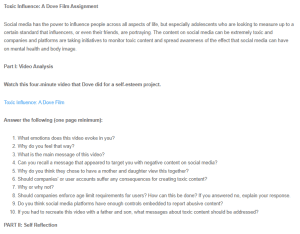
Toxic Influence: A Dove Film Assignment
Social media has the power to influence people across all aspects of life, but especially adolescents who are looking to measure up to a certain standard that influencers, or even their friends, are portraying. The content on social media can be extremely toxic and companies and platforms are taking initiatives to monitor toxic content and spread awareness of the effect that social media can have on mental health and body image.
Social Media Marketing Term Project Report
Part I: Video Analysis
Watch this four-minute video that Dove did for a self-esteem project.
Answer the following (one page minimum):
- What emotions does this video evoke in you?
- Why do you feel that way?
- What is the main message of this video?
- Can you recall a message that appeared to target you with negative content on social media?
- Why do you think they chose to have a mother and daughter view this together?
- Should companies’ or user accounts suffer any consequences for creating toxic content?
- Why or why not?
- Should companies enforce age limit requirements for users? How can this be done? If you answered no, explain your response.
- Do you think social media platforms have enough controls embedded to report abusive content?
- If you had to recreate this video with a father and son, what messages about toxic content should be addressed?
PART II: Self Reflection
Answer the following self-reflection questions (one page minimum):
- How many social media profiles do you have?
- How much time do you think you spent on your phone, on average, last week?
- How much time do you think you spent on social media, on average, last week?
- If you have screen time turned on, what is your limit? If you don’t have screen time turned on, what do you do to limit your time on social media?
- How much time did you spend on social media, on average, last week?
- When was the last time you deleted/logged off your social media accounts?
- What prompted you to take this action?
- If you haven’t deleted or logged off your accounts, what would convince you to take a break from them?
- Is there any content in your social media accounts that you do not want your employer/school to see?
- Do you have a professional LinkedIn profile? How many people and companies are in your connections?
PART III: Prepare a Presentation
Create a social media wellness short film. Fill out the table below with your plan.
- Choose the Platform: Facebook, Instagram, TikTok, etc.
- Identify the Primary Audience: Be specific about the age group, lifestyle, or other demographic
- Explain the objective of your campaign (influence behavior, choose a brand, etc.)
- State the main message. In 1 or 2 sentences, state your marketing message.
| Title of Your Social Campaign | Platform | Primary Audience | Campaign Objective | Main Message |
You may copy/paste this table into your document or recreate a table in Word.
Prepare a Cover Page in APA format.
Answers to your questions should be a minimum of three double-spaced pages and written in complete, grammatically correct sentences. Label your paper with the three main parts used in the assignment description.
Prepare a References page including the YouTube video link, the Dove web site, and at least one other source that discusses unethical social media behavior and/or regulation. Your References page should be prepared in APA format.
 Complete the order form and upload all of your files, including any instructions, rubrics, or other materials provided by your instructor.
  Complete the order payment after filling in the order form. We’ll receive your order and assign it to a writer.
 The assigned writer will complete your paper and forward it to our Editing Team for review and approval.
 Once approved by the editor, the completed paper will be uploaded to your account for you to download, review and approve.