
Social Issues – Opioid Epidemic
The opioid epidemic traces its roots to various causes, including social, economic, political, and cultural factors. Over the years, the use and misuse of opioids have scaled up in the U.S., causing deaths, addictions, and disorders, among other effects. Many stakeholders have played crucial parts in alleviating the epidemic, but some strategies have been viewed as political and not instrumental. This paper discusses the opioid epidemic history and how sociopolitical factors contributed to the development, furtherance, and reduction of the epidemic. It will also consider the specific view of Alabama’s governor, Ivey, and what she has done to address the issue.
Description of the Opioid Epidemic
Opioids refer to a group of drugs, including pain reliever prescriptions (CBO, 2022). Even though prescription drugs are available to people on a legal basis and their clinical applications are valid, they are prone to nonmedical use and can be distributed illegally. According to CBO (2022), some opioids like heroin and fentanyl are produced illegally, although fentanyl can also be produced legally. It is the misuse of opioids that causes an epidemic, leading to serious effects and death.
History of the Opioid Epidemic
In a nation-state such as the U.S., the opioid epidemic is considered a health crisis. From the beginning, the epidemic was driven by too much availability and consumption of pharmaceutical opioids, and now the increased opioid overdose number is not connected to heroin as well as illegal manufacturing of fentanyl analogs and fentanyl (Lyden & Binswanger, 2019).
The medical characteristics of opiates like heroin and morphine were initially recognized in the 1800s and were marketed to patients and physicians as effective and safe ways of reducing suffering (Lyden & Binswanger, 2019). Since the industry and federal oversight were minimal, opioids were freely utilized by laypeople and doctors to treat normal sicknesses such as minor pain, anxiety, diarrhea, and cough (Lyden & Binswanger, 2019). This led to increased use, which bred the associated risks of opioids. In 1889, Adams James found out that opium, which surpassed other solutions to sicknesses, was also powerful in causing detrimental harm (Lyden & Binswanger, 2019).
Moreover, with Adams and other scholars noting the harmful effects of opium, changes in the medical sector were made by the early 1990s. Policymakers thought of restraining the use and approach to opioid use (Lyden & Binswanger, 2019). This led to the birth of the Harrison Anti-Narcotic Act in 1915, which regulated dispensing practices and the prescription of opioids. Such initiatives were the preliminary efforts to reduce the consumption of opioids, thus assisting in addressing the first opioid crisis.
The opioid crisis wave II started in 2010 when increases in deaths related to heroin overdose were reported (CDC, 2023). The last wave was reported in 2013, which included synthetic opioid overdose deaths, especially from manufacturers of illicit fentanyl (CDC, 2023). CDC stated that the fentanyl illicit manufacture market keeps changing and that it can be found joined with cocaine, counterfeit pills, and heroin.
Socio-Political Factors
According to Jalali et al. (2020), the immediate context and the community where individuals live influence their everyday behaviors in a mighty way. There are variables like medication disposal services, accessibility to treatment, geographic conditions, prescribers’ view of the risk, types of available opioid formulations that are prescribed, norms, political environment, and access to illegal and legal opioids that perpetuate misuse of opioids. CBO (2020) suggests that the prescription of opioids increased because of the aggressive promotion attempts by pharmaceutical companies. Clinical norms had started to emphasize the assessment of patient’s pain, and they treated it with an opioid prescription. Besides, the reimbursement and oversight incentives in the healthcare system facilitated the development of opioid use and prescription (CBO, 2020). It is, therefore, highly recognizable that pharmaceutical firms played a huge part in the birth of the opioid crisis. For example, in 2007, as the epidemic started to inflict profound harm, Purdue Pharma was found guilty of the charges posed by the federal government in relation to misbranding of OxyContin (Jones et al., 2018). According to Jones et al. (2018), Purdue Pharma went into an agreement to pay $634.5 million to settle the investigations by the Justice Department and a $16.5 million settlement to over 20 states as well as the Columbia District. Purdue Pharma faced the accusation of overstating the advantages of opioids used for chronic pain and, in the process, downplaying the additional risk that comes with OxyContin and deceiving the healthcare industry and physicians (Jones et al., 2018).
In addition, there were changes in the markets for illegal opioids, which also affected the crisis. To start with, the increased prescription opioid supply facilitated their illegal distribution and nonmedical use (CBO, 2020). Lately, there has been an increased demand for fentanyl and heroin as their prices have reduced and the availability of prescription opioids has fallen. Now, the fentanyl price is low since it is produced in the laboratory, and due to its high potency characteristic, it can be carried around in small portions without being noticed. CBO (2020) found that much illegal fentanyl is manufactured in Mexico from precursor chemicals that are manufactured in China.
Moreover, research evidence shows that the demand for opioids is higher among populations with reduced real wages and low social status, such as non-Hispanic White people who lack college education (CBO, 2020). Besides, Dasgupta et al. (2018) attest that substance use issues and poverty work synergistically and are often reinforced by unstable housing and psychiatric disorders. They add that the most successful employment in the low-income populations includes jobs in the manufacturing industry and service with physical hazards, including the military. With persistent employment in these conditions over the years, the on-job injuries can lead to chronic pain, resulting in a spiral of poverty and disability (Dasgupta et al., 2018). Consequently, it is very easy for individuals in manual labor with serious injuries to fall into nonmedical use of opioids (Dasgupta et al., 2018).
Following the rising levels of opioid use, especially illegal use, former President Trump seemed proactive in addressing the issue by guiding the Department of Health and Human Services (HHS) to pronounce the crisis a health emergency (Davis, 2017). During his campaign, he vowed to reduce the problem of drug abuse and addiction, which resonated well with working-class voters in support of his campaign. However, he failed to fulfill this vow that would have prompted the quick allocation of federal funds to address the problem of opioid use.
Effects of Opioids Epidemic on the Health Care of Alabama
In 2015, Alabama ranked the highest among the states with more prescriptions of opioids at 5.8 million prescriptions (BCBS, 2017). CDC also reported Alabama as the highest among states with opioid prescriptions of pain relievers. The state has about 4.85 million people, and with over 5.8 prescriptions in 2015, this means that the prescription per head (child, woman, and man) is 1.2. According to Alabama Public Health (2018), about 5% of the population in Alabama over the age of 17 (175,000 persons) are reported to have used opioid pain relievers with no medical need. Specifically, approximately 30,000 people above age 17 are said to depend on prescription painkillers and heroin (Alabama Public Health, 2018). These figures surpassed the statistics of alcohol use disorder for the first time in the history of Alabama in 2015.
Governor Kay Ivey’s Stance on Opioid Epidemic
In 2017, Governor Ivey founded the Alabama Opioid Overdose and Addiction Council, composed of the mental health commissioner, attorney general, and health officer of the state. This council was created by her signing into law Executive Order 708 (The Office of Alabama Governor, 2017). The council’s aim is to put in place strategies for community responses, treatment, intervention, and prevention of the opioid epidemic. Governor Ivey stated that the epidemic was damaging the families in Alabama, and despite the issue being non-political, she was doing all she could to address it (Specker, 2018). The law she pushed for alters the prior Opioid Misuse and Addiction of Alabama Council. For example, the law entails adding the attorney general as co-chair in the third seat, a physician chosen by the Alabama Medical Association, and other key persons in the health sector. So far, the governor has reviewed the council and put in place recommendations for reducing deaths due to the opioid epidemic.
Remedy for Opioid Epidemic: Enhancing Prescribing Practices
Prescribing rates have notably reduced over the past few years. However, the high availability and opioid pain medication use have played a major role in the contemporary epidemic. For instance, in 2016, the rate of opioid medication prescription in the U.S. was about thrice as high as in the year 1999 (Lyden & Binswanger, 2019). Moreover, in 2016, more than 17,000 people died from a pharmaceutical overdose of opioids (Lyden & Binswanger, 2019). Various research studies have indicated a spatial and temporal connection between overdose mortality and the availability of pharmaceutical opioids (Lyden & Binswanger, 2019). In addition, Lyden & Binswanger (2019) argue that even when a physician prescribes it and the patient takes it as instructed, the use of pharmaceutical opioids can result in harmful health outcomes, including fatal overdoses and addiction (Dunn et al., 2010). Additionally, Gomes et al. (2014) suggest that such risks are furthered with long-acting opioid therapy, opioid formulations, concurrent benzodiazepine use, high equivalent doses of morphine, diagnosis of mental health, and history of tobacco use and substance use disorders.
In summary, it is recommended that states that have not installed prescription drug monitoring programs (PDMP) can join the others in these programs and enhance their prescribing practices. Besides, Lyden & Binswanger (2019) write that various states have reported that PDMP is effective in the process outcomes, like enhancing physicians’ confidence, limiting the availability of controlled substances, and identifying patients with more than one prescriber. Research also indicates that state-based PDMP is linked with the 1.12 opioid-based overdose death reduction per 100,000 population every year (Lyden & Binswanger, 2019). It was also found that states that kept their PDMP under regular review, updates, and monitoring showed further mortality rate reduction (Lyden & Binswanger, 2019). The guidelines of the CDC stipulate constant review of the PDMP information before every opioid prescription, before starting sustainable opioid therapy, and during its course periodically (Lyden & Binswanger, 2019). Leaders need to stop blaming other actors for the rise of the opioid epidemic and start focusing on resolving the issue effectively through legislation or advocacy.
References
Alabama Public Health (2018). Alabama Creates Plan To Help Solve the Opioid Epidemic. https://www.alabamapublichealth.gov/blog/assets/ah0718.pdf
BlueCross BlueShield- BCBS. (2017). Opioid Epidemic Grows as Alabama Ranks First Nationally Having More Opioid Prescriptions than People. https://www.bcbs.com/press-releases/opioid-epidemic-grows-alabama-ranks-first-nationally-having-more-opioid
CBO. (2022). The Opioid Crisis and Recent Federal Policy Responses. https://www.cbo.gov/system/files/2022-09/58221-opioid-crisis.pdf
Centre for Disease Control and Prevention- CDC. (2023). Understanding the Opioid Overdose Epidemic. https://www.cdc.gov/opioids/basics/epidemic.html
Dasgupta, N., Beletsky, L., & Ciccarone, D. (2018). Opioid crisis: no easy fix to its social and economic determinants. American journal of public health, 108(2), 182-186.
Davis, J. H. (2017). Trump declares opioid crisis a ‘health emergency’ but requests no funds. New York Times.
Dunn, K. M., Saunders, K. W., Rutter, C. M., Banta-Green, C. J., Merrill, J. O., Sullivan, M. D., & Von Korff, M. (2010). Overdose and prescribed opioids: Associations among chronic non-cancer pain patients. Annals of Internal Medicine, 152(2), 85.
Gomes, T., Mamdani, M. M., Paterson, J. M., Dhalla, I. A., & Juurlink, D. N. (2014). Trends in high-dose opioid prescribing in Canada. Canadian Family Physician, 60(9), 826-832.
Jalali, M. S., Botticelli, M., Hwang, R. C., Koh, H. K., & McHugh, R. K. (2020). The opioid crisis: a contextual, social-ecological framework. Health research policy and systems, 18(1), 1-9.
Jones, M. R., Viswanath, O., Peck, J., Kaye, A. D., Gill, J. S., & Simopoulos, T. T. (2018). A brief history of the opioid epidemic and strategies for pain medicine. Pain and therapy, 7(1), 13-21.
Lyden, J., & Binswanger, I. A. (2019). The United States opioid epidemic. In Seminars in perinatology (Vol. 43, No. 3, pp. 123-131). WB Saunders.
Specker, L. (2018). What will Alabama’s next Governor and AG do about the Opioid Crisis? https://www.al.com/news/mobile/2018/10/what_will_alabamas_next_govern.html
The Office of Alabama Governor (2017). Governor Ivey Establishes Alabama Opioid Overdose and Addiction Council. https://governor.alabama.gov/newsroom/2017/08/governor-ivey-establishes-alabama-opioid-overdose-and-addiction-council/.
ORDER A PLAGIARISM-FREE PAPER HERE
We’ll write everything from scratch
Question 
Social Issues – Opioid Epidemic
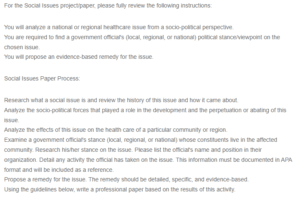
For the Social Issues project/paper, please fully review the following instructions:
You will analyze a national or regional healthcare issue from a socio-political perspective.
You are required to find a government official’s (local, regional, or national) political stance/viewpoint on the chosen issue.
You will propose an evidence-based remedy for the issue.
Social Issues Paper Process:
Research what a social issue is and review the history of this issue and how it came about.
Analyze the socio-political forces that played a role in the development and the perpetuation or abating of this issue.
Analyze the effects of this issue on the health care of a particular community or region.
Examine a government official’s stance (local, regional, or national) whose constituents live in the affected community. Research his/her stance on the issue. Please list the official’s name and position in their organization. Detail any activity the official has taken on the issue. This information must be documented in APA format and will be included as a reference.
Propose a remedy for the issue. The remedy should be detailed, specific, and evidence-based.
Using the guidelines below, write a professional paper based on the results of this activity.
 Complete the order form and upload all of your files, including any instructions, rubrics, or other materials provided by your instructor.
 Complete the order payment after filling in the order form. We’ll receive your order and assign it to a writer.
 The assigned writer will complete your paper and forward it to our Editing Team for review and approval.
 Once approved by the editor, the completed paper will be uploaded to your account for you to download, review and approve.