
Social Change Project: Final Project Report
Housing insecurity is a social problem of concern in the United States that is distinguished by unaffordability in terms of housing, overcrowding, and the constant threat of eviction or homelessness. The issue affects marginalized groups, such as people of color, single parents, LGBTQ+ youth, veterans, and persons with disabilities. This report examines the issue of housing insecurity, the preliminary policy response (the Florida SHIP program), and an alternative policy (the National Housing Trust Fund). It describes the project’s activities, the knowledge gained, the opportunities for professional development, the relationship between policy and direct social work practice, and the future use of advocacy.
Brief Synopsis
Housing insecurity, marked by unaffordable rent, overcrowding, and frequent displacement, remains a severe and growing social issue in the United States. The vulnerable groups, including people of color, individuals with disabilities, LGBTQ+ youth, single parents, and veterans, are mostly affected by housing insecurity (Houghtaling et al., 2024). The first explored intervention intended for local support of affordable housing is the Florida State Housing Initiatives Partnership (SHIP) program. Nevertheless, it had its drawbacks, which is why the National Housing Trust Fund (NHTF) was pursued. The NHTF is a long-term, low-income, affordable housing federal funding program that aligns closely with the social work principles of equity, justice, and human dignity (Gutierrez et al., 2021).
Steps of the Project
Influence of Professional Experience on Problem Selection
My experience as a social work professional exposed me to the situations that clients go through daily because of unstable housing, including disrupted treatment, mental problems, and family dysfunction. These statements, in line with my advocacy purpose to endorse the idea of dignity and equity, prompted me to choose the topic of housing insecurity. I began by identifying issues, consulted relevant policies such as the SHIP program in Florida, and was able to find more sustainable solutions, including the NHTF. This procedure aligns with the NASW Code of Ethics, which emphasizes the importance of social justice and the significance of human relationships (Gross, 2025).
Policy Analysis Informed by Experience
The experiences that I had in working with the people who approached me with issues such as eviction, homelessness, and overcrowded housing made the consequences of housing insecurity more tangible because I understood the intricacy of its influence. Such experiences emphasized the importance of extensive, lasting solutions, and this shaped my perspective on policy evaluation. In particular, I experienced the reality that short-term aid often fails, which shaped my criticism of the SHIP program not reaching as far as it could. It also informed the endorsement of the National Housing Trust Fund, which has more resilient financing and focuses on vulnerable groups. Personal insight helped ensure my analysis stayed grounded in real client needs.
What I Learned through Each Step
At the end of each step, I developed a better understanding of the intersection between social work and policy advocacy. The discovery of housing insecurity provided insight into how structural inequalities continue to disadvantage vulnerable populations. The experience of analyzing the SHIP program taught me the importance of measuring the effectiveness of the policy and its reach to the community. The suggestion of advocacy strategies enhanced the position of social workers as agents of social justice, particularly through education and coalition formation (Lucio et al., 2024). Finally, the proposal of the NHTF made me appreciate the power of long-term, federally funded proposal that takes care of sustainable change and are in line with the NASW Code of Ethics.
Opportunities for Growth
One opportunity for growth is to involve myself earlier in the process by speaking with policymakers to learn more about their priorities and how I can adjust my advocacy accordingly. This would act as a stimulus to enhance the chances of securing political support for housing programs, such as the NHTF. Second, I would refine my public speaking strategies to be more compelling and data-driven when addressing decision-makers, using personal stories alongside statistics to humanize the issue. Finally, I would seek to gain a deeper understanding of options that are more locally focused, potentially more politically viable in more conservative areas, and strike a balance between ideological aims and possible avenues through which the policy could be adopted.
How Policy Relates to Direct Practice
Policy influences social work practice in critical ways. First, it specifies what services can be available and accessible, such as housing help or mental health care, and which practitioners will assist the clients. Additionally, policy determines eligibility rules, which in turn affect who receives it and when (Hinterleitner et al., 2023). Finally, policy serves as a source of information on ethical practice because it coordinates interventions within the broader framework of social justice. Advocacy by social workers can help establish an increasingly just and client-responsive environment, as social workers promote policies that respond to actual client needs (Jansson, 2017).
Applying Advocacy Skills as a Social Worker
As a social worker, I will utilize advocacy skills by identifying systemic obstacles and barriers that have impacted my clients and seeking to influence policy changes at both the local and state levels. I will also utilize data and research to support my arguments, mobilize within coalitions with community organizations, and educate decision-makers on the experiences of marginalized groups. I will also incorporate both the micro and macro approaches to foster efforts that will lead to the development of policies supporting social justice, equity, and the availability of necessary resources, such as housing and healthcare.
Conclusion
In conclusion, housing insecurity remains a threat to the future and the welfare of millions, especially people of marginalized groups. This social change initiative highlighted the importance of sustainable, equity-based policy solutions over short-term programs, such as Florida SHIP. The National Housing Trust Fund is a more effective alternative, offering long-term investment in affordable housing that aligns with the social work values of dignity and justice. In the future, advocacy skills will remain essential for achieving positive, client-centered change in the social work field.
References
Gross, E. B. (2025). Social work values and the NASW code of ethics: Problems of function and possibilities for change. Journal of Progressive Human Services, 35(3), 1–23. https://doi.org/10.1080/10428232.2025.2455883
Gutierrez, E. C., Allan, E., & Haberle, M. (2021). The National Housing Trust Fund and Fair Housing: A set of policy recommendations. Poverty & Race Research Action Council. https://www.jstor.org/stable/resrep32130
Hinterleitner, M., Knill, C., & Steinebach, Y. (2023). The growth of policies, rules, and regulations: A review of the literature and research agenda. Regulation & Governance, 18(2). https://doi.org/10.1111/rego.12511
Houghtaling, L. M., Simon, K., Gower, A. L., McCurdy, A., Rider, G. N., Russell, S. T., & Eisenberg, M. E. (2024). Unaccompanied unstable housing among racially, ethnically, sexually, and gender diverse youth: Intersecting identities bearing the greatest burden. American Journal of Orthopsychiatry, 94(3), 311. https://psycnet.apa.org/buy/2024-44930-001
Jansson, B. S. (2017). Empowerment series: Becoming an effective policy advocate (8th ed.). Cengage Learning. https://bookshelf.vitalsource.com/books/9798214338224
Lucio, R., Aiken, E. C., Maughan, G., Campbell, M., & Louis-Caines, K. (2024). Agents of change: The role LEAD plays in identity formation, community engagement, and social justice advocacy. Journal of Human Rights and Social Work. https://doi.org/10.1007/s41134-024-00306-2
ORDER A PLAGIARISM-FREE PAPER HERE
We’ll write everything from scratch
Question 
Social Change Project: Final Project Report
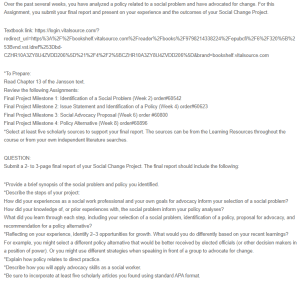
Over the past several weeks, you have analyzed a policy related to a social problem and have advocated for change. For this Assignment, you submit your final report and present on your experience and the outcomes of your Social Change Project.
Social Change Project – Final Project Report
Textbook link: https://login.vitalsource.com/?redirect_uri=https%3A%2F%2Fbookshelf.vitalsource.com%2Freader%2Fbooks%2F9798214338224%2Fepubcfi%2F6%2F320%5B%253Bvnd.vst.idref%253Dbd-CZHR10A3ZY8U4ZVDD206%5D%21%2F4%2F2%5BCZHR10A3ZY8U4ZVDD206%5D&brand=bookshelf.vitalsource.com
*To Prepare:
Read Chapter 13 of the Jansson text.
Review the following Assignments:
Final Project Milestone 1: Identification of a Social Problem (Week 2) order#60542
Final Project Milestone 2: Issue Statement and Identification of a Policy (Week 4) order#60623
Final Project Milestone 3: Social Advocacy Proposal (Week 6) order #60800
Final Project Milestone 4: Policy Alternative (Week 8) order#60896
*Select at least five scholarly sources to support your final report. The sources can be from the Learning Resources throughout the course or from your own independent literature searches.
QUESTION:
Submit a 2- to 3-page final report of your Social Change Project. The final report should include the following:
*Provide a brief synopsis of the social problem and policy you identified.
*Describe the steps of your project:
How did your experiences as a social work professional and your own goals for advocacy inform your selection of a social problem?
How did your knowledge of, or prior experiences with, the social problem inform your policy analyses?
What did you learn through each step, including your selection of a social problem, identification of a policy, proposal for advocacy, and recommendation for a policy alternative?
*Reflecting on your experience, identify 2–3 opportunities for growth. What would you do differently based on your recent learnings?
For example, you might select a different policy alternative that would be better received by elected officials (or other decision makers in a position of power). Or you might use different strategies when speaking in front of a group to advocate for change.
*Explain how policy relates to direct practice.
*Describe how you will apply advocacy skills as a social worker.
*Be sure to incorporate at least five scholarly articles you found using standard APA format.
 Complete the order form and upload all of your files, including any instructions, rubrics, or other materials provided by your instructor.
  Complete the order payment after filling in the order form. We’ll receive your order and assign it to a writer.
 The assigned writer will complete your paper and forward it to our Editing Team for review and approval.
 Once approved by the editor, the completed paper will be uploaded to your account for you to download, review and approve.