
Social and Environmental Determinants of Health
Public safety is the most fundamental responsibility of the Centre for Disease Control. CDC ensures that the public at state and local public health systems are equipped for the emergence of a natural disaster, such as infections or environmental or occupational incidents that hurt public health. CDC can achieve this by allocating funds to preparedness activities for public health in my project. I will provide an action plan for bioterrorism emergencies (Chen et al., 2018). This plan, therefore, will be essential in giving institutional guidelines on preparedness for a bioterrorism attack, assessing the readiness needs such as local emergency network notification, relocation of the affected individuals to acute care facilities, comprehensive communication, and management network activation.
Often, bioterrorism emergencies may occur as a cover event where individuals may be unknowingly exposed, and the only cluster of the disease symptoms raises the alarm of a suspected outbreak. In some cases, it may occur as an announced Bioterrorism attack in which the community is warned against exposure (Erenler et al., 2018).
Are you in need of help on your assignment ? Get in touch with us.
Risk Assessment Through Syndrome-Based Criteria
This is the process of prompt Identifying the hazards and the risk factors that are typically related to the outbreak/potential cause of the harm through a thorough analysis and evaluation of the associated risk and determination of the appropriate ways to eliminate the hazard or control the risk in cases when it cannot be stopped. The action plan of risk assessment records the needed actions to curb or prevent the identified hazard. The action plan includes Risk identification, risk analysis, evaluation of the impacts of the identified risks, role assessment of each threat, development of preventive strategy, a stand-by contingency plan formulation, measurement of risk threshold, and monitoring and reporting the outcomes. Initiate high-risk symptom recognition and description as you await laboratory results to confirm the type of bioterrorism agent (Bohannon et al., 2019).
Identification of Epidemiologic Features
Use epidemiological principles to discriminate the patients’ clinical presentations if they are typical to endemic disease or unusual events. Raise concern if they are of a usual event such as rapid disease incidence, rise and fall of the epidemic curve in a short period, low attack rates for people who are indoors, and high fetal rates.
Infection Control
Using strong leadership and effective communication skills carefully, organize and rehearse patient management plans. Manage all patients who are suspected of having been exposed to the bioterrorism agent using a standard precaution. To reduce the infection, use isolation precautions to separate the infected patients from those typically epidemically sick regardless of their presumed diagnostic status. Avoid direct contact with body fluids such as blood, sweat, and secretions. Encourage handwashing after getting into contact with body fluids or secretions or suspected infected surfaces. Encourage the use of personal protective devices such as gloves, face shields, face masks, and gowns when attending to an infected patient (Makiela et al., 2018).
Patient Placement and Transportation
Follow the routine infection control practice and facility patient practice for small-scale events. In cases of a large outbreak, regular triage and isolation strategies are imposed by applying practical alternatives by grouping patients with similar symptoms in the same department or ward. Ensure proper ventilation and adequate waste disposal and plumbing. These patients should be transported according to the guidelines for patients with epidemiological disease (Popescu, 2019).
Cleaning and Sterilization of Environment and Equipment
Apply the principles of standard precautions. Establish a procedure for routine cleaning, care, and disinfecting of the environment and surfaces. Provide adequate approved germicidal agents at the facility to the patients and the staff. Establish policies to prevent occupational injuries and contact with bloodborne pathogens.
References
Bohannon, M. E., Shuster, C. E., Smedley, W. S., Wiseman, S. A., & Grotte, J. H. (2019). Countering Biological Warfare (BW) Pathogens Concept Pt. 1. Institute for Defense Analyses Alexandria United States. https://apps.dtic.mil/sti/citations/AD1103117
Chen, S., Xu, Q., Buchenberger, J., Bagavathi, A., Fair, G., Shaikh, S., & Krishnan, S. (2018). Dynamics of health agency response and public engagement in public health emergency: a case study of CDC tweeting patterns during the 2016 Zika epidemic. JMIR public health and surveillance, 4(4), e10827. https://publichealth.jmir.org/2018/4/e10827?utm_source=TrendMD&utm_medium=cpc&utm_campaign=JMIR_TrendMD_1
Erenler, A. K., Güzel, M., & Baydin, A. (2018). How prepared are we for possible bioterrorist attacks: An approach from emergency medicine perspective. The Scientific World Journal, 2018. https://www.hindawi.com/journals/tswj/2018/7849863/abs/
Makiela, S., Weber, A., Maguire, B. J., & Taylor-Robinson, A. W. (2018). Infection control protocols: is it time to clean up our act? Australasian Journal of Paramedicine, 15(3). http://ajp.paramedics.org/index.php/ajp/article/view/624
Popescu, S. (2019). Infection Prevention and Control: A Biodefense Measure. Defense Against Biological Attacks, 145. https://www.ncbi.nlm.nih.gov/pmc/articles/pmc7123648/
ORDER A PLAGIARISM-FREE PAPER HERE
We’ll write everything from scratch
Question 
Social and Environmental Determinants of Health
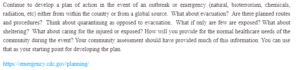
Continue to develop a plan of action in the event of an outbreak or emergency (natural, bioterrorism, chemicals, radiation, etc) either from within the country or from a global source. What about evacuation? Are there planned routes and procedures? Think about quarantining as opposed to evacuation. What if only a few are exposed? What about sheltering? What about caring for the injured or exposed? How will you provide for the normal healthcare needs of the community during the event? Your community assessment should have provided much of this information. You can use that as your starting point for developing the plan.
 Complete the order form and upload all of your files, including any instructions, rubrics, or other materials provided by your instructor.
  Complete the order payment after filling in the order form. We’ll receive your order and assign it to a writer.
 The assigned writer will complete your paper and forward it to our Editing Team for review and approval.
 Once approved by the editor, the completed paper will be uploaded to your account for you to download, review and approve.