
Sensory Perception Disorder Care Map
| Assessment
and Data Collection |
Three NANDA-I Approved Nursing Diagnosis | One Smart Goal for EACH Nursing Diagnosis | Two Nursing Interventions with Rationale for EACH Nursing Diagnosis |
| Disease Process:
Raised intraocular pressure and changes in the optic nerve head cause central visual field loss (Mahabadi et al., 2022).
Common Labwork/Diagnostics: Complete blood count. Erythrocyte sedimentation rate. Fundus photography. Scanning laser polarimetry. Serology for syphilis. Assessment Data (consider subjective, objective, and health history): Personal data: Vision changes, double vision, visual loss, painful eyes, itchy eyes, blurry vision, light sensitivity, and headache (Dietze et al., 2022). Objective data: Vision, blood pressure, heart rate, weight, height, BMI, SPO2, and temperature. |
Nursing Diagnosis:
Deficient knowledge related to a new diagnosis of primary open-angle glaucoma as evidenced by patients on side effects, mechanism of action, and administration of eye drops.
Nursing Diagnosis: Altered visual sensory perception is related to decreased vision, as evidenced by a diagnosis of primary open-angle glaucoma (Mahabadi et al., 2022).
Nursing Diagnosis Risk for injury related to vision loss as evidenced by a decrease in vision (Mahabadi et al., 2022). |
SMART Goal:
The patient understands her diagnosis and treatment.
SMART Goal: To prevent further vision loss (Mahabadi et al., 2022).
SMART Goal: Ensure the patient stays in a safe environment and is free of injury. |
1. Educate the patient on open-angle glaucoma using a language and terms that the patient understands to ensure she understands her diagnosis.
2. Educate the patient on her prescribed medication. Inform the patient on class, side effects, use, and mechanism of action of the eye drop (Fineide et al., 2022). Ensure the patient demonstrates how to administer the drug. Medication education is done to improve patient compliance and self-administration (Aremu et al., 2022).
1. Compliance with prescribed eye drops to prevent further vision loss (Aremu et al., 2022). 2. Educate the patient on the possibility of complete or partial vision loss to ensure the patient is mentally prepared and visits the hospital in case of further vision loss.
1. Educate the patient, her family, and her caregiver on safety measures, such as ensuring the patient’s house is well-lit and ensuring there are no things on the floor to prevent injury. 2. Encourage the patient to use spectacles to increase visual acuity and prevent falls and accidents. |
References
Aremu, T. O., Oluwole, O. E., Adeyinka, K. O., & Schommer, J. C. (2022). Medication Adherence and Compliance: Recipe for Improving Patient Outcomes. Pharmacy (Basel, Switzerland), 10(5), 106. https://doi.org/10.3390/pharmacy10050106.
Dietze, J., Blair, K., & Havens, S. J. (2022). Glaucoma. StatPearls Publishing. https://www.ncbi.nlm.nih.gov/books/NBK538217/.
Fineide, F., Lagali, N., Adil, M. Y., Arita, R., Kolko, M., Vehof, J., & Utheim, T. P. (2022). Topical glaucoma medications – Clinical implications for the ocular surface. The ocular surface, 26, 19–49. Advanced online publication. https://doi.org/10.1016/j.jtos.2022.07.007.
Mahabadi, N., Foris, L. A., & Tripathy, K. (2022). Open Angle Glaucoma. StatPearls Publishing. https://www.ncbi.nlm.nih.gov/books/NBK441887/.
ORDER A PLAGIARISM-FREE PAPER HERE
We’ll write everything from scratch
Question 
Sensory Perception Disorder Care Map
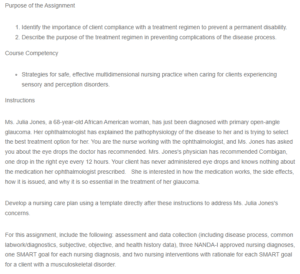
Purpose of the Assignment
- Identify the importance of client compliance with a treatment regimen to prevent a permanent disability.
- Describe the purpose of the treatment regimen in preventing complications of the disease process.
Course Competency
- Strategies for safe, effective multidimensional nursing practice when caring for clients experiencing sensory and perception disorders.
Instructions
Ms. Julia Jones, a 68-year-old African American woman, has just been diagnosed with primary open-angle glaucoma. Her ophthalmologist has explained the pathophysiology of the disease to her and is trying to select the best treatment option for her. You are the nurse working with the ophthalmologist, and Ms. Jones has asked you about the eye drops the doctor has recommended. Mrs. Jones’s physician has recommended Combigan, one drop in the right eye every 12 hours. Your client has never administered eye drops and knows nothing about the medication her ophthalmologist prescribed. She is interested in how the medication works, the side effects, how it is issued, and why it is so essential in the treatment of her glaucoma.
Develop a nursing care plan using a template directly after these instructions to address Ms. Julia Jones’s concerns.
For this assignment, include the following: assessment and data collection (including disease process, common labwork/diagnostics, subjective, objective, and health history data), three NANDA-I approved nursing diagnoses, one SMART goal for each nursing diagnosis, and two nursing interventions with rationale for each SMART goal for a client with a musculoskeletal disorder.
 Complete the order form and upload all of your files, including any instructions, rubrics, or other materials provided by your instructor.
 Complete the order payment after filling in the order form. We’ll receive your order and assign it to a writer.
 The assigned writer will complete your paper and forward it to our Editing Team for review and approval.
 Once approved by the editor, the completed paper will be uploaded to your account for you to download, review and approve.