
Self-Prescribed Pain Medication
Kristelle,
Thank you for sharing your post. I agree with you on the Patient’s request for a 6-month supply of pain medication being of concern. This is because self-prescribed pain medication is common in the United States (Reiman et al., 2017). There are several adverse effects associated with taking an overdose of narcotics. This includes systemic failures involving the kidney and liver, whose primary function is drug metabolism (Yang & Tonnesseen., 2019). Since ML, a 54-year-old grandmother, is on other drugs, she is likely to be a victim of liver failure. When the liver fails, one goes into a state of systemic toxicity because of a slow metabolism process. It is the role of the practitioner to reassess the Patient before prescribing other pain medications. It is important to educate the Patient on the risks of overdosing on opioids. These risks include respiratory distress and other serious effects. With the higher dose, a practitioner should review the pain medication after administration of diazepam. This helps to evaluate the impact of drug-drug reactions on the Patient.
It is also important for a practitioner to follow safe steps during pain medication prescriptions. The first step is to carry out a detailed assessment of the need to prescribe opiates to a patient. The second step is advising on alternative options for pain therapy. These include treatments such as stretching, strengthening, and exercises. That includes referring them to physical therapists to design physical exercise programs. The third one is the prescription of non-opiates before narcotics. The fourth step comprises educating the patients on the importance of taking drugs as prescribed by the physician. Information on the dangers of overdosing is also important. Her daughter should be educated on the clinical manifestations of a person who has overdosed and on first aid management skills. The other step is starting the Patient on low doses of pain medication.
References
Reiman, A., Welty, M., & Solomon, P. (2017). Cannabis as a substitute for opioid-based pain medication: patient self-report. Cannabis and cannabinoid research, 2(1), 160-166.
Yang, R., & Tonnesseen, T. I. (2019). DAMPs and sterile inflammation in drug hepatotoxicity. Hepatology International, 13(1), 42-50.
ORDER A PLAGIARISM-FREE PAPER HERE
We’ll write everything from scratch
Question 
-I NEED TO RESPOND TO THIS TOPIC
-Length: A minimum of 150 words per post, not including references
Citations: At least one high-level scholarly reference in APA per post from within the last five years
Self-Prescribed Pain Medication
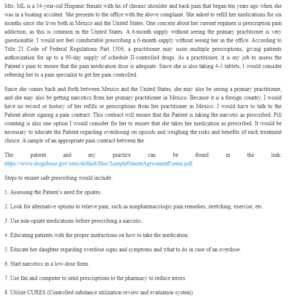
Mrs. ML is a 54-year-old Hispanic female with hx of chronic shoulder and back pain that began ten years ago when she was in a boating accident. She presents to the office with the above complaint. She asked to refill her medications for six months since she lives both in Mexico and the United States. One concern about her current regimen is prescription pain addiction, as this is common in the United States. A 6-month supply without seeing the primary practitioner is very questionable. I would not feel comfortable prescribing a 6-month supply without seeing her in the office. According to Title 21 Code of Federal Regulations Part 1306, a practitioner may issue multiple prescriptions, giving patients authorization for up to a 90-day supply of schedule II-controlled drugs. As a practitioner, it is my job to assess the Patient’s pain to ensure that the pain medication dose is adequate. Since she is also taking 4-5 tablets, I would consider referring her to a pain specialist to get her pain controlled.
Since she comes back and forth between Mexico and the United States, she may also be seeing a primary practitioner, and she may also be getting narcotics from her primary practitioner in Mexico. Because it is a foreign country, I would have no record or history of her refills or prescriptions from her practitioner in Mexico. I would have to talk to the Patient about signing a pain contract. This contract will ensure that the Patient is taking the narcotic as prescribed. Pill counting is also one option I would consider for her to ensure that she takes her medication as prescribed. It would be necessary to educate the Patient regarding overdosing on opioids and weighing the risks and benefits of each treatment choice. A sample of an appropriate pain contract between the
The patient and my practice can be found in the link: https://www.drugabuse.gov/sites/default/files/SamplePatientAgreementForms.pdf.
Steps to ensure safe prescribing would include:
1. Assessing the Patient’s need for opiates.
2. Look for alternative options to relieve pain, such as nonpharmacologic pain remedies, stretching, exercise, etc.
3. Use non-opiate medications before prescribing a narcotic.
4. Educating patients with the proper instructions on how to take the medication.
5. Educate her daughter regarding overdose signs and symptoms and what to do in case of an overdose.
6. Start narcotics in a low-dose form.
7. Use fax and computer to send prescriptions to the pharmacy to reduce errors.
8. Utilize CURES (Controlled substance utilization review and evaluation system)
Given that she is also on other medications for hypertension and cholesterol, a maximum of 90-day supply could be given to the Patient. Since all of her medications need a prescription, the minimum requirements of the prescription form (paper and electronic) should be used. Under the California Health and Safety Code Article 1 Section 11162.1, included in the prescription is the Serial number of the medicine, date of issue, Patient’s name and address, Prescriber’s name, Prescriber’s address, DEA number, drug name, drug dose form, drug strength, directions of drug use, quantity prescribed, number of refills, and the signature of the practitioner prescribing the medication. Losartan, Gabapentin, Atorvastatin, and Diazepam may be called into the pharmacy, while Norco would need a written script or an electronic order before dispensing the medication to the Patient. According to Section 11165 of the health and safety code under California law, the practitioner should utilize the CURES database and report the prescription of narcotics within 24 hours. This may be done by any staff working in the practitioner’s office. In addition, the practitioner may search the database before prescribing opioid medication to the Patient to prevent the Patient from “pill shopping.”
In California, a restricted practice state, standardized procedures should be followed in furnishing schedule II to IV medications. This link provides California guidelines for prescribing Schedule II to IV medications. https://www.mbc.ca.gov/Download/Publications/pain-guidelines.pdf
References
California Legislative Information Health and Safety Code Division 10 Uniform Controlled Substances Act [11000-11651] Chapter 4. Prescriptions [11150-11209]. Article 1. Requirement of Prescriptions [11150-11180]. n.d. Accessed July 5, 2021. https://leginfo.legislature.ca.gov/faces/codes_displayText.xhtml?lawCode=HSC&division=10.&title=&part=&chapter=4.&article=1.
United States Department of Justice Drug Enforcement Administration Diversion Control Division. n.d. Accessed July 5, 2021. https://www.deadiversion.usdoj.gov/GDP/(DEA-DC-017)(DEA065)%20Early%20RX%20Refill%20-%20OMB%203-20-20%202200%20DAA%20approved.pdf
 Complete the order form and upload all of your files, including any instructions, rubrics, or other materials provided by your instructor.
 Complete the order payment after filling in the order form. We’ll receive your order and assign it to a writer.
 The assigned writer will complete your paper and forward it to our Editing Team for review and approval.
 Once approved by the editor, the completed paper will be uploaded to your account for you to download, review and approve.