
Role of Ethics on Teams
A strong ethical culture is crucial to creating a productive workplace. In this case, new members into our organization should understand why it is important to be ethically responsible by considering. Further, it is crucial to understand how ethics influence teams and the broader corporate environment. Thus, this training is purposed to explore ethical culture across the five levels and highlight essential considerations that should be made in the work environment.
Corporate and Team Ethical Culture
Corporate culture refers to the values, policies, and behaviors an organization embraces. It entails leadership decisions, a code of conduct, and accountability structures. Notably, these elements shape how employees understand what is acceptable within the organization. According to Xing (2022), a strong corporate culture aligns with an organization’s mission. Therefore, the organization can enforce compliance with social responsibilities. On the other hand, team ethical culture is more localized whereby its norms apply to a small group of individuals. The groups can be within departments or the whole organization. However, the culture must comply with the broader organizational ethical culture.
Ethical Considerations for In-Person and Virtual Employees
Ethical behavior is based on respect, accountability, and confidentiality without regard to in-person and virtual environments. A difference occurs regarding the mode of application and the concerns involved. Essentially, in-person employees face physical boundaries-related ethical issues. Therefore, leaders must foster an environment that promotes employee safety. Diversity and inclusion should be practiced transparently (Roy et al., 2024). Regarding virtual employees, organizations need to put emphasis on clear guidelines. Further, they should maintain open communication. Notably, this is so because virtual employees encounter limited informal observations. Challenges related to data privacy are often the cause of ethical issues.
Five Levels of Ethical Culture
According to BSR’s ethical culture model, there are five interrelated levels of ethical culture. The five include individual, interpersonal, group, intergroup, and inter-organizational levels (Cabana & Kaptein, 2021). At the individual level, ethics stem from individual integrity and moral development. The individual level is often shaped by personal values. Second, the interpersonal level ethics applies to interactions between coworkers. Notably, this level is shaped by aspects like active listening, speaking up against unethical behavior, and fairness. Third, at the group level, ethical culture is demonstrated via the norms and practices of a team. Group-level ethics are reflected in team activities such as problem-solving, and support to various team members (Halbusi et al., 2021). Fourth, the intergroup level refers to the relationships between departments. Ethical intergroup culture promotes collaboration, knowledge sharing, and avoidance of competitive behaviors that undermine the prevailing company objectives. Lastly, the inter-organizational level encompasses interactions between external partners. Examples of the involved stakeholders include the community, vendors, and customers. At this level, ethical culture is meant to foster transparency, compliance, and social responsibility by the organization to all stakeholders.
Scenario Demonstrating the Five Levels
A product launch scenario is considered to emphasize the understanding of the five ethical culture levels. At the individual level, a product manager takes note of minor safety issues associated with the product that should be launched soon. Guided by personal integrity, the issues are raised regardless of the tight schedule involved. The product manager proceeds to discuss the issue with a colleague in the research and development team. The colleague listens carefully and agrees to investigate the issue, which demonstrates the interpersonal level of culture. At the group level, a meeting is held to assess the safety issue. As a group, they agree to prioritize consumer safety. At the intergroup level, the marketing department collaborates with the product team to revise the launch plan despite the disappointment. Notably, this intergroup collaboration offers insight into how intergroup collaboration prioritizes the organization’s values. At the inter-organizational level, the company communicates transparently with vendors about the likely delay, citing commitment to product safety.
Conclusion
Understanding ethical culture based on levels makes application easier. The organization can achieve success and be considered an ethical firm.
References
Cabana, G. C., & Kaptein, M. (2021). Team ethical cultures within an organization: A differentiation perspective on their existence and relevance. Journal of Business Ethics, 170(4), 761–780. https://doi.org/10.1007/s10551-019-04376-5
Halbusi, H. A., Williams, K. A., Ramayah, T., Aldieri, L., & Vinci, C. P. (2021). Linking ethical leadership and ethical climate to employees’ ethical behavior: The moderating role of person–organization fit. Personnel Review, 50(1), 159–185. https://doi.org/10.1108/pr-09-2019-0522
Roy, A., Newman, A., Round, H., & Bhattacharya, S. (2024). Ethical culture in organizations: A review and agenda for future research. Business Ethics Quarterly, 34(1), 97–138. https://doi.org/10.1017/beq.2022.44
Xing, S. (2022). Ethical conflict and knowledge hiding in teams: Moderating role of workplace friendship in education sector. Frontiers in Psychology, 13. https://doi.org/10.3389/fpsyg.2022.824485
ORDER A PLAGIARISM-FREE PAPER HERE
We’ll write everything from scratch
Question 
Role of Ethics on Teams
Assignment Instructions
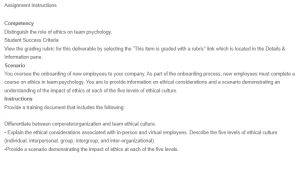
Role of Ethics on Teams
Competency
Distinguish the role of ethics on team psychology.
Student Success Criteria
View the grading rubric for this deliverable by selecting the “This item is graded with a rubric” link which is located in the Details & Information pane.
Scenario
You oversee the onboarding of new employees to your company. As part of the onboarding process, new employees must complete a course on ethics in team psychology. You are to provide information on ethical considerations and a scenario demonstrating an understanding of the impact of ethics at each of the five levels of ethical culture.
Instructions
Provide a training document that includes the following:
.
Differentiate between corporate/organization and team ethical culture.
• Explain the ethical considerations associated with in-person and virtual employees. Describe the five levels of ethical culture (individual, interpersonal, group, intergroup, and inter-organizational).
•Provide a scenario demonstrating the impact of ethics at each of the five levels.
 Complete the order form and upload all of your files, including any instructions, rubrics, or other materials provided by your instructor.
  Complete the order payment after filling in the order form. We’ll receive your order and assign it to a writer.
 The assigned writer will complete your paper and forward it to our Editing Team for review and approval.
 Once approved by the editor, the completed paper will be uploaded to your account for you to download, review and approve.