
Response to Healthy People 2020
Sandeep,
Thank you for sharing your post. Indeed, communities of color bear a disproportionate burden regarding ill health. There is a slight improvement in the differentials in mortality about cardiovascular disease (Coke, 2018). cardiovascular disease (CVD) mortality among African Americans is 2-3 times higher than whites of any age. These CVD differences are thought to be partially due to disparities in the treatment and prevention of CVD. Treatment disparities are due to racial differences that cannot be justified by the health condition or patient’s treatment preferences. Notable discrepancies have been identified in the outcomes, management, and diagnosis of many cardiac disease conditions and risk factors. There has been less literature that has evaluated the interventions aiming at reducing these disparities. However, increasing literature describes the interventions designed to improve care among ethnic minorities. Although this later body of literature does not directly address the reduction in ethnic disparities, the interventions that are found to be of significant impact can still be used in resolving the differences between African Americans and Hispanics, who have been found to receive lesser-quality care in comparison to whites for a broad measure of healthcare quality. Hypertension, for example, has an earlier onset and a higher prevalence among African Americans (Graham, 2015). Hypertension (HTN) is also harder to control and is linked to enhanced levels of organ damage. Half of the CVD mortality disparity between African Americans and whites may be hypertension. African Americans have five times the likelihood of many possibly preventable hospital admissions for HTN compared to whites. Nurse practitioners can help minimize these disparities, and one way to do so is through telemonitoring. When African American patients are monitored via telemedical devices, there are bound to be positive impacts on symptom management, medication adherence, and keeping appointment schedules.
References
Coke, L. A. (2018). Eliminating Cardiovascular Health Disparities: There Has Been Progressing, but There Is More to Do! Journal of Cardiovascular Nursing, 33(6), 506-508.
Graham, G. (2015). Disparities in cardiovascular disease risk in the United States. Current cardiology reviews, 11(3), 238-245.
ORDER A PLAGIARISM-FREE PAPER HERE
We’ll write everything from scratch
Question 
– I NEED TO RESPOND TO THIS TOPIC
– A minimum of 150 words per post, not including references
Citations: At least one high-level scholarly reference in APA per post from within the last five years
Response to Healthy People 2020
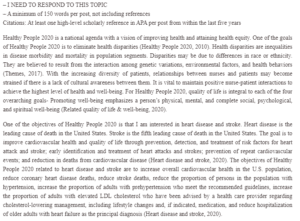
Healthy People 2020 is a national agenda that aims to improve health and attain health equity. One of the goals of Healthy People 2020 is to eliminate health disparities (Healthy People 2020, 2010). Health disparities are inequalities in disease morbidity and mortality in population segments. Disparities may be due to differences in race or ethnicity. They are believed to result from the interaction among genetic variations, environmental factors, and health behaviors (Themes, 2017). With the increasing diversity of patients, relationships between nurses and patients may become strained if there is a lack of cultural awareness between them. It is vital to maintain positive nurse-patient interactions to achieve the highest level of health and well-being. For Healthy People 2020, quality of life is integral to the four overarching goals- Promoting well-being emphasizes a person’s physical, mental, and complete social, psychological, and spiritual well-being (Related quality of life & well-being, 2020).
One of the objectives of Healthy People 2020 is that I am interested in heart disease and stroke. Heart disease is the leading cause of death in the United States. Stroke is the fifth leading cause of death in the United States. The goal is to improve cardiovascular health and quality of life through prevention, detection, and treatment of risk factors for heart attack and stroke; early identification and treatment of heart attacks and strokes; prevention of repeat cardiovascular events; and reduction in deaths from cardiovascular disease (Heart disease and stroke, 2020). The objectives of Healthy People 2020 related to heart disease and stroke are to increase overall cardiovascular health in the U.S. population, reduce coronary heart disease deaths, reduce stroke deaths, reduce the proportion of persons in the population with hypertension, increase the proportion of adults with prehypertension who meet the recommended guidelines, increase the proportion of adults with elevated LDL cholesterol who have been advised by a health care provider regarding cholesterol-lowering management, including lifestyle changes and, if indicated, medication, and reduce hospitalization of older adults with heart failure as the principal diagnosis (Heart disease and stroke, 2020).
However, healthy People 2020 will positively affect patient care because we can teach people about leading modifiable (controllable) and most preventable risk factors for heart disease and stroke are high blood pressure, high cholesterol, cigarette smoking, diabetes, unhealthy diet, and physical inactivity, and overweight and obesity. This program will also help to identify cofactors that affect cardiovascular health, such as maternal and child health, access to educational opportunities, availability of healthy foods, physical education, opportunities for physical activity, including safe and walkable communities, access to healthy foods, quality of working conditions, and access to affordable, quality health care (Heart disease and stroke, 2020).
As APRNs or nurse practitioners, while serving the patient community, we can assess the prevalence of risk factors for heart disease, access to treatment, appropriate and timely treatment, treatment outcomes, and mortality (Heart Disease and Stroke, 2020). NPs are unique because they use select skills from medicine and advanced nursing skills that may result in more significant benefits to patients and the healthcare system. Benefits may include decreased costs, increased patient engagement with their care, and improved quality of life. NPs educate and promote prevention services based on evidence-based guidance to reduce the risk and rate of stroke. Educating patients, especially those in high-risk groups, on the importance of stroke prevention and knowing the warning signs is critical to getting early, time-sensitive treatment and improved outcomes. So, NPS must educate people to keep their blood pressure, cholesterol, and blood sugar levels within healthy ranges. Exercise regularly and maintain a healthy weight. Do not smoke, consume alcohol, or use illegal drugs. If you have been diagnosed with heart disease, follow your doctor’s instructions carefully (2020).
References
Heart disease and stroke. (2020). Retrieved March 15, 2021, from https://www.healthypeople.gov/2020/topics-objectives/topic/heart-disease-and-stroke
Nurse practitioner CE for World Stroke Day. (2020). Retrieved March 16, 2021, from https://www.aanp.org/news-feed/nurse-practitioner-ce-for-world-stroke-day
Related quality of life & well-being. (2020). Retrieved March 15, 2021, from https://www.healthypeople.gov/2020/topics-objectives/topic/health-related-quality-of-life-well-being
Themes, U. (2017). Cultural and spiritual awareness. Retrieved March 15, 2021, from https://nursekey.com/cultural-and-spiritual-awareness/
 Complete the order form and upload all of your files, including any instructions, rubrics, or other materials provided by your instructor.
 Complete the order payment after filling in the order form. We’ll receive your order and assign it to a writer.
 The assigned writer will complete your paper and forward it to our Editing Team for review and approval.
 Once approved by the editor, the completed paper will be uploaded to your account for you to download, review and approve.