
Response to Cultural Competence in Healthcare
I like the perspective that your discussion provides regarding cultural sensitivity and competence. Culture is an important aspect of every human being, patient, or healthcare provider. However, as healthcare providers, we are tasked to prioritize the cultural beliefs of patients and harmonize or integrate these with the current healthcare practices and interventions. In the series New Amsterdam, Dr. Reynolds is compelled to allow the family members to perform a cultural protection practice prior to the operation of their child. In the series, the surgeon’s resistance is used to depict the importance of harmonizing the cultural beliefs of patients with current interventions. When this ritual is performed, the patient gains stability, and the doctor carries out the operation successfully (Dennis, 2019). This aspect confirms that cultural beliefs have a direct impact on patient outcomes. These beliefs affect the patient’s adherence to medication and treatment as well (Shahin, Kennedy, & Stupans, 2019).
References
Dennis, K. (Director). (2019). New Amsterdam [Motion Picture]. Retrieved from https://www.showmax.com/eng/tvseries/ttgv7lhh-new-amsterdam
Shahin, W., Kennedy, G., & Stupans, I. (2019). The impact of personal and cultural beliefs on medication adherence of patients with chronic illnesses: a systematic review. Patient Prefer Adherence, 13, 1019-1035.
ORDER A PLAGIARISM-FREE PAPER HERE
We’ll write everything from scratch
Question 
Response to Cultural Competence in Healthcare
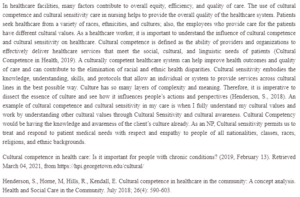
In healthcare facilities, many factors contribute to overall equity, efficiency, and quality of care. The use of cultural competence and cultural sensitivity care in nursing helps to provide the overall quality of the healthcare system. Patients seek healthcare from a variety of races, ethnicities, and cultures; also, the employees who provide care for the patients have different cultural values. As a healthcare worker, it is important to understand the influence of cultural competence and cultural sensitivity on healthcare. Cultural competence is defined as the ability of providers and organizations to effectively deliver healthcare services that meet the social, cultural, and linguistic needs of patients (Cultural Competence in Health, 2019). A culturally competent healthcare system can help improve health outcomes and quality of care and can contribute to the elimination of racial and ethnic health disparities. Cultural sensitivity embodies the knowledge, understanding, skills, and protocols that allow an individual or system to provide services across cultural lines in the best possible way. Culture has so many layers of complexity and meaning. Therefore, it is imperative to dissect the essence of culture and see how it influences people’s actions and perspectives (Henderson, S., 2018). An example of cultural competence and cultural sensitivity in my care is when I fully understand my cultural values and work by understanding other cultural values through Cultural Sensitivity and cultural awareness. Cultural Competency would be having the knowledge and awareness of the client’s culture already. As an NP, Cultural sensitivity permits us to treat and respond to patient medical needs with respect and empathy to people of all nationalities, classes, races, religions, and ethnic backgrounds.
Cultural competence in health care: Is it important for people with chronic conditions? (2019, February 13). Retrieved March 04, 2021, from https://hpi.georgetown.edu/cultural/
Henderson, S., Horne, M, Hills, R., Kendall, E. Cultural competence in healthcare in the community: A concept analysis. Health and Social Care in the Community. July 2018; 26(4): 590-603.
 Complete the order form and upload all of your files, including any instructions, rubrics, or other materials provided by your instructor.
 Complete the order payment after filling in the order form. We’ll receive your order and assign it to a writer.
 The assigned writer will complete your paper and forward it to our Editing Team for review and approval.
 Once approved by the editor, the completed paper will be uploaded to your account for you to download, review and approve.