
Religious Landscape
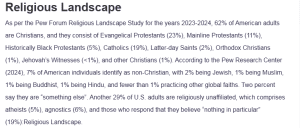
As per the Pew Forum Religious Landscape Study for the years 2023-2024, 62% of American adults are Christians, and they consist of Evangelical Protestants (23%), Mainline Protestants (11%), Historically Black Protestants (5%), Catholics (19%), Latter-day Saints (2%), Orthodox Christians (1%), Jehovah’s Witnesses (<1%), and other Christians (1%). According to the Pew Research Center (2024), 7% of American individuals identify as non-Christian, with 2% being Jewish, 1% being Muslim, 1% being Buddhist, 1% being Hindu, and fewer than 1% practicing other global faiths. Two percent say they are “something else”. Another 29% of U.S. adults are religiously unaffiliated, which comprises atheists (5%), agnostics (6%), and those who respond that they believe “nothing in particular” (19%):Religious Landscape.
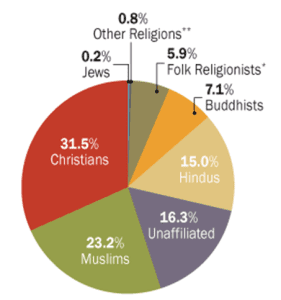
Eighty-four percent of people worldwide identify as religious, making up 5.8 billion of the 6.9 billion people on the planet in 2010, according to the Pew Forum’s Global Religious Landscape survey. The world’s population is composed of 32% Christians, twenty-three percent Muslims, fifteen percent Hindus, 7% Buddhists, and 0.2% Jews. Less than 1% of people worldwide practice other religions, such as Baha’i, Sikhism, Shintoism, and Zoroastrianism, while 6% follow folk or traditional religions.
The religious unaffiliated, which consists of atheists, agnostics, and those without a specific religious identification, comprise 16% of the world population, making them the third-largest group of people on the globe (Pew Research Center, 2012). These groups of religion are unevenly distributed across the globe, with a majority concentrated within the Asia-Pacific region, while Christians are the most widely distributed globally.
While Florida, my home state, is largely Christian, with 64% of residents identifying as Christian, several religious minorities add to the state’s cultural and religious diversity. The largest religious minority, based on the Pew Forum religious statistics, is Judaism, which comprises 3% of Florida’s adult population. In comparison, other religious minorities are Buddhism at 2%, Islam at 1%, and Hinduism at 1%. As a Gainesville resident, I have had the privilege of getting to know people from the Jewish population at interdenominational events and cultural programs that regularly showcase the rich religious diversity within the state.
References
Pew Research Center. (2012, December 18). The Global Religious Landscape. Pew Research Center’s Religion & Public Life Project; Pew Research Center. https://www.pewresearch.org/religion/2012/12/18/global-religious-landscape-exec/
Pew Research Center. (2024). U.S. adults | Religious Landscape Study. Pew Research Center. https://www.pewresearch.org/religious-landscape-study/region/united-states/
ORDER A PLAGIARISM-FREE PAPER HERE
We’ll write everything from scratch
Question 
NO AI USE AT ALL:
Explore the Pew Forum Religious Landscape report at http://www.pewforum.org/
- What percentage of adults in the United States are Christian?
- What percentage of adults in the U.S. are members of non-Christian faiths?
religions pie chart
Religious Landscape
Explore the Pew Forum Global Religious Landscape report at http://www.pewforum.org/2012/
- What are the largest religious groups in the world?
- What percentage of the population of the world is religious?
Even though the U.S. is mostly Christian, it is also home to a diverse array of religious minorities. Locate religious demographics for your home state or country. What is the largest minority religion in your home state or country? Do you happen to know any members of the minority group? Share your answers with peers via discussion.
Note:
- The client is from Gainesville, Florida
 Complete the order form and upload all of your files, including any instructions, rubrics, or other materials provided by your instructor.
  Complete the order payment after filling in the order form. We’ll receive your order and assign it to a writer.
 The assigned writer will complete your paper and forward it to our Editing Team for review and approval.
 Once approved by the editor, the completed paper will be uploaded to your account for you to download, review and approve.