
Religion and Spirituality in Healthcare
Sally,
Thank you for sharing your post. The advances in technology in the past century have tended to alter the focus of medicine from caring and service-oriented to care-oriented and technological. Technology has resulted in passages that are pretty phenomenal and have made prolonging life a reality. However, in the last few decades, healthcare professionals have made attempts at balancing their care through the reclamation of medicine’s spiritual foundation by recognizing that before modern times, spirituality was most times related to healthcare. Compassionate or spiritual care involves serving the entire person spiritually, socially, emotionally, and physically. This service is inherently spiritual (Timmins & Caldeira, 2019).
One of the challenges physicians face is helping people find meaning and accepting their health situation amid pain and suffering. Spirituality and religion form the foundation of purpose and meaning for many people. Similarly, while patients try to come to terms with the disease and its physical aspects, they must also deal with other pain. This kind of pain is related to spiritual and mental suffering, to an inability of the patient to engage in life’s most profound questions. A patient may ask numerous questions, including, “What happens to me after death comes knocking?” Why is this happening to me? If God is alive, why is He unfair to me? Have I wronged God in any way, and if so, can He forgive and heal me? With the time left, will I manage to do all that is pending in my life? Will anyone miss me? How will people remember me after I am gone? True healing will call for the healthcare practitioner to have answers to these and many other questions (Zaidi, 2018).
References
Timmins, F., & Caldeira, S. (Eds.). (2019). Spirituality in healthcare: perspectives for innovative practice. Springer.
Zaidi, D. (2018). Influences of religion and spirituality in medicine. AMA Journal of Ethics, 20(7), E609-612.
ORDER A PLAGIARISM-FREE PAPER HERE
We’ll write everything from scratch
Question 
I NEED TO RESPOND TO THIS
– A minimum of 150 words per post, not including references
Citations: At least one high-level scholarly reference in APA per post from within the last five years
Religion and Spirituality in Healthcare
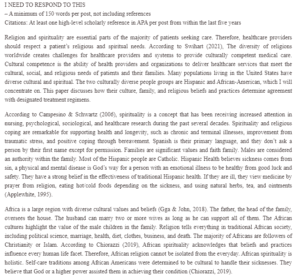
Religion and spirituality are essential parts of the majority of patients seeking care. Therefore, healthcare providers should respect a patient’s religious and spiritual needs. According to Swihart (2021), The diversity of religions worldwide creates challenges for healthcare providers and systems to provide culturally competent medical care. Cultural competence is the ability of health providers and organizations to deliver healthcare services that meet the cultural, social, and religious needs of patients and their families. Many populations living in the United States have diverse cultural and spiritual. The two culturally diverse people groups are Hispanic and African-American, which I will concentrate on. This paper discusses how their culture, family, and religious beliefs and practices determine agreement with designated treatment regimens.
According to Campesino & Schwartz (2006), spirituality is a concept that has been receiving increased attention in nursing, psychological, sociological, and healthcare research during the past several decades. Spirituality and religious coping are remarkable for supporting health and longevity, such as chronic and terminal illnesses, improvement from traumatic stress, and positive coping through bereavement. Spanish is their primary language, and they don’t ask a person by their first name except for permission. Families are significant values and faith family. Males are considered an authority within the family. Most of the Hispanic people are Catholic. Hispanic Health believes sickness comes from sin, a physical and mental disease is God’s way for a person with an emotional illness to be healthy from good luck and safety. They have a strong belief in the effectiveness of traditional Hispanic health. If they are ill, they view medicine by prayer from religion, eating hot/cold foods depending on the sickness, and using natural herbs, tea, and ointments (Applewhite, 1995).
Africa is a large region with diverse cultural values and beliefs (Gga & John, 2018). The father, the head of the family, oversees the house. The husband can marry two or more wives as long as he can support all of them. The African cultures highlight the value of the male children in the family. Religion tells everything in traditional African society, including political science, marriage, health, diet, clothes, business, and death. The majority of Africans are followers of Christianity or Islam. According to Chiorazzi (2019), African spirituality acknowledges that beliefs and practices influence every human life facet. Therefore, African religion cannot be isolated from the everyday. African spirituality is holistic. Self-care traditions among African Americans were determined to be cultural to handle their sicknesses. They believe that God or a higher power assisted them in achieving their condition (Chiorazzi, 2019).
References
Applewhite, S. L. (1995). Curanderismo: Demystifying the health beliefs and practices of elderly Mexican Americans. Health & Social Work, 20(4), 247-53. Retrieved from https://search.proquest.com/docview/210559219?accountid=34574
Campesino, M., & Schwartz, G. E. (2006). Spirituality among Latinas/os: implications of culture in conceptualization and measurement. ANS. Advances in nursing science, 29(1), 69–81. https://doi.org/10.1097/00012272-200601000-00007
Chiorazzi, A. (2019, March 22). The spirituality of Africa. Retrieved March 11, 2021, from https://news.harvard.edu/gazette/story/2015/10/the-spirituality-of-africa
Gga_ad & John O. Kakonge are presidents of the Association of Former International Civil Servants of the United Nations (AFICS) in Kenya. He has served as Kenya’s Ambassador and Permanent Representative to the UN in Geneva. Previously. (2018, October 01). The role of culture in Africa’s development. Retrieved March 11, 2021, from https://gga.org/the-role-of-culture-in-africas-development/
Swihart DL, Yarrarapu SNS, Martin RL. Cultural Religious Competence In Clinical Practice. 2021 January 05. In: StatPearls [Internet]. Treasure Island (FL): StatPearls Publishing; 2021 Jan–. PMID: 29630268.
 Complete the order form and upload all of your files, including any instructions, rubrics, or other materials provided by your instructor.
 Complete the order payment after filling in the order form. We’ll receive your order and assign it to a writer.
 The assigned writer will complete your paper and forward it to our Editing Team for review and approval.
 Once approved by the editor, the completed paper will be uploaded to your account for you to download, review and approve.