
Question Development Tool
Appendix B
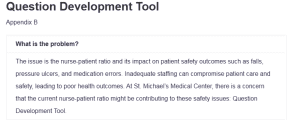
| What is the problem? | |
| The issue is the nurse-patient ratio and its impact on patient safety outcomes such as falls, pressure ulcers, and medication errors. Inadequate staffing can compromise patient care and safety, leading to poor health outcomes. At St. Michael’s Medical Center, there is a concern that the current nurse-patient ratio might be contributing to these safety issues: Question Development Tool. | |
| What are the data and sources of information that validate the problem? | |
|
☒Safety and risk management concerns: Internal incident reports have shown frequent occurrences of falls and medication errors, particularly during shifts with low nurse staffing. ☒Data: Hospital audit data from St. Michael’s Medical Center indicates higher patient safety event rates in units with higher nurse-to-patient ratios. ☐Financial information: ☒Lack of evidence for current practice: The current nurse-patient ratio policy is not based on recent evidence or national benchmarks for optimal staffing. ☒Quality indicators: Data showing that patients in units with higher nurse-patient ratios experience fewer adverse events. ☒Practice observations: Nurses and charge nurses have consistently reported being overextended, especially during night and weekend shifts, contributing to delays in care and errors. ☐Other: |
|
| Why is the problem essential and relevant? What would happen if it were not addressed? | |
| This issue is critical because inadequate nurse-patient ratios can negatively impact patient safety and the quality of care provided. If not addressed, it could result in an increase in patient harm, such as falls, pressure ulcers, medication errors, a decrease in patient satisfaction, and higher costs due to prolonged hospital stays and more frequent adverse events. In the long term, it could lead to a deterioration of the hospital’s reputation, and legal implications may arise due to safety violations. | |
| What is the current practice? | |
| Current practice involves standard nurse-patient ratios that may not fully meet the needs of patients in certain units. During peak hours or in high-acuity areas, the ratio is stretched, making it harder for nurses to provide high-quality, timely care. Balancing staffing resources with patient demand is an ongoing challenge. | |
| Is this a background question to establish the state of the evidence on a topic (with no comparison group) or a foreground question to compare specific interventions? | |
| ☐Background | ☒ Foreground |
| What are the PICO components? | |
| P (patient, population, or problem): Adult patients in acute care settings at St. Michael’s Medical Center.
I (intervention): Implementation of improved nurse-patient ratios (e.g., one nurse per four patients or lower depending on acuity level).
C (comparison with other interventions if foreground question): Existing standard nurse-patient ratios (e.g., one nurse per six or more patients as currently practiced).
O (outcomes): Reduction in patient safety incidents such as falls, pressure ulcers, and medication errors; improved overall patient safety indicators. |
|
| Initial EBP question: | |
| In adult patients in acute care settings at St. Michael’s Medical Center, how does improving nurse-patient ratios compared to current practice affect patient safety outcomes (such as falls, pressure ulcers, and medication errors) over a 6-month period? | |
| List possible search terms for each part of the PICO question: | ||
| PICO Element | Possible Search Terms | |
|
P |
“adult patients”
“acute care settings” “hospitalized patients” “nurse-patient ratio” |
|
|
I |
“improved nurse-patient ratio”
“nurse staffing levels” “optimal staffing levels” |
|
|
C |
“current nurse-patient ratio”
“standard staffing ratios” “nurse staffing practices” |
|
|
O |
“patient safety outcomes”
“falls” “pressure ulcers” “medication errors” “adverse events” “patient safety incidents” |
|
| What are preliminary inclusion and exclusion criteria (e.g., date, population, setting, other)? | ||
| Inclusion:
· Studies published within the last 5 years. · Research conducted in hospital or acute care settings. · Studies comparing nurse-patient ratios and patient safety outcomes. · Peer-reviewed publications. |
Exclusion:
· Studies not involving adult patients. · Research outside of acute care settings. · Studies older than 5 years. · Non-peer-reviewed sources.
|
|
| What evidence needs to be reviewed? (Check all that apply) | ||
|
☒Peer-reviewed publications (from databases such as PubMed, CINAHL, and Embase) ☒Standards (regulatory, professional, community) ☒Clinical Practice Guidelines ☒Organizational data (e.g., quality improvement or financial data, local clinical expertise, patient/family preferences) ☒Evidence-based professional organization position statements ☒Consensus studies (e.g., commissioned reports from the National Academy of Medicine, professional organizations, and philanthropic foundations) ☐Other |
||
| Revised EBP question: | ||
| In adult patients in acute care settings at St. Michael’s Medical Center, how does improving nurse-patient ratios compared to current practice affect patient safety outcomes (such as falls, pressure ulcers, and medication errors) over a 6-month period? | ||
| What are the measures that indicate whether the EBP project is successful? (Measures may structure, process, and/or outcome) | ||
| Structure Measures:
· Average nurse-patient ratio per shift. · Number of RNs scheduled per unit per 24-hour cycle. Process Measures: · Adherence to the new staffing policy. · Nurse-reported workload and time allocation for patient care tasks. Outcome Measures: · The rate of patient falls per 1,000 patient days is as follows: o Incidence of pressure ulcers o Number of reported medication administration errors o Patient satisfaction scores related to nursing care |
||
ORDER A PLAGIARISM-FREE PAPER HERE
We’ll write everything from scratch
Question 
LITERATURE REVIEW
This week, you will begin a Literature Review Assignment, which will be due Day 7 of Week 10. For this three-part Assignment, you will search for evidence using the tools that are part of the Johns Hopkins Translation of Evidence Model.
Note: This is a three-part Assignment. By Day 7 of Week 10, you must complete and submit Appendices B, G, and H found in the Dang et.al. text.To Prepare
Question Development Tool
- Review the Literature Review Assignment resources located in this week’s Learning Resources. Pay special attention to Chapters 19, 20, and 21 of the White et al. text; Chapters 4, 5, 6, and 11 of the Dang et al. text; and the articles addressing the PICOT format.
- Note: Be sure to review Appendices B, E, F, G, and H in the Dang et al. text. You will be required to complete and submit Appendices B, G, and H for this Assignment.
- Select an organization with which you are familiar and a practice or organization issue which needs addressing.
- Note: You may reuse organizations and/or issues that you selected earlier in this course or select new ones.
- Consider possible practice questions to address the issue you selected. Ask yourself:
- Why is it a problem?
- What has been done about it?
- What is the gap in practice?
- Select one practice question to develop using Appendix B.
- Note: The PICOT components will assist you in identifying search terms. Make sure your practice question is evidence-based, nursing focused, and has measurable outcomes.
- Using the Walden Library, search the evidence to identify 15 or more recent peer-reviewed articles (within the past 5 years) related to your practice question.
- Note: Use Appendices E and F to help you search, but you do not need to submit these for grading.
- Using Appendix H, grade the evidence and select the 10 articles with the strongest evidence ratings.
- Note: if you have more than 10 articles that you deem worthy, you can enter up to 15 into Appendix H.
- Using Appendix H, synthesize the 10 articles you selected.
- Using Appendix G, enter all relevant information about the 10 articles you selected and synthesized.
- Note: This is a three-part Assignment. By Day 7 of Week 10, you must complete and submit Appendices B, G, and H found in the Dang et.al. text.
For this three-part Assignment, you will submit three items as follows:
- Part 1: Submit your completed Appendix B, which demonstrates your fully developed practice question.
- Part 2: Submit your completed Appendix H, which demonstrates your grading and synthesizing of the evidence you identified. Note: You will complete Appendix H before Appendix G, despite being out of order alphabetically.
- Part 3: Submit your completed Appendix G, which lists the relevant information about the evidence you selected.
 Complete the order form and upload all of your files, including any instructions, rubrics, or other materials provided by your instructor.
  Complete the order payment after filling in the order form. We’ll receive your order and assign it to a writer.
 The assigned writer will complete your paper and forward it to our Editing Team for review and approval.
 Once approved by the editor, the completed paper will be uploaded to your account for you to download, review and approve.