
Quantitative Research Designs: Correlational, Quasi-Experimental, and Experimental
Overview of Quantitative Research Designs
Three primary designs under quantitative study are linked to various aims of empirical research: correlational, quasi-experimental, and experimental designs. All of these designs have various strengths and weaknesses depending on the research context as well as their aims.
Correlational Research Design
Correlational research design analyzes the statistical connection between two or several variables without altering any variables. This design tests naturally existing relations and identifies the strength and direction of associations between variables (Curtis et al., 2016). Correlational research can help find out the prevalence and relations between variables, as well as predict events based on existing data and information.
When to Use
Correlational designs are appropriate when researchers want to explore relationships between variables that cannot be ethically or practically manipulated, such as personality traits, socioeconomic status, or naturally occurring behaviors.
Advantage
Correlational research has the significant advantage of forming associations and patterns under naturally existing conditions without experimental manipulation, and as such, results have high generalizability to natural settings (Curtis et al., 2016).
Limitation
One of the limitations of correlational research is that causal relationships cannot be drawn from the results because correlational research does not indicate causation.
Research Question Example
What is the relationship between student anxiety levels and academic performance in undergraduate students?
Quasi-Experimental Research Design
Quasi-experimental design refers to a design where an independent variable is manipulated, but there is no random assignment to conditions. Like a true experiment, quasi-experimental design is employed for establishing cause-and-effect between an independent variable and a dependent variable (Harris et al., 2006). This is generally applied where random assignment is not possible or unethical.
When to Use
Quasi-experimental designs are used when researchers must study cause-and-effect relations but cannot assign participants to conditions because of practical, ethical, or logistical reasons.
Benefit
This design allows researchers to study causal relationships in real-world settings where true experiments would be impractical or unethical, providing greater external validity than laboratory experiments.
Limitation
Quasi-experiments also do not rule out the issue of confounding variables since the design does not entail random assignment of participants into conditions, and that compromises the internal validity (Harris et al., 2006).
Research Question Example
What is the effectiveness of a new teaching method on student achievement scores compared to traditional instruction methods?
Experimental Research Design
Experimental design for research consists of the planned manipulation of an independent variable along with controlling for confounding variables by means of random assignment of participants to conditions. This design is considered the gold standard for establishing causal relations for quantitative research.
When to Use
Experimental research designs are used when researchers require establishing definite cause-and-effect relations and can manipulate variables as well as assign participants randomly to various conditions.
Advantage
Experimental design’s main advantage is establishing causation by means of controllable manipulation and random assignment, offering high internal validity and robust support for causal inference (Biau et al., 2008).
Limitation
Experimental designs can have limited external validity because of the artificial nature of laboratory conditions, and ethical concerns can restrict the kind of variables that can be manipulated.
Research Question Example
What effect does caffeine consumption have on cognitive performance in college students?
Research Problem and Design Selection
This proposed research will discuss the particular issue of academic procrastination among graduate students and its connection to levels of stress and academic achievement. This is an area of particular concern as there are unique academic pressures that graduates have to encounter, and these could potentially play into procrastination habits.
Research Question
To what extent does academic procrastination predict stress levels and academic performance in graduate students?
Hypotheses
- H1: Higher levels of academic procrastination will predict higher stress levels in graduate students
- H2: Higher levels of academic procrastination will predict lower academic performance in graduate students
Proposed Design
A correlational design involving multiple regression analysis would suit the study best. This design choice is motivated by the fact that the research question is concerned with predictive relationships between naturally existing variables that cannot, for ethical reasons, be manipulated. This correlational design affords the possibility of studying the way academic procrastination (independent variable) predicts levels of stress and academic performance (outcome variables) in natural-world educational contexts. Multiple regression analysis will allow for the simultaneous study of the way that procrastination predicts the two outcome variables, controlling for potentially confounding variables like type of program, grade of study, and demographic variables (Biau et al., 2008).
References
Biau, D. J., Kernéis, S., & Porcher, R. (2008). Statistics in brief: the importance of sample size in the planning and interpretation of medical research. Clinical Orthopaedics and Related Research, 466(9), 2282-2288. https://doi.org/10.1007/s11999-008-0346-9
Curtis, E. A., Comiskey, C., & Dempsey, O. (2016). Importance and use of correlational research. Nurse Researcher, 23(6), 20-25. https://doi.org/10.7748/nr.2016.e1382
Harris, A. D., McGregor, J. C., Perencevich, E. N., Furuno, J. P., Zhu, J., Peterson, D. E., & Finkelstein, J. (2006). The use and interpretation of quasi-experimental studies in medical informatics. Journal of the American Medical Informatics Association, 13(1), 16-23. https://doi.org/10.1197/jamia.M1749
ORDER A PLAGIARISM-FREE PAPER HERE
We’ll write everything from scratch
Question 
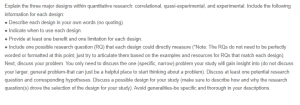
Explain the three major designs within quantitative research: correlational, quasi-experimental, and experimental. Include the following information for each design:
● Describe each design in your own words (no quoting).
Quantitative Research Designs – Correlational, Quasi-Experimental, and Experimental
● Indicate when to use each design.
● Provide at least one benefit and one limitation for each design.
● Include one possible research question (RQ) that each design could directly measure (*Note: The RQs do not need to be perfectly worded or formatted at this point; just try to articulate them based on the examples and resources for RQs that match each design).
Next, discuss your problem. You only need to discuss the one (specific, narrow) problem your study will gain insight into (do not discuss your larger, general problem-that can just be a helpful place to start thinking about a problem). Discuss at least one potential research question and corresponding hypotheses. Discuss a possible design for your study (make sure to describe how and why the research question(s) drove the selection of the design for your study). Avoid generalities-be specific and thorough in your descriptions.
 Complete the order form and upload all of your files, including any instructions, rubrics, or other materials provided by your instructor.
  Complete the order payment after filling in the order form. We’ll receive your order and assign it to a writer.
 The assigned writer will complete your paper and forward it to our Editing Team for review and approval.
 Once approved by the editor, the completed paper will be uploaded to your account for you to download, review and approve.