
Quality Healthcare-Measuring NP Performance
Quality healthcare remains one of the most quoted principles of healthcare operationalizations and has always remained an agenda in healthcare improvements and innovations. Healthcare organizations’ and providers’ performance in quality and effective healthcare is central to quality healthcare. Healthcare effectiveness data and information (HEDIS) measures performance in healthcare and outlines areas where meaningful improvements can be made to ensure significant differences in individuals’ health. Comprehensive diabetic care, under the effectiveness of care domain, is such an area in healthcare outlined by HEDIS that maintains significance in contemporary healthcare. This is because the prevalence of diabetes in the U.S remains high, and if left untreated or poorly managed, results in detrimental complications such as hypertension, chronic kidney disease, peripheral nephropathy, diabetic blindness, and others. This paper outlines patient interventions in comprehensive diabetic care, the effectiveness of these interventions in improving patient outcomes and lowering costs, and how these interventions can improve NP patient ratings.
Patient Interventions
Medication adherence
Adherence to anti-diabetic pharmacotherapy is the primary determinant of therapeutic success in patients with diabetes. Effective use of anti-diabetic medications improves the quality of life of persons with diabetes and delays diabetic complications. Therapy is often tailored to individual patients, with the primary target being to maintain a low level of HbA1c and stabilize blood sugars. Due to the chronic nature of the disease and the cost implications of managing it, adherence to anti-diabetic medications has remained a challenge to many diabetics. Mannan et al. (2021) attribute low adherence to medication among patients with diabetes to poor patient-provider relationships, pill burden, side effects, and poor access to drugs. Poor adherence to anti-diabetic medication remains a significant source of quality and safety compromise in comprehensive diabetic care, with morbidity and mortality being the consequence.
Healthcare providers play a role in ensuring proper medication adherence. Their role in this regard is to discover poor medication adherence and take measures to correct it, heightening their surveillance of the patients to ascertain their medication-taking behaviors and educating them on proper medication use. Mannion et al. (2021) highlight that fostering a robust patient-provider relationship provides a groundwork for monitoring medication-taking habits. Healthy relationships may also enhance patients’ compliance with their treatment regimen as they are more likely to follow instructions from their caregivers if they trust them. Other strategies for improving medication adherence include simplifying the medication regimens to make them understandable and using lower-priced generics for patients with constrained finances to procure medications.
Diabetic Screening and Monitoring
Diabetic screening remains a valuable health promotion and preservation program. These programs are targeted towards at-risk groups and patients with active disease to prevent detrimental health consequences of the disease. Community educational programs on diabetes are targeted at encouraging at-risk community members to screen for high blood glucose to promote early detection of the disease. This will enable the initiation of treatment and subsequently lower the propensity to develop diabetic complications. Dos Santos et al. (2020) report that the high prevalence of undiagnosed diabetics remains a viable reason for heightening community screening efforts to increase the number of people with diabetes on therapy. In the U.S. alone, roughly 7 million Americans have undiagnosed diabetes. This reinforces the significance of heightening community screening for the disease to increase the number of people with diabetes enrolled for comprehensive diabetic care.
Diabetic monitoring is another patient intervention that maintains significance in comprehensive diabetic care. These interventions are informed by the progressive nature of the disease and its propensity to cause organ damage and other complications. Patient monitoring enables the optimization of diabetes management and has been associated with optimal glycemic control. The target for diabetic monitoring is usually to ascertain glycemic control as informed by blood sugar levels and the progression of the disease as informed by the HbA1c levels (Su et al., 2019). Diabetic monitoring is valuable in informing adjustments in the medication regimen and adherence. It also enables the detection of diabetic complications. Significant in the diabetic monitoring and care continuum is eye examination to eliminate diabetic retinopathy, blood pressure control, kidney functionalities to eliminate diabetic nephropathy, and the levels of HbA1c to inform the progression of the disease and the need to optimize treatment with innovations in healthcare communication technologies such as telehealth, diabetic monitoring can be done remotely via assistive devices such as glucometers, which provide real-time glucose measurements on the patients and communicate them to healthcare providers (Andrès et al., 2019). Effective monitoring will optimize management, prolong the life of the patients, and lower their chances of developing complications.
Dieting and Physical Activity as Preventive and Management Interventions
Lifestyle modifications to enhance physical activity and diet are essential diabetic prevention and management measures. Diet and physical activity are modifiable risk factors for type 2 diabetes. Diets rich in fats and calories increase an individual’s chances of developing diabetes. Physical inactivity has also been implicated in type 2 diabetes. As a preventive measure, at-risk populations should be educated on a healthy diet and physical activity as modifiable risks for developing diabetes. Physical exercise lowers insulin resistance, HbA1c, triglycerides, and blood pressure. Regular exercising has been implicated in cardiorespiratory fitness and optimal glycemic control, underlining the need for regular exercising among patients with diabetes. They should be encouraged to eat healthy diets abundant in nutrients and low in calories. They should also be encouraged to exercise frequently to lessen their likelihood of developing the disease. A healthy diet also optimizes glycemic control by lowering blood sugar. The combined benefits of healthy dieting and physical activity as adjunctive interventions to pharmacotherapy are superior to pharmacotherapy alone in managing diabetes.
Improved Patient Outcomes
Medication adherence, patient monitoring, and early detection of diabetes are valuable patient interventions in comprehensive diabetic care and have been implicated in improved patient outcomes. Medication adherence is essential in glycemic control and optimal diabetic management. People with diabetes who adhere to their medications have a little propensity to develop diabetic complications and tend to lead a better quality of life. Additionally, medication adherence lowers hospital visitation and readmission rates. Wong et al. (2020) assert that medication adherence enables better control of chronic disorders and ensures overall long-term wellness and quality health. This highlights the need for adhering to medications for a patient with long-term illnesses such as diabetes.
Patient monitoring is another indicator of quality diabetic care. Patient monitoring improves outcomes by providing a framework for collecting and sharing patient data on blood glucose, patient response to treatment, and medication adherence. It also gives insight into interventions that can optimize their clinical outcomes. Monitoring will also enable the detection of complications before they progress further. The impact of effective patient monitoring is often evident in optimized pharmacotherapy; the resultant improvement in clinical outcomes is apparent in optimal glycemic control, treatment of complications, and enhanced patient response to therapy. This will prevent rapid deterioration in the patient’s quality of life and keep them away from the hospital.
Physical activity and diet are vital non-pharmacological interventions in comprehensive diabetic care that help improve clinical outcomes. Physical activity and healthy dieting optimize blood glucose control and enhance response to pharmacotherapy with anti-diabetic medications. Regular exercising and healthy dieting are also modifying factors for various diabetic complications such as hypertension and cerebrovascular accidents. Adjunctive use of these non-pharmacologic interventions and pharmacotherapy will improve outcomes by lessening the likelihood of developing complications and preventing hospitalizations attributable to these complications (Cannata et al., 2020). For these reasons, regular exercise and a healthy diet are recommended for people with diabetes.
Cost Savings
Medication adherence, physical exercise and dieting, and patient monitoring improve clinical outcomes by lowering the likelihood of diabetic complications, prolonging the life of individual diabetic patients, and improving their quality of life. This will impact the overall cost of healthcare for these individuals. Optimal diabetes management considerably lowers healthcare costs by eliminating extra expenses that patients would otherwise incur in treating diabetic complications. Additionally, these interventions lower hospitalization rates and the subsequent healthcare cost considerations accustomed to complications or disease exacerbations because of not adhering to their medications. Physical exercises and dieting save healthcare costs by optimizing management and eliminating costs attributable to inadequate response to pharmacotherapy. Monitoring is also valuable as it helps detect complications early enough before they progress (Murphy et al., 2019). These interventions are thus essential in healthcare cost savings.
Patient Ratings
The interventions outlined will considerably improve patient ratings of the services given to them. This is because these interventions are patient-oriented and targeted at enhancing their wellness. Educating the patients on medication adherence, physical activity, diet, and monitoring will enable them to lead a quality life and lower their chances of developing complications. This will make these patients develop a greater sense of appreciation for the care processes given to them and improve their ratings on these services. Positive engagement with the patients during the implementation of these interventions and enhanced patient experiences and clinical outcomes also strengthen their satisfaction with the treatment processes. According to Mannion et al. (2021), patient satisfaction is high when their needs are addressed and clinical outcomes are improved. The interventions outlined above will improve patient outcomes, improving their satisfaction with the care process.
Comprehensive diabetic care remains a critical HEDIS quality measurement and performance indicator. This is because of the high prevalence of the disease in the U.S. Several interventions are valuable in the comprehensive management of diabetes. Interventions such as educating the patients on medication adherence, physical exercise, diet, screening, and patient monitoring are pivotal in diabetic care as they improve the clinical outcomes of diabetic patients. These interventions lower the propensity to develop diabetic complications by optimizing glycemic control. They remain vital cost-saving strategies in diabetes management as they eliminate extra costs that would have been otherwise used in managing diabetic complications. These interventions also enhance patient satisfaction with the care processes and may improve the service rating.
References
Andrès, E., Meyer, L., Zulfiqar, A.-A., Hajjam, M., Talha, S., Bahougne, T., Ervé, S., Hajjam, J., Doucet, J., Jeandidier, N., & Hajjam El Hassani, A. (2019). Telemonitoring in diabetes: Evolution of concepts and technologies, focusing on results of the more recent studies. Journal of Medicine and Life, 12(3), 203–214. https://doi.org/10.25122/jml-2019-0006
Cannata, F., Vadalà, G., Russo, F., Papalia, R., Napoli, N., & Pozzilli, P. (2020). Beneficial effects of physical activity in diabetic patients. Journal of Functional Morphology and Kinesiology, 5(3), 70. https://doi.org/10.3390/jfmk5030070
dos Santos, E. S., Máximo, R. de, de Andrade, F. B., de Oliveira, C., Lima-Costa, M. F., & Alexandre, T. da. (2020). Differences in the prevalence of prediabetes, undiagnosed diabetes, and diagnosed diabetes and associated factors in cohorts of Brazilian and English older adults. Public Health Nutrition, 24(13), 4187–4194. https://doi.org/10.1017/s1368980020003201
Mannan, A., Hasan, M. M., Akter, F., Rana, M. M., Chowdhury, N. A., Rawal, L. B., & Biswas, T. (2021). Factors associated with low adherence to medication among patients with type 2 diabetes at different healthcare facilities in southern Bangladesh. Global Health Action, 14(1). https://doi.org/10.1080/16549716.2021.1872895
Mannion, S. E., Staab, E. M., Li, J., Benitez, A., Wan, W., Campbell, A., Schaefer, C. T., Quinn, M. T., & Baig, A. A. (2021). Patient and clinician satisfaction with diabetes group visits in Community Health Centers. Journal of Patient Experience, 8, 237437352110564. https://doi.org/10.1177/23743735211056467
Murphy, H. R., Feig, D. S., Sanchez, J. J., de Portu, S., & Sale, A. (2019). Modeling potential cost savings from the use of real‐time continuous glucose monitoring in pregnant women with type 1 diabetes. Diabetic Medicine, 36(12), 1652–1658. https://doi.org/10.1111/dme.14046
Su, D., Michaud, T. L., Estabrooks, P., Schwab, R. J., Eiland, L. A., Hansen, G., DeVany, M., Zhang, D., Li, Y., Pagán, J. A., & Siahpush, M. (2019). Diabetes management through remote patient monitoring: The importance of patient activation and engagement with the technology. Telemedicine and e-Health, 25(10), 952–959. https://doi.org/10.1089/tmj.2018.0205
Wong, Z. S. Y., Siy, B., Da Silva Lopes, K., & Georgiou, A. (2020). Improving patients’ medication adherence and outcomes in nonhospital settings through eHealth: Systematic review of Randomized Controlled Trials. Journal of Medical Internet Research, 22(8). https://doi.org/10.2196/17015
ORDER A PLAGIARISM-FREE PAPER HERE
We’ll write everything from scratch
Question 
This assignment aims to have students research the measurement tools of NP performance. Through the use of quality patient outcomes, students will list and discuss three different patient interventions, how they would specifically measure the outcomes, and how these primary care interventions result in improved patient outcomes and cost savings for the practice. In addition, students will discuss how these interventions improve patient ratings.
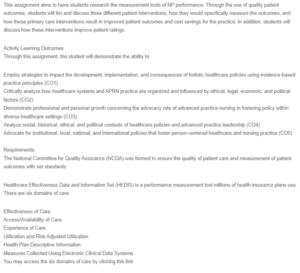
Quality Healthcare-Measuring NP Performance
Activity Learning Outcomes
Through this assignment, the student will demonstrate the ability to:
Employ strategies to impact the development, implementation, and consequences of holistic healthcare policies using evidence-based practice principles (CO1)
Critically analyze how healthcare systems and APRN practice are organized and influenced by ethical, legal, economic, and political factors (CO2)
Demonstrate professional and personal growth concerning the advocacy role of advanced practice nursing in fostering policy within diverse healthcare settings (CO3)
Analyze social, historical, ethical, and political contexts of healthcare policies and advanced practice leadership (CO4)
Advocate for institutional, local, national, and international policies that foster person-centered healthcare and nursing practice (CO5)
Requirements:
The National Committee for Quality Assurance (NCQA) was formed to ensure the quality of patient care and measurement of patient outcomes with set standards.
Healthcare Effectiveness Data and Information Set (HEDIS) is a performance measurement tool millions of health insurance plans use. There are six domains of care:
Effectiveness of Care.
Access/Availability of Care.
Experience of Care.
Utilization and Risk Adjusted Utilization.
Health Plan Descriptive Information.
Measures Collected Using Electronic Clinical Data Systems
You may access the six domains of care by clicking this link:
(NCQA, n.d. https://www.ncqa.org/hedis/Links to an external site.)
As an APN, productivity will be essential for the practice to determine reimbursement and salary. Fee-for-service practices will require a set number of daily patients to maintain productivity. A capitated practice will need the APN to have a large panel of patients and focus on controlling costs. This can be accomplished through effective primary care that is accessible and convenient for the patients and has a method of measuring the quality of care.
Write a formal paper in APA format with a title page, introduction, the three required elements below, conclusion, and reference page.
You are now employed as an NP in primary care. Choose one performance measure from one of the six domains of care, i.e., Adult BMI Assessment, Prenatal and Postpartum care, etc.
Develop three different patient interventions for that one performance measure and how you would specifically implement the intervention and measure the outcomes for that particular performance measure in clinical practice.
How would these primary care interventions improve patient outcomes and healthcare cost savings?
How can these interventions result in improved NP patient ratings?
 Complete the order form and upload all of your files, including any instructions, rubrics, or other materials provided by your instructor.
 Complete the order payment after filling in the order form. We’ll receive your order and assign it to a writer.
 The assigned writer will complete your paper and forward it to our Editing Team for review and approval.
 Once approved by the editor, the completed paper will be uploaded to your account for you to download, review and approve.