
Psychological Tests Analysis
Ms. Z, an African American woman aged thirty-five, came for a psychiatric assessment after being hospitalized for a recent suicide attempt and having a history of chronic depression. Despite electroconvulsive therapy and antidepressant drugs, depressive symptoms have remained. She has had a history of mood swings that started at age 18 and is now coping in her career as an office administrator, with the help of her husband. Ms. Z wonders whether going to college and getting her bachelor’s degree is possible for her, and she would appreciate more details about her psychological profile. She took two tests during her testing: the Wechsler Adult Intelligence Scale – Fourth Edition (WAIS-IV) to assess cognition and the Minnesota Multiphasic Personality Inventory – 2 (MMPI-2) to screen for psychological and emotional problems.
Test and Assessment Development Analysis
Test One: WAIS-IV
A certified examiner administers the WAIS-IV one-on-one in a quiet, distraction-free environment, and it usually takes sixty to ninety minutes to complete. It has ten normative subtests across four indexes: Verbal Comprehension, Perceptual Reasoning, Working Memory, and Processing Speed. The clinician uses standard instructions, and the response is immediately scored following administration to allow for accuracy (Sullivan et al., 2021). Rapport, pacing, and test-fatigue monitoring are critical to obtain valid scores.
A stratified sample of two thousand and two hundred people from the 2005 US Census, ranging in age from sixteen to ninety, served as the basis for standardizing the WAIS-IV, with representation in age, gender, race, educational attainment, and geographical location. The test can be used with diverse groups, including individuals with clinical disorders, with the caveat that scores are not to be interpreted without caution among the emotionally disturbed (Nielsen & Staios, 2023). Ms. Z’s scores reflect average intelligence (FSIQ = 102), with relative strength in Perceptual Reasoning and mild weakness in Working Memory.
This test generates a total IQ score and index scores for different areas of cognition. These may also provide insight into problem-solving, concentration, memory, and language. The WAIS-IV states in Ms. Z that she has intellectual functioning to perform well in school, though her lower The working memory index (WMI = 92) can indicate a lack of concentration under pressure. WAIS-IV is quite valid and dependable. For indices, internal consistency varies from.88 to.98, while test-retest reliability extends from.82 to.94, depending on the subtest. Validity studies have established its use in clinical and school settings, aligning with contemporary intelligence theories. Although it has numerous positive aspects, the test may be impacted by cultural, socioeconomic, or affective variables.
Test Two: MMPI-2
Usually given on paper or by computer, the MMPI-2 is a standardized self-report questionnaire that takes 60 to 90 minutes to complete. The 567 true-false items make up the MMPI-2, which is used to evaluate psychopathology and personality traits (Floyd & Gupta, 2023). MMPI-2 reading proficiency is approximately eighth grade, and the test is scored using standard software to generate clinical and content scale profiles.
A representative sample of 2,600 adults was used to standardize the MMPI-2, which was adjusted for gender, age, and race. While it has been normed in numerous clinical populations, cultural factors are still required, even in minority group interpretations (Joo & Liu, 2020). Ms. Z’s profile showed clinically significant scores on Depression (D = 112), Psychasthenia (PT = 86), and Schizophrenia (SC = 90), suggesting severe emotional disturbance and likely cognitive disorganization.
The MMPI-2 yields clinical, validity, and content scores on scales that enable clinicians to diagnose psychopathology and understand emotional functioning. The elevated Depression and Social Discomfort scores of Ms. Z indicate a profound depressive state, further supporting the referral basis. The MMPI-2 has strong psychometric functions. Test-retest reliability ranges from .60 to .90, with excellent internal consistency in central scales (Floyd & Gupta, 2023). The test is valid and reliable in various populations, although clinical consideration is necessary regarding cultural background and response styles, particularly in minority populations.
References
Floyd, A. E., & Gupta, V. (2023, April 24). Minnesota multiphasic personality inventory. PubMed; StatPearls Publishing. https://www.ncbi.nlm.nih.gov/books/NBK557525/
Joo, J. Y., & Liu, M. F. (2020). Culturally tailored interventions for ethnic minorities: A scoping review. Nursing Open, 8(5), 2078–2090. https://doi.org/10.1002/nop2.733
Nielsen, T. R., & Staios, M. (2023). Clinical utility of WAIS-IV matrix reasoning among adult low educated recent immigrants; A note of caution. Archives of Clinical Neuropsychology. https://doi.org/10.1093/arclin/acad006
Sullivan, A., Ridley, N., Monds, L. A., Logge, W., Hurzeler, T., & Morley, K. C. (2021). Assessing the validity of the Wechsler Adult Intelligence Scale (WAIS-IV) in predicting completion in a long-term residential rehabilitation for substance use problems. Applied Neuropsychology: Adult, 1–6. https://doi.org/10.1080/23279095.2021.1967954
ORDER A PLAGIARISM-FREE PAPER HERE
We’ll write everything from scratch
Question 
Psychological Tests Analysis
Overview
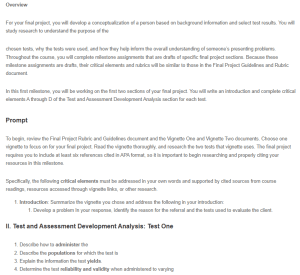
For your final project, you will develop a conceptualization of a person based on background information and select test results. You will study research to understand the purpose of the chosen tests, why the tests were used, and how they help inform the overall understanding of someone’s presenting problems. Throughout the course, you will complete milestone assignments that are drafts of specific final project sections. Because these milestone assignments are drafts, their critical elements and rubrics will be similar to those in the Final Project Guidelines and Rubric document.
Psychological Tests Analysis
In this first milestone, you will be working on the first two sections of your final project. You will write an introduction and complete critical elements A through D of the Test and Assessment Development Analysis section for each test.
Prompt
To begin, review the Final Project Rubric and Guidelines document and the Vignette One and Vignette Two documents. Choose one vignette to focus on for your final project. Read the vignette thoroughly, and research the two tests that vignette uses. The final project requires you to include at least six references cited in APA format, so it is important to begin researching and properly citing your resources in this milestone.
Specifically, the following critical elements must be addressed in your own words and supported by cited sources from course readings, resources accessed through vignette links, or other research.
- Introduction: Summarize the vignette you chose and address the following in your introduction:
- Develop a problem In your response, identify the reason for the referral and the tests used to evaluate the client.
II. Test and Assessment Development Analysis: Test One
- Describe how to administer the
- Describe the populations for which the test is
- Explain the information the test yields.
- Determine the test reliability and validity when administered to varying
III. Test and Assessment Development Analysis: Test Two
- Describe how to administer the
- Describe the populations for which the test is
- Explain the information the test yields.
- Determine the test’s reliability and validity when administered to varying
 Complete the order form and upload all of your files, including any instructions, rubrics, or other materials provided by your instructor.
  Complete the order payment after filling in the order form. We’ll receive your order and assign it to a writer.
 The assigned writer will complete your paper and forward it to our Editing Team for review and approval.
 Once approved by the editor, the completed paper will be uploaded to your account for you to download, review and approve.