
Protected Health Information Privacy, Security, Confidentiality Best Practices
Protected Health Information (PHI)
PHI means any information connected with health-related information that can be used in the identification of a person and is received, created, transmitted, or maintained by a healthcare provider. These are names, addresses, medical diagnoses, treatment plans, photos, and billing information. PHI is legally protected under the Health Insurance Portability and Accountability Act (HIPAA), and healthcare workers must uphold its privacy and security. PHI is particularly delicate in mental health and rehabilitation facilities because of the stigma that usually surrounds behavioral health and substance use disorders. HIPAA violations may occur even with informal internet posts or individual stories disclosed online (Isola & Al Khalili, 2023). The HIPAA Privacy Rule regulates the legitimate use and sharing of PHI. In addition, this rule requires the implementation of due administrative, physical, and technical safeguards for electronically supportable health information.
Privacy, Security, and Confidentiality
Privacy, security, and confidentiality are pillars in healthcare settings when it comes to protecting PHI.
- Privacy enables patients to exercise control over who has access to their health information. For example, a patient can decide to give select providers access to their mental health records.
- Security refers to the measures, such as encrypted software, secure logins, and firewalls, employed to prevent unauthorized access to data.
- Confidentiality entails the duty of healthcare professionals to ensure that information about a patient does not leak out.
Technology poses new risks such as sharing the content of therapy sessions on non-secure apps or leaving clinical systems open on unattended workstations (Mensah et al., 2024). Even social media posts providing unclear details about a patient’s recovery process can be traced back, and that is a violation. In other facilities where digital communication is part of the process, not logging out of devices or being negligent when using shared systems can easily put PHI at risk.
Importance of Interdisciplinary Collaboration to Safeguard ePHI
The security of PHI, particularly electronic protected health information (ePHI), requires a collaborative effort among an interdisciplinary team, including therapists, nurses, physicians, administrators, IT personnel, and case managers. In psychiatric facilities, cooperation means that only those with direct interaction with the patient can access PHI. For example, IT specialists collaborate with clinical teams to implement access-by-role in electronic health records, ensuring that only authorized staff can view or modify data. The administrative teams assist in setting up secure communication protocols, whereas clinical staff also participate in team training regarding HIPAA compliance (Alrasheeday et al., 2023). By understanding their responsibilities, the facility is positioned to take a high-powered, proactive approach to protecting PHI. Huddles among an interdisciplinary team and collective reporting tools encourage a timely detection of risks and enhance interdepartmental accountability.
Social Media Usage and PHI
- Termination Cases
- In 2015, a New York nurse lost her job after she uploaded a picture of a trauma room to Instagram, even though no patient appeared in the picture, as the identifiable trauma room meant a breach of HIPAA.
- In Texas, a nurse lost their job following the sharing of pediatric immunization records on Facebook, which revealed PHI against policy and trust (Amod, 2024).
- Organizational Sanctions
- The reactive disciplinary measures applied in facilities include transformative retraining, suspension, and termination. Some healthcare workers have had their professional licenses revoked due to infractions of digital conduct policies (Shojaei et al., 2024).
- Financial Penalties
-
- HHS notes that healthcare organizations have been fined between $100,000 and $4 million for disclosing PHI on social media (American Medical Association, n.d.). In several incidents, organizations have been fined for security failures related to the mishandling of sensitive or confidential patient content by employees sharing patient content to reduce breaches.
-
Evidence-Based Strategies to Reduce Breaches
- Implementing mandatory annual HIPAA and digital conduct training tailored to mental health scenarios (Mohr et al., 2025).
- Restricting the use of personal smartphones in patient care and counseling areas.
- Using centralized, encrypted communication platforms like Microsoft Teams or TigerConnect.
- Establishing and promoting anonymous reporting systems for suspected or observed privacy violations.
- Including real-life disciplinary case studies in training sessions to reinforce the consequences of improper conduct.
References
Alrasheeday, A. M., Alshammari, B., Alkubati, S. A., Pasay-an, E., Albloushi, M., & Alshammari, A. M. (2023). Nurses’ attitudes and factors affecting use of electronic health record in Saudi Arabia. Healthcare, 11(17), 2393. https://doi.org/10.3390/healthcare11172393
American Medical Association. (n.d.). HIPAA violations & enforcement. American Medical Association. https://www.ama-assn.org/practice-management/hipaa/hipaa-violations-enforcement
Amod, F. (2024, December 4). Social media HIPAA violations: Texas Hospital vaccination controversy. HIPAA Times. https://hipaatimes.com/social-media-hipaa-violations-texas-hospital-vaccination-controversy
Isola, S., & Al Khalili, Y. (2023). Protected health information. PubMed; StatPearls Publishing. https://www.ncbi.nlm.nih.gov/books/NBK553131/
Mensah, N. K., Adzakpah, G., Kissi, J., Taylor-Abdulai, H., Johnson, S. B., Agbeshie, P. A., Opoku, C., Abakah, J., Osei, E., Agyekum, A. Y., & Boadu, R. O. (2024). Health professionals’ ethical, security, and patient safety concerns using digital health technologies: A mixed method research study. Health Services Insights, 17. https://doi.org/10.1177/11786329241303379
Mohr, D. C., Silverman, A. L., Youn, S. J., Areán, P., Bertagnolli, A., Carl, J., Carlton, T., Chaudhary, N., Cooper, D., DeVito, S., Eaneff, S., Flom, M., Forman-Hoffman, V. L., Fortunato, L., Franchino, K., Graham, A. K., Greenberger, H., Hauflaire, J., Kaveladze, B., & Kornfield, R. (2025). Digital mental health treatment implementation playbook: Successful practices from implementation experiences in American healthcare organizations. Frontiers in Digital Health, 7. https://doi.org/10.3389/fdgth.2025.1509387
Shojaei, P., Vlahu-Gjorgievska, E., & Chow, Y.-W. (2024). Security and privacy of technologies in health information systems: A systematic literature review. Computers, 13(2), 41. https://doi.org/10.3390/computers13020041
ORDER A PLAGIARISM-FREE PAPER HERE
We’ll write everything from scratch
Question 
Protected Health Information Privacy, Security, Confidentiality Best Practices
Prepare a 2 page interprofessional staff update on HIPAA and appropriate social media use in health care.
First, select one of the health care settings described in the following resource:
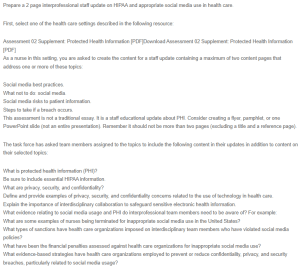
Protected Health Information Privacy, Security, Confidentiality Best Practices
Assessment 02 Supplement: Protected Health Information [PDF]Download Assessment 02 Supplement: Protected Health Information [PDF]
As a nurse in this setting, you are asked to create the content for a staff update containing a maximum of two content pages that address one or more of these topics:
Social media best practices.
What not to do: social media.
Social media risks to patient information.
Steps to take if a breach occurs.
This assessment is not a traditional essay. It is a staff educational update about PHI. Consider creating a flyer, pamphlet, or one PowerPoint slide (not an entire presentation). Remember it should not be more than two pages (excluding a title and a reference page).
The task force has asked team members assigned to the topics to include the following content in their updates in addition to content on their selected topics:
What is protected health information (PHI)?
Be sure to include essential HIPAA information.
What are privacy, security, and confidentiality?
Define and provide examples of privacy, security, and confidentiality concerns related to the use of technology in health care.
Explain the importance of interdisciplinary collaboration to safeguard sensitive electronic health information.
What evidence relating to social media usage and PHI do interprofessional team members need to be aware of? For example:
What are some examples of nurses being terminated for inappropriate social media use in the United States?
What types of sanctions have health care organizations imposed on interdisciplinary team members who have violated social media policies?
What have been the financial penalties assessed against health care organizations for inappropriate social media use?
What evidence-based strategies have health care organizations employed to prevent or reduce confidentiality, privacy, and security breaches, particularly related to social media usage?
Notes
Your staff update is limited to two double-spaced content pages. Be selective about the content you choose to include in your update so you can meet the page length requirement. Include need-to-know information. Omit nice-to-know information.
Many times people do not read staff updates, do not read them carefully, or do not read them to the end. Ensure your staff update piques staff members’ interest, highlights key points, and is easy to read. Avoid overcrowding the update with too much content.
Also, supply a separate reference page that includes two or three peer-reviewed and one or two non-peer-reviewed resources (for a total of 3–5 resources) to support the staff update content.
Written communication: Ensure the staff update is free from errors that detract from the overall message.
Submission length: Maximum of two double-spaced content pages.
Font and font size: Use Times New Roman, 12-point.
Citations and references: Provide a separate reference page that includes 2–3 current, peer-reviewed and 1–2 current, non-peer-reviewed in-text citations and references (total of 3–5 resources) that support the staff update’s content. Current means no older than 5 years.
APA format: Be sure your citations and references adhere to APA format. Consult the Evidence and APA page for an APA refresher.
 Complete the order form and upload all of your files, including any instructions, rubrics, or other materials provided by your instructor.
  Complete the order payment after filling in the order form. We’ll receive your order and assign it to a writer.
 The assigned writer will complete your paper and forward it to our Editing Team for review and approval.
 Once approved by the editor, the completed paper will be uploaded to your account for you to download, review and approve.