
Prioritizing Assessments and Implementation of Care
Prioritizing Assessments and Activities
Generally, patient prioritization during the clinical assessment is key as it helps identify severely ill patients who require prompt intervention. This may also be referred to as triage. According to Alkhaqani & Ali (2022), triage is the process of selecting patients in terms of their level of illness. The selection is made based on danger signs that the patients may have. For instance, patients with altered mentation and breathing issues may be prioritized over alert and responsive patients.
As healthcare providers, it is crucial to prioritize patients based on their presenting status. In the case scenario, the patient with altered mentation and fluctuating sugars would be prioritized first. This is because hypoglycemia is dangerous and may even lead to death if not corrected promptly (Przezak, Bielka & Molęda, 2022). Besides, random blood sugar is often tested during the primary survey to ensure the patient is not hypoglycemic. Second, the prioritization would be for the patient with signs of impending stroke. Stroke is a debilitating condition and may even lead to respiratory depression. For this reason, attending to this patient early on would prevent stroke progression and improve the patient’s quality of health. The remaining two patients with myocardial infarction of different stages would be treated depending on the specific stage of their infarction and depending on the arrhythmias they present with. However, the two patients may not require immediate intervention compared to the patient with fluctuating sugars and the other patient with signs of impending stroke. Nonetheless, it would also be key to inquire and consult with other healthcare providers to ensure all the patients receive timely care.
Critical Thinking and Organizing and Prioritizing the Implementation of Care
As stated in the paragraph above, I would prioritize the patients based on their level of urgency for their conditions. To start with, I would prioritize patients with life-threatening conditions requiring urgent intervention. During the process, I would ensure I assess the patients wholesomely, including any drug reactions or contraindications the patients may have. This is important as the patient’s plan must include the medications that should be given for their treatment. My thinking process would include patient evaluation to identify the potential harm and analyze available information to determine the best course of action. In the first step of the assessment, I would assess the patient’s symptoms, potential risk factors, and potential complications. This would be crucial in determining the most appropriate treatment option.
References
Alkhaqani, A. L., & Ali, B. R. M. (2022). Evidence-based nursing care of the patient with acute myocardial infarction: A case report. Int J Nurs Heal Sci, 4(1), 1-7.
Przezak, A., Bielka, W., & Molęda, P. (2022). Fear of hypoglycemia—An underestimated problem. Brain and Behavior, 12(7), e2633. https://doi.org/10.1002/brb3.2633.
ORDER A PLAGIARISM-FREE PAPER HERE
We’ll write everything from scratch
Question 
Prioritizing Assessments and Implementation of Care
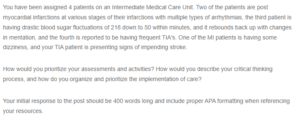
You have been assigned 4 patients on an Intermediate Medical Care Unit. Two of the patients are post myocardial infarctions at various stages of their infarctions with multiple types of arrhythmias, the third patient is having drastic blood sugar fluctuations of 218 down to 50 within minutes, and it rebounds back up with changes in mentation, and the fourth is reported to be having frequent TIA’s. One of the MI patients is having some dizziness, and your TIA patient is presenting signs of impending stroke.
How would you prioritize your assessments and activities? How would you describe your critical thinking process, and how do you organize and prioritize the implementation of care?
Your initial response to the post should be 400 words long and include proper APA formatting when referencing your resources.
 Complete the order form and upload all of your files, including any instructions, rubrics, or other materials provided by your instructor.
 Complete the order payment after filling in the order form. We’ll receive your order and assign it to a writer.
 The assigned writer will complete your paper and forward it to our Editing Team for review and approval.
 Once approved by the editor, the completed paper will be uploaded to your account for you to download, review and approve.