
Prevalence, Correlates and Misperception of Depression Symptoms in the United States
- Summarize the main findings of the article in one paragraph. What are the key conclusions regarding the prevalence and correlates of depression symptoms in the United States?
Using NHANES 2015–2018 data, the research was analyzed to determine depression levels in U.S. adults while also exploring the differences between patient-reported depression and clinical depression assessments. Scientific assessment via PHQ-9 showed depression levels at 8.0%, yet monthly reports for depression reached 19.7% among adults. Research showed people misjudged their condition because 1.1 million adults experienced symptoms without describing any depressive mood (Cao et al., 2020). Self-reported depression rates aligned with clinical depression assessment results based on age, sexual orientation, racial heritage, financial status, and amount of sedentary behavior.
- Describe the logistic regression model used in the study. What were the dependent and independent variables? How were they measured?
The study used Multivariable Logistic Regression Models to assess depression, with the dependent variable being either a PHQ-9 score ≥10 or self-reported frequency of depression. Independent variables included age, sex, race/ethnicity, education, poverty level, BMI, sitting time, physical activity, chronic conditions, smoking status, and medication use, measured using validated NHANES surveys, clinical exams, and lab results.
- What were the research questions and hypotheses explored in the article? How does logistic regression help address these questions?
The study explored two questions: (1) whether self-report and PHQ-9 methods produced different depression prevalence rates and (2) how depression correlates differed based on the measurement approach. This research postulated that individuals tend to misunderstand their actual clinical depression status (Cao et al., 2020). Logistic regression served to demonstrate how depression odds varied between individual predictors as groups using self-report versus PHQ-9 assessment methods.
- What assumptions does logistic regression make about the data? Did the authors discuss any potential violations of these assumptions in the study?
The independence of observations forms the base of the model, together with the absence of multicollinearity and linear logit transformations for continuous variables and adequate sample size. The research took complex survey design into consideration, yet the authors did not specifically address violations such as multicollinearity or linearity assumptions.
- How did the authors assess the fit of the logistic regression model? What measures or tests were used?
The authors did not include specific model fit statistics, such as AIC, BIC, and the Hosmer-Lemeshow test. Instead, they included adjusted odds ratios accompanied by their 95% confidence intervals and statistical significance values. The statistical assessments indicate a good fit of the models, but additional model fit analysis would have been more beneficial to the study findings.
- Identify and discuss any independent variables found statistically significant predictors of depression symptoms in the study.
The research demonstrated that the female gender (OR = 1.41) combined with low education level and income, inactive lifestyle, and extended sitting periods (OR = 1.87 for longer than 8 hours) increased the risk along with diabetes and heart disease conditions.
- What are odds ratios, and how did the authors interpret them in the context of the study?
The odds ratio identifies the probability that specific variables will produce a given result. An outcome rate ratio of 1.41 indicates that females would develop depression at a 41 percent elevated rate compared to males under equivalent other conditions.
- Choose one independent variable and explain how its coefficient was interpreted in the logistic regression model. What does it imply about the relationship between the variable and depression symptoms?
The amount of time one spends sitting proves to be a crucial behavioral factor. People who spent more than eight hours sitting per day faced a depression risk elevation of 1.87 when compared to adults who spent less than four hours sitting daily (Cao et al., 2020). An intensive positive link exists between inactive behavior and depressive symptoms, thus supporting the notion that decreasing sitting time can become an effective depression prevention method.
-
- Discuss any limitations of the study that the authors mentioned. How might these limitations affect the conclusions drawn from the logistic regression analysis?
The authors acknowledged three main limitations due to self-reported data collection, the research design type, and differences between subjective and clinical medical evaluation methods. The research findings should be interpreted with care because these factors might compromise the results produced by logistic regression.
- Based on the article and your understanding of logistic regression, suggest one recommendation for future research on depression symptoms in the United States.
The causality assessment needs longitudinal research studies to determine if lower depression risk is achievable through reduced sitting time. The inclusion of clinical interviews would help achieve better diagnosis accuracy.
———————
Total Points: 15
References
Cao, C., Hu, L., Xu, T., Liu, Q., Koyanagi, A., Yang, L., Carvalho, A. F., Cavazos-Rehg, P. A., & Smith, L. (2020). Prevalence, correlates and misperception of depression symptoms in the United States, NHANES 2015–2018. Journal of Affective Disorders, 269, 51–57. https://doi.org/10.1016/j.jad.2020.03.031
ORDER A PLAGIARISM-FREE PAPER HERE
We’ll write everything from scratch
Question 
Prevalence, Correlates and Misperception of Depression Symptoms in the United States
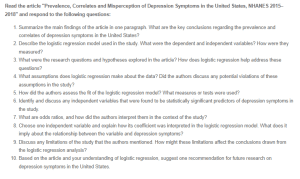
Read the article “Prevalence, Correlates and Misperception of Depression Symptoms in the United States, NHANES 2015–2018” and respond to the following questions:
- Summarize the main findings of the article in one paragraph. What are the key conclusions regarding the prevalence and correlates of depression symptoms in the United States?

Prevalence, Correlates and Misperception of Depression Symptoms in the United States
- Describe the logistic regression model used in the study. What were the dependent and independent variables? How were they measured?
- What were the research questions and hypotheses explored in the article? How does logistic regression help address these questions?
- What assumptions does logistic regression make about the data? Did the authors discuss any potential violations of these assumptions in the study?
- How did the authors assess the fit of the logistic regression model? What measures or tests were used?
- Identify and discuss any independent variables that were found to be statistically significant predictors of depression symptoms in the study.
- What are odds ratios, and how did the authors interpret them in the context of the study?
- Choose one independent variable and explain how its coefficient was interpreted in the logistic regression model. What does it imply about the relationship between the variable and depression symptoms?
- Discuss any limitations of the study that the authors mentioned. How might these limitations affect the conclusions drawn from the logistic regression analysis?
- Based on the article and your understanding of logistic regression, suggest one recommendation for future research on depression symptoms in the United States.
 Complete the order form and upload all of your files, including any instructions, rubrics, or other materials provided by your instructor.
  Complete the order payment after filling in the order form. We’ll receive your order and assign it to a writer.
 The assigned writer will complete your paper and forward it to our Editing Team for review and approval.
 Once approved by the editor, the completed paper will be uploaded to your account for you to download, review and approve.