
Presentation Outline – Diabetes
When was the last time you got screened for diabetes? Every day, we get exposed to various risk factors for the development of diabetes. The CDC (Centers for Disease Control and Prevention) (2022) reported that, as of 2020, a total of 37.3 million people in the United States, 11.3 percent of the U.S. population, were living with diabetes. Out of these, only 28.7 had been diagnosed and were engaged in care. Over 8.5 million Americans had not been diagnosed and were unaware of their diabetes status (CDC, 2022). Additionally, an estimated 96 million individuals are prediabetic. This presentation focuses on the significance of diabetes, the factors contributing to diabetes, the strategies to manage, reverse, and manage diabetes, and the importance of nurses in diabetes care. Hire our assignment writing services in case your assignment is devastating you. We offer assignment help with high professionalism.
The cost of diabetes, both economically and socially, is high.
A. The cost of diabetes
Economic costs of diabetes
- Diagnosed diabetes alone in 2017 cost the U.S. economy an estimated $327 billion, of which $237 billion was directly linked to medical costs and $90 billion in lost productivity (CDC, 2022).
- Diabetes-associated comorbidities increase the burden of disease (Nowakowska et al., 2019).
- Diabetic patients spend more on care (over $9,601 in 2017 (CDC, 2022)).
B. Social costs of diabetes
The social costs of diabetes are usually viewed from an economic perspective.
- Patients have reduced social productivity and increased dependency (especially for aged diabetic patients)
- Increased need for caregivers.
- Risked social isolation of patients.
- Both caregivers and patients have an increased risk of negative mental outcomes.
2. Multiple risk factors contribute to the development of diabetes.
A. Modifiable lifestyle factors contribute to most diabetes cases (Zhang et al., 2020).
1. Diabetes is closely associated with lifestyle and diet choices and styles
- Sedentary life choices
- Eating a lot of junk foods and sweetened beverages.
- Smoking and drinking excess alcohol.
- Not getting enough sleep for a long period of time.
- Being overweight is associated with junk foods, sugary foods and drinks, and a life with reduced physical activity.
- Living a stressful life and life with other chronic health conditions, such as heart health issues, increases the risks of developing diabetes.
B. Other risk factors of diabetes are biological and non-modifiable
1. Aging increases the risk of diabetes.
2. An individual’s non-modifiable factors;
- Family history with diabetes and genetics.
- Race and ethnicity of a person predispose them to diabetes.
3. Diabetes prevention, management, and reversal of the condition require timely patient- and person-focused interventions.
A. Lifestyle changes can help prevent, manage, or reverse diabetes.
1. Lifestyle modifications and choices
- Eating healthy.
- Becoming physically active.
- Adopting hobbies that improve physical activities.
- Reducing the consumption of alcohol and smoking.
- Having healthy sleep patterns.
- Effectively managing existing chronic health conditions.
B. Early screening
- Determine risks due to non-modifiable factors.
- Adopt early interventions to manage and reduce the impact of diabetes on an individual.
4. Importance of nurses in diabetes care
A. Nurses are central in diabetes care, especially in primary care settings
- Assisting patients with medication management, including insulin administration.
- Educating patients and supporting lifestyle changes.
- Promoting community-level awareness
Conclusion
In conclusion, diabetes increases the cost of care and has negative economic and social impacts. Diabetes also increases the risks and impact of other comorbid conditions. The risk factors for diabetes are modifiable and non-modifiable, meaning the disease can be prevented and managed through lifestyle modifications and early disease risk assessment.
References
CDC (Centers for Disease Control and Prevention). (2022, October 25). By the Numbers: Diabetes in America. https://www.cdc.gov/diabetes/health-equity/diabetes-by-the-numbers.html
Nowakowska, M., Zghebi, S. S., Ashcroft, D. M., Buchan, I., Chew-Graham, C., Holt, T., Mallen, C., van Marwijk, H., Peek, N., Perera-Salazar, R., Reeves, D., Rutter, M. K., Weng, S. F., Qureshi, N., Mamas, M. A., & Kontopantelis, E. (2019). The comorbidity burden of type 2 diabetes mellitus: patterns, clusters, and predictions from a large English primary care cohort. BMC Medicine, 17(1), 1–10. https://doi.org/10.1186/S12916-019-1373-Y/FIGURES/4
Zhang, Y., Pan, X. F., Chen, J., Xia, L., Cao, A., Zhang, Y., Wang, J., Li, H., Yang, K., Guo, K., He, M., & Pan, A. (2020). Combined lifestyle factors and risk of incident type 2 diabetes and prognosis among individuals with type 2 diabetes: a systematic review and meta-analysis of prospective cohort studies. Diabetologia, 63(1), 21–33. https://doi.org/10.1007/S00125-019-04985-9
ORDER A PLAGIARISM-FREE PAPER HERE
We’ll write everything from scratch
Question 
Presentation Outline – Diabetes
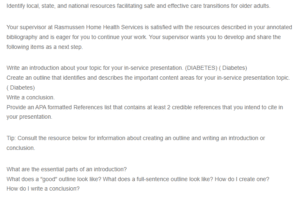
Identify local, state, and national resources facilitating safe and effective care transitions for older adults.
Your supervisor at Rasmussen Home Health Services is satisfied with the resources described in your annotated bibliography and is eager for you to continue your work. Your supervisor wants you to develop and share the following items as a next step.
Write an introduction about your topic for your in-service presentation. (DIABETES) ( Diabetes)
Create an outline that identifies and describes the important content areas for your in-service presentation topic. ( Diabetes)
Write a conclusion.
Provide an APA formatted References list that contains at least 2 credible references that you intend to cite in your presentation.
Tip: Consult the resource below for information about creating an outline and writing an introduction or conclusion.
What are the essential parts of an introduction?
What does a “good” outline look like? What does a full-sentence outline look like? How do I create one?
How do I write a conclusion?
 Complete the order form and upload all of your files, including any instructions, rubrics, or other materials provided by your instructor.
 Complete the order payment after filling in the order form. We’ll receive your order and assign it to a writer.
 The assigned writer will complete your paper and forward it to our Editing Team for review and approval.
 Once approved by the editor, the completed paper will be uploaded to your account for you to download, review and approve.