
Population Health Care Delivery Project-Community Risk Assessment
Community risk assessment is a participatory process that draws communities, professionals, and other groups to assess various health risks and prepare to cope and risk reduction strategies for the identified hazards. Community risk assessment is integral to health promotion within communities. It utilizes scientific information to identify imminent risks, evaluate the risks and suggest measures to curtail these risks. The participatory discourses apparent during community risk assessments enable a consensual approach of community members in addressing these risks. Participatory discourses recognize variations in vulnerability and coping mechanisms among community members and suggest group-specific measures for curtailing these risks. This paper details a community assessment for children and adolescents.
Demographic and Social Determinants
The pursuit of healthy communities has fallen short of addressing specific risks associated with children and adolescents. Childhood and adolescence are developmental stages that present contextual variables to health promotional campaigns that may impede or promote these processes. Several socio-demographic factors have been identified as variables for health-related quality of life among children and adolescents. These include family status, race and ethnic disparities, cultural backgrounds, social connectedness, and access to education.
The family is an essential determinant of health among children and adolescents. Family-specific health risks for children and adolescents include poor attachment of parents with their children, parental substance use, dysfunctional families, lack of adult supervision, and sexual abuse, among others. Race and ethnic disparities are other traditional problems that have disadvantaged children and adolescents from minority communities across the U.S. Members of ethnic and racial minority groups are less likely to receive preventive care and experience higher morbidity and mortality.
Culture is another aspect of race and ethnicity that sometimes disadvantages children and adolescents. Culture affects the perception of health, beliefs on illness and causes of disease, and health-seeking behaviour. Multicultural and diverse communities are more likely to lag in specific aspects of healthy living not only because of the traditional disparities of these groups but also because of their inherent cultural alignments. Subica & Link (2022) note that health disparities are more common among ethnic and culturally minority groups across the globe. These disparities are majorly attributable to the inequitable distribution of resources and inherent characteristics of these groups that limit the utility of the limited health resources.
Community Infrastructure Variables
Community infrastructure variables are factors within communities that enhance the community’s capacity to promote health, prepare for and respond to various health risks and prevent disease. Community infrastructural variables provide a framework for planning, delivering, and improving community health. According to Dassah et al. ( 2018), access to, availability, acceptability, affordability, and proximity of community health infrastructures are factors that affect the capacity of a community to prepare and respond to various health risks. Li et al. (2018) assert that community infrastructures and the adequacy of community establishments are contributory factors to their health.
Availability details the adequacy of community resources or establishments that promote the health of children and adolescents. Acceptability details how available community infrastructures are aligned with the specific needs of the population in question. Community resources targeted at promoting the health of children and adolescents should be appropriate for them. These resources should also be based on perceived or anticipated experiential emotional and cognitive responses to the intervention targeted them. Geography or proximity details the traditional barriers to community infrastructural or establishments attributable to distance and other geographical barriers. Affordability of healthcare is another infrastructural variable that attaches costs to care services and interrogates the ability of communities to access these services.
Community infrastructural variables provide a foundation for community risk assessment. Understanding the correlation between these variables and the identified risks enables the establishment of a framework for mitigating these risks. Community infrastructures are the cornerstone of public health promotion programs targeting adolescents and children. The primary layers of vital community infrastructure are public health agencies and community health organizations, among others.
Analysis of Surveillance Data Collected for the Risk Assessment
Surveillance provides a systematic approach for collecting, interpreting, and disseminating data on various identified health risks for a given population. Surveillance data on risk assessment for children and adolescents can be used to estimate the extent of these risks, determine their distribution within communities, monitor these risks, and establish an address plan (Ibrahim, 2020). This data can be obtained from administrative databases, disease registries, surveys, sentinel surveillance, vital records, lab specimens, publications, and periodicals. This data can reveal information on disease trends, the position of the community in responding to risks, and the vulnerability of children or adolescents to specific risks, among others.
Data calculations and analysis assign numerical values to the data obtained, making it simple, accurate, sensitive, and acceptable. The risk matrix analysis gives a systematic approach to calculating various health risks and provides a framework for risk management. This risk calculation tool shows a correlation between the probability of a specific risk occurring and the severity or impact of the risk on the target population (Lemmens et al., 2022). The risk assessment score is another tool that helps identify individuals who may be at risk and helps create awareness amongst these groups. The risk assessment score for a specific identified risk is the average of the likelihood of this risk occurring, the anticipated impact of that risk, and the current impact value.
Epidemiologic data to be used in risk assessment must meet the following criteria: the data must be accurate, unique, complete, timely, consistent, and valid. Errors in an epidemiologic dataset are unfavourable and may lead to the disqualification of the data. It is of significance to determine the extent of these errors as well as how they may affect the outcomes. Widespread errors warrant disqualification of the data. Errors within the agreeable range can be omitted.
Analysis of the Outcomes
Risk assessment among children and adolescents outlines several risk factors for individuals in this group and recommends protective factors for curtailing these risks and the interventions for effecting a positive change and generating positive health outcomes among members of these groups. Increasing education literacy among children and adolescents is the first intervention that can produce positive health outcomes (Raghupathi & Raghupathi, 2020). Education literacy equips children and adults with critical thinking skills and basic knowledge of health, thereby enabling them to make informed decisions on their health.
Another intervention is to minimize the exposure of children and adolescents to substance use, violence, and abuse. Studies show that early exposure of children and adolescents to substance abuse, violence, and abuse causes psychological harm to them and has been implicated in several mental health illnesses in later developmental stages. This intervention involves or accords parents and guardians with the responsibility of ensuring their children’s well-being by not exposing them to these vices. Policy interventions on access to healthcare and elimination of ethnic and cultural disparities in healthcare also produce positive health outcomes for children and adolescents. Such policies enhance access to care and ensure that children from ethnic minorities have access to primary healthcare and receive a quality education.
Epidemiologic and Biostatistical Research Methods
Epidemiologic research methods are research methods that identify and classify the genesis and spread of diseases. The qualitative study design is an example of traditional epidemiologic research methods (Heath & Boer, 2020). This method involves collecting non-numerical data, such as texts, and analyzing them to understand the perspective or opinion that the data portrays. Observation, interviews, secondary research, surveys, and focus groups can execute qualitative research. This research method gives an in-depth analysis of specific concepts and can form a basis for other research. This research method is flexible and naturalistic, provides real-life and meaningful insights on various aspects, and can lead to the generation of new ideas, mainly when it uses an open-ended approach in interrogating some aspects of the population. This method is, however, unreliable because of many uncontrolled factors that can affect the data obtained. It is also labour intensive because of the large amount of data it generates. It also has limited generalizability, thus making it challenging to draw generalized conclusions from the data obtained.
Conclusion
Children and adolescents still face specific health risks in the course of their development. These risks border on access to healthcare and quality education and traditional disparities affecting minority groups. Risk assessment enables the identification of these risks and informs public health initiatives to curtail these risks. Several interventions have been used to restrict some of these risks. These include expanding access to healthcare and education among the minority groups that are most likely to be affected by these risks.
References
Dassah, E., Aldersey, H., McColl, M., & Davison, C. (2018). Factors affecting access to primary health care services for persons with disabilities in rural areas: a “best-fit” framework synthesis. Global Health Research And Policy, 3(1). https://doi.org/10.1186/s41256-018-0091-x
Heath, G., & Boer, N. (2020). Epidemiologic Research: A Primer for the Clinical Exercise Physiologist. Journal Of Clinical Exercise Physiology, 9(1), 29-39. https://doi.org/10.31189/2165-6193-9.1.29
Ibrahim, N. (2020). Epidemiologic surveillance for controlling Covid-19 pandemic: types, challenges, and implications. Journal Of Infection And Public Health, 13(11), 1630-1638. https://doi.org/10.1016/j.jiph.2020.07.019
Lemmens, S., Lopes van Balen, V., Röselaers, Y., Scheepers, H., & Spaanderman, M. (2022). The risk matrix approach: a helpful tool weighing probability and impact when deciding on preventive and diagnostic interventions. BMC Health Services Research, 22(1). https://doi.org/10.1186/s12913-022-07484-7
Li, M., Zhong, R., Zhu, S., Ramsay, L., Li, F., & Coyte, P. (2018). Access to Community Living Infrastructure and Its Impact on the Establishment of Community-Based Day Care Centres for Seniors in Rural China. International Journal Of Environmental Research And Public Health, 15(6), 1184. https://doi.org/10.3390/ijerph15061184
Raghupathi, V., & Raghupathi, W. (2020). The influence of education on health: an empirical assessment of OECD countries for the period 1995–2015. Archives Of Public Health, 78(1). https://doi.org/10.1186/s13690-020-00402-5Raghupathi, V., & Raghupathi, W. (2020). The influence of education on health: an empirical assessment of OECD countries for the period 1995–2015. Archives Of Public Health, 78(1). https://doi.org/10.1186/s13690-020-00402-5
Subica, A., & Link, B. (2022). Cultural trauma is a fundamental cause of health disparities. Social Science &Amp; Medicine, 292, 114574. https://doi.org/10.1016/j.socscimed.2021.114574
ORDER A PLAGIARISM-FREE PAPER HERE
We’ll write everything from scratch
Question 
Population Health Care Delivery Project-Community Risk Assessment
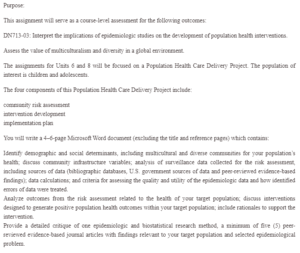
Purpose:
This assignment will serve as a course-level assessment for the following outcomes:
DN713-03: Interpret the implications of epidemiologic studies on the development of population health interventions.
Assess the value of multiculturalism and diversity in a global environment.
The assignments for Units 6 and 8 will be focused on a Population Health Care Delivery Project. The population of interest is children and adolescents.
The four components of this Population Health Care Delivery Project include:
community risk assessment
intervention development
implementation plan
You will write a 4–6-page Microsoft Word document (excluding the title and reference pages) which contains:
Identify demographic and social determinants, including multicultural and diverse communities for your population’s health; discuss community infrastructure variables; analysis of surveillance data collected for the risk assessment, including sources of data (bibliographic databases, U.S. government sources of data and peer-reviewed evidence-based findings); data calculations; and criteria for assessing the quality and utility of the epidemiologic data and how identified errors of data were treated.
Analyze outcomes from the risk assessment related to the health of your target population; discuss interventions designed to generate positive population health outcomes within your target population; include rationales to support the intervention.
Provide a detailed critique of one epidemiologic and biostatistical research method, a minimum of five (5) peer-reviewed evidence-based journal articles with findings relevant to your target population and selected epidemiological problem.
 Complete the order form and upload all of your files, including any instructions, rubrics, or other materials provided by your instructor.
 Complete the order payment after filling in the order form. We’ll receive your order and assign it to a writer.
 The assigned writer will complete your paper and forward it to our Editing Team for review and approval.
 Once approved by the editor, the completed paper will be uploaded to your account for you to download, review and approve.