
Plant Experiment Scientific Report
-
- Group Members’ Names and Section Number
- Title
- One line describing the experiment
- More than just “Plant Project” or “Plant Experiment”
- Include both the common and scientific name, formatted properly
- Introduction
- Background
Lentil (Lens culinaris) functions as a significant leguminous crop that extends across the globe because of its high nutritious value and atmospheric nitrogen fixation, enabling better soil quality. Lentil serves as an excellent experimental subject because it is a quick-growing cool-season annual plant whose growth patterns follow predictable patterns (Zeroual et al., 2022). Plants experience development changes because of multiple environmental factors, including soil quality, amount of light exposure, water availability and seed planting density point. The critical factor in plant competition for light, water and nutrients is seed density, which represents the number of planted seeds in a defined area or container (Bebre et al., 2021). When plant seed density rises, the competitive environment strengthens, which results in both limited growth and decreased plant health.
- Objective
The purpose of this experiment involves assessing seed density effects on lentil seedling growth through measuring average plant height over specified time.
- Rationale
The research findings pertain to both agricultural production along the scientific field of plant biology. The experiment mirrors commercial farming situations by studying plant height results from populating lentil plant pots with one, two or three seeds at a time because plant density optimization directly impacts production output. The correct selection of seeding rates requires knowledge about plant crowding effects on growth by both farmers and researchers (Zeroual et al., 2022). The research will demonstrate the effect that seed population density has on lentil plant development under laboratory conditions.
- Hypotheses
- Alternative Hypothesis (H₁): Seed density significantly affects the average height of Lens culinaris seedlings.
- Null Hypothesis (H₀): Seed density has no significant effect on the average height of Lens culinaris seedlings.
References
Bebre, I., Riebl, H., & Annighöfer, P. (2021). Seedling growth and biomass production under different light availability levels and competition types. Forests, 12(10), 1376. https://doi.org/10.3390/f12101376
Zeroual, A., Baidani, A., & Idrissi, O. (2022). Drought stress in lentil (Lens culinaris, Medik) and approaches for its management. Horticulturae, 9(1), 1. https://doi.org/10.3390/horticulturae9010001
ORDER A PLAGIARISM-FREE PAPER HERE
We’ll write everything from scratch
Question 
Plant Experiment Scientific Report
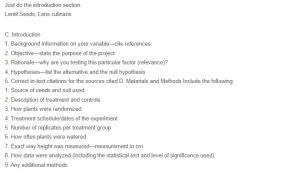
Just do the introduction section.
Lentil Seeds, Lens culinaris
Plant Experiment Scientific Report
C. Introduction
1. Background information on your variable—cite references
2. Objective—state the purpose of the project
3. Rationale—why are you testing this particular factor (relevance)?
4. Hypotheses—list the alternative and the null hypothesis
5. Correct in-text citations for the sources cited D. Materials and Methods Include the following:
1. Source of seeds and soil used
2. Description of treatment and controls
3. How plants were randomized
4. Treatment schedule/dates of the experiment
5. Number of replicates per treatment group
6. How often plants were watered
7. Exact way height was measured—measurement in cm
8. How data were analyzed (including the statistical test and level of significance used)
9. Any additional methods
 Complete the order form and upload all of your files, including any instructions, rubrics, or other materials provided by your instructor.
  Complete the order payment after filling in the order form. We’ll receive your order and assign it to a writer.
 The assigned writer will complete your paper and forward it to our Editing Team for review and approval.
 Once approved by the editor, the completed paper will be uploaded to your account for you to download, review and approve.