
PICOT Question – Teenage Depression
1) Identify and describe one practice-related issue or concern. You may choose to build on the practice issue you identified in NR500NP/NR501NP. Provide support for the issue from scholarly nursing sources current within the last 5 years.
The practice issue of concern is teenage depression. Depression impacts the social lives of teenagers. It causes apathy, hopelessness, irritability, and frustration. Teens are unable to establish healthy relationships with their peers and family members. Also, depression increases the likelihood of isolation and suicidal ideations among teens. Findings from 2020 indicate that about 4.1 million teens experienced a depressive episode in the USA (NIMH.gov, 2022). The prevalence of depression among females than males was about twenty-five percent and nine percent, respectively (NIMH.gov, 2022). Furthermore, the highest prevalence of depressive episodes was reported among multiracial teenagers (approximately 29 percent) (NIMH.gov, 2022). The prevalence of depressive episodes among Hispanics, whites, Asians, and blacks was approximately 15 percent, 18 percent, 13.9 percent, and 13 percent, respectively (NIMH.gov, 2022).
Teen depression is attributed to multifactorial etiologies. To begin with, a genetic predisposition has been identified. The risk of depression is increased by about twenty to fifty percent among teenagers with a family history of mental health issues (Horowitz & Graf, 2019). Secondly, traumatic childhood experiences increase the risk of teen depression. This entails aspects such as neglect, abuse, assault, and loss of loved ones (Horowitz & Graf, 2019). Thirdly, underlying chronic healthcare conditions increase the risk of depression. For instance, a teenager with diabetes mellitus or cancer is likely to be anxious, afraid, and depressed about the disease and the treatment process (Daly, 2022). Furthermore, teens with attention deficit hyperactivity disorder are likely to be depressed because the disease impacts their concentration and learning ability (Daly, 2022). Fourthly, the cases of depression are higher among unsupported gays, lesbians, transgender, bisexuals, and other sexual minorities compared to heterosexuals (Jones et al., 2022). Fifthly, depression can be an indicator of an adverse effect or withdrawal symptom of substance abuse such as alcohol (Daly, 2022).
The prevalence of teen depression and its impact on teenagers’ social lives necessitate the formulation of strategies to address the problem. This can be achieved via concerted efforts among all various stakeholders, such as parents, teachers, nurse practitioners, and members of the interdisciplinary team. The first intervention is the comprehensive screening of teenagers to identify any manifestations of depression (Davis & Leon, 2021). In this context, parents and teachers should report suspicions of depressive episodes to healthcare providers. This is essential to ensure a timely diagnosis of depression. The second intervention entails the management of depression (Davis & Leon, 2021). Lee et al. (2020) report that this is achieved via non-pharmacological approaches such as psychotherapy and pharmacological approaches.
2) Explain why the issue/concern is important to nurse practitioner practice and the issue’s impact on health outcomes. Provide support for the importance of the issue from scholarly nursing sources current within the last 5 years.
Teen depression is relevant to nursing and nurse practitioner practice. Firstly, nurse practitioners play a significant role in providing individualized mental healthcare in a primary care setup (Davis & Leon, 2021). Providing mental health care for teen depression in a primary care setup offers many merits. It improves access to mental health services within the local community and provides cost-effective services compared to specialty care (Davis & Leon, 2021). Secondly, nurse practitioners play a key role in health promotion and prevention of teen depression. This is accomplished by educating the public and patients (Davis & Leon, 2021). Health promotion and prevention enable teens to avert or cope with risk factors, hence lowering the incidence of depression. Thirdly, nurse practitioners play a significant role in periodic risk assessment via screening teens for depression (Davis & Leon, 2021). Periodic risk assessment promotes the timely diagnosis of depression and initiation of treatment. Fourthly, nurse practitioners promote an interdisciplinary approach to teen mental healthcare by working in concert with specialists (Davis & Leon, 2021). In this context, nurse practitioners assess patients and determine the need for referral for specialist management. Nurse practitioners accomplish this by upholding holistic care.
Furthermore, depression impacts health outcomes among teenagers. To begin with, depression is associated with physical manifestations that impact treatment and healthcare outcomes (Lee et al., 2020). For instance, it can trigger back pain, arthralgia, fatigue, gastrointestinal problems, headache, appetite changes, and sleep disturbances (Lee et al., 2020). These physical manifestations impede the ability of a person to execute their routine tasks. Also, they worsen the morbidity associated with depression and lower patients’ quality of life. These physical symptoms are likely to lower adherence to treatment plans, which impacts healthcare outcomes. Besides physical manifestations, depression causes emotional manifestations that impact health outcomes (Lee et al., 2020). Patients are likely to be withdrawn from friends and loved ones, demonstrate apathy and anhedonia, and exhibit pessimism and irritability (Lee et al., 2020). These symptoms lower the quality of teens’ social lives and their ability to care for themselves. As such, long-term symptoms increase the risk of suicidal ideations.
Nurse practitioners (NPs) play a key role in mitigating the impact of depression on health outcomes. As earlier stated, they are involved in screening and diagnosing teen depression. To accomplish this, NPs use standardized risk assessment tools and the DSM-5 diagnostic criteria (Lee et al., 2020). The two approaches enable nurses to determine the severity of depression. By so doing, they design care plans that address each patient’s physical, emotional, and social needs. Holistic care can be achieved by collaborating with parents, teachers, and other healthcare providers. In this context, parents and teachers are key informants that enable nurses to make accurate diagnoses. The nursing process will enable NPs to formulate and assess patients’ needs and select the best pharmacological non-pharmaceutical approach to manage patients. Regardless of choice, care plans should be optimized to achieve the best outcomes.
3) Define each element of your PICOT question in one or two sentences.
- P-Population and Problem (The problem of concern is teenage depression.)
Teenagers are individuals aged between thirteen and nineteen years. This population is likely to be depressed due to multifactorial factors such as traumatic childhoods, genetics, and underlying conditions (Horowitz & Graf, 2019).
- I–Intervention(Application of both psychotherapy and pharmacological approaches.)
Psychotherapy entails the use of techniques such as cognitive behavioral therapy, psychoanalytic therapy, or interpersonal therapy (Lee et al., 2020). On the other hand, pharmacological approaches use medication to manage depression.
- C–Comparison(Use of pharmacological approaches alone.)
Pharmacological approaches are commonly used in the management of teenage depression. This approach embraces various medication classes, such as fluoxetine and imipramine (Lee et al., 2020).
- O–Outcome(Manage depression adequately and optimize teens’ quality of life.)
The success of the intervention will be demonstrated by optimal patient outcomes as evidenced by an improvement in the physical, psychological, and emotional well-being of teenagers.
- T–Timeframe(The timeframe is five months.)
Psychotherapy and pharmacological approaches will be offered for five months. After that, an evaluation will be done to determine the outcomes of the intervention.
Construct your PICOT question in the standard PICOT question format (narrative) and define each letter separately, such as:
- P = Teenagers with depressive episodes
- I = Application of both psychotherapy and pharmacological approaches
- C = Use of pharmacological approaches alone
- O = Manage depression adequately and optimize teens’ quality of life
- T = Five months
- PICOT Question written in full: Among teenagers with depressive episodes, does the implementation of both psychotherapy and pharmacological approaches compared to pharmacological approaches alone optimize the management of depression and improve teens’ quality of life within five months?
References
Daly, M. (2022). Prevalence of Depression Among Adolescents in the U.S. From 2009 to 2019: Analysis of Trends by Sex, Race/Ethnicity, and Income. Journal of Adolescent Health, 70(3), 496–499. https://doi.org/10.1016/j.jadohealth.2021.08.026
Davis, L. L., & Leon, M. (2021). Depression Screening in Adolescents: Implications for Primary Care Nurse Practitioners. The Journal for Nurse Practitioners, 18(3), 259-264. https://doi.org/10.1016/j.nurpra.2021.12.003.
Horowitz, J. M., & Graf, N. (2019). Most U.S. Teens See Anxiety and Depression as Major Problems. Pew Research Center, February. https://www.pewresearch.org/social-trends/2019/02/20/most-u-s-teens-see-anxiety-and-depression-as-a-major-problem-among-their-peers/.
Lee, Y., Brietzke, E., Cao, B., Chen, Y., Linnaranta, O., Mansur, R. B., Cortes, P., Kösters, M., Majeed, A., Tamura, J. K., Lui, L. M. W., Vinberg, M., Keinänen, J., Kisely, S., Naveed, S., Barbui, C., Parker, G., Owolabi, M., Nishi, D., McIntyre, R. S. (2020). Developing and implementing guidelines for managing depression: A systematic review. Bulletin of the World Health Organization, 98(10), 683-697H. https://doi.org/10.2471/BLT.20.251405.
NIMH.gov. (2022). Major Depression. https://www.nimh.nih.gov/health/statistics/major-depression.
ORDER A PLAGIARISM-FREE PAPER HERE
We’ll write everything from scratch
Question 
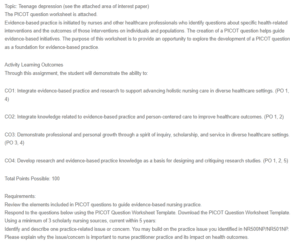
Topic: Teenage depression (see the attached area of interest paper)
The PICOT question worksheet is attached.
Evidence-based practice is initiated by nurses and other healthcare professionals who identify questions about specific health-related interventions and the outcomes of those interventions on individuals and populations. The creation of a PICOT question helps guide evidence-based initiatives. The purpose of this worksheet is to provide an opportunity to explore the development of a PICOT question as a foundation for evidence-based practice.
PICOT Question – Teenage Depression
Activity Learning Outcomes
Through this assignment, the student will demonstrate the ability to:
CO1: Integrate evidence-based practice and research to support advancing holistic nursing care in diverse healthcare settings. (PO 1, 4)
CO2: Integrate knowledge related to evidence-based practice and person-centered care to improve healthcare outcomes. (PO 1, 2)
CO3: Demonstrate professional and personal growth through a spirit of inquiry, scholarship, and service in diverse healthcare settings. (PO 3, 4)
CO4: Develop research and evidence-based practice knowledge as a basis for designing and critiquing research studies. (PO 1, 2, 5)
Total Points Possible: 100
Requirements:
Review the elements included in PICOT questions to guide evidence-based nursing practice.
Respond to the questions below using the PICOT Question Worksheet Template. Download the PICOT Question Worksheet Template.
Using a minimum of 3 scholarly nursing sources, current within 5 years:
Identify and describe one practice-related issue or concern. You may build on the practice issue you identified in NR500NP/NR501NP.
Please explain why the issue/concern is important to nurse practitioner practice and its impact on health outcomes.
Describe each element of your PICOT question in one or two sentences, being sure to address all of the following:
P-Population and problem– What is the nursing practice concern or problem, and whom does it affect?
I–Intervention– What evidence-based solution for the problem would you like to apply?
C–Comparison– What is another solution to the problem? Note that this is typically the current practice, with no intervention or alternative solutions.
O–Outcome– How will you know that the intervention worked? Think about how you will measure the outcome.
T–Time frame– What timeframe is involved in the EBP initiative or the target completion date?
Construct your PICOT question in the standard PICOT question format (narrative) and define each letter separately, such as:
P =
I =
C =
O =
T =
PICOT question was written in full =
Abide by the Chamberlain College of Nursing Academic Integrity Policy.
At the graduate level, we like to see you synthesizing your ideas into your own words. No direct quotes may be used in this worksheet.
Use APA formatting guidelines for references and citations.
 Complete the order form and upload all of your files, including any instructions, rubrics, or other materials provided by your instructor.
 Complete the order payment after filling in the order form. We’ll receive your order and assign it to a writer.
 The assigned writer will complete your paper and forward it to our Editing Team for review and approval.
 Once approved by the editor, the completed paper will be uploaded to your account for you to download, review and approve.