
Perspectives of the Natural Law Theory, Religion, and Social Contract Theory
What is natural law theory? Be sure to discuss its origins in Aristotle, the tension between what ought to be and what is, and its contrast to the contemporary scientific worldview.
The Natural Law theory posits that everything in nature is governed by the laws of nature. The theory is divided into three main parts. The first part postulates that the world has a rational order, where everything has a purpose (Rachels 56). Aristotle viewed the world similarly, noting that nature or natural processes are not random but occur for the sake of a certain result or outcome. He furthered this idea by arguing that, to understand anything, the questions “What is it? What is it made of? How did it come to be? What is it for?” must be asked (Rachels 56). This system, according to Aristotle, applies to everything—artificial objects, natural objects, inorganic objects, and living beings. Therefore, everything has its place in the world and exists for a particular reason. Christian philosophers supported this notion but added that value and purpose are part of God’s plan.
In the second part of the theory, the laws of nature elucidate how things “are” and how they “ought to be” (Rachels 57). Notably, societies live in harmony when each thing serves its “natural” purpose, and, as such, things that cannot or do not serve their purposes are considered unnatural/wrong. For instance, the purpose of sex, according to the Natural Law theory, is procreation; therefore, engaging in any sexual activity for purposes other than procreation is considered unnatural and thus condemned. Nonetheless, critics object to this theory, arguing that it confuses “is” and “ought.” In the example above, it may be correct that sex is for procreation, but it does not follow that sex should be for that purpose only. In another example, it is natural for individuals to lie to get out of trouble; however, that ought not to be the case because people should be truthful. Evidently, “what is” and “what ought to be” differ logically, and no conclusion concerning one follows from the other (Rachels 58-59).
Lastly, the third part concerns moral knowledge and posits that natural laws are laws of reason. Hence, what is right is that which is backed by the best reasons (Rachels 58). Additionally, individuals are considered capable of determining what is right because God gives everyone the ability to reason. Notably, the Natural Law theory needs no facts as it argues that things occur due to the laws of cause and effect, and this contrasts the modern scientific worldview. Contemporary science explains the world with facts, and the laws of chemistry, biology, and physics are the only natural laws, and they work blindly with no purpose.
Discuss the difficulties in using religion as a basis for ethics in the context of scripture and church tradition.
Using religion as a basis for ethics in the context of scripture and church tradition poses several difficulties. Foremost, finding specific moral guidance from the scriptures is often challenging because contemporary problems differ from issues from ancient times. Also, some issues in the modern world may not be mentioned in the scriptures. Second, church tradition and the scriptures often disagree on various matters. For instance, the New Testament looks down upon being rich, while the Old Testament, like through Jabez, who asks God to enlarge his territories, embraces being wealthy (Rachels 60). Consequently, such uncertainty in the scripture leads one into conflicting decisions. Third, different generations hold varying views on certain matters and would, therefore, interpret church traditions differently and in a manner that supports their preferred ethical position. In addition, most church traditions were formed when little relevance was known and when the church was barely intellectual. Thus, it would be irrational to use such traditions as a basis for an ethical dilemma in the modern world (Rachels 62). After all, ethics is an issue of reason, not faith, and the scripture and church tradition do not always provide solutions to ethical dilemmas individuals encounter (Rachels 64).
Describe the four advantages of social contract theory.
In the social contract theory, morality exists because of the rules that rational individuals accept as long as others also accept and follow these rules. The theory is advantageous on four accounts—first, people are bound to follow moral rules because they ensure harmonious living (Rachels 91). Second, people find it rational to follow morally binding rules because it is beneficial to them and because they want everyone else to firmly follow the rules. Third, breaking the rules releases law-abiding individuals from their obligations toward law-breakers (Rachels 92). Accordingly, law-abiders can retaliate, making it legitimate for governments to enforce the laws. Fourth, there is a limit to how much morality is demanded of individuals. Rational individuals will not accept rules that demand so much self-sacrifice that others will not follow. In that case, one is allowed to put their self-interests first, like in a scenario where one has to choose between their own death and the deaths of strangers.
Works Cited
Rachels, James. The Elements of Moral Philosophy. 9th ed., McGraw-Hill Education, 2018.
ORDER A PLAGIARISM-FREE PAPER HERE
We’ll write everything from scratch
Question 
Perspectives of the Natural Law Theory, Religion, and Social Contract Theory
Perspectives of the Natural Law Theory, Religion, and Social Contract Theory
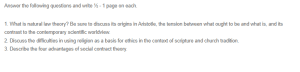
Answer the following questions and write ½ – 1 page on each.
1. What is natural law theory? Be sure to discuss its origins in Aristotle, the tension between what ought to be and what is, and its contrast to the contemporary scientific worldview.
2. Discuss the difficulties in using religion as a basis for ethics in the context of scripture and church tradition.
3. Describe the four advantages of social contract theory.
 Complete the order form and upload all of your files, including any instructions, rubrics, or other materials provided by your instructor.
  Complete the order payment after filling in the order form. We’ll receive your order and assign it to a writer.
 The assigned writer will complete your paper and forward it to our Editing Team for review and approval.
 Once approved by the editor, the completed paper will be uploaded to your account for you to download, review and approve.