
Personnel Management Report
Compliance with legal and regulatory requirements is key to any organization. These requirements include protecting employees against sexual harassment, providing equal opportunities for all employees, and ensuring safe working conditions. If an organization fails to comply with legal and regulatory requirements within its jurisdiction, it can attract penalties from the state, employee lawsuits, and consequential complaints from other relevant stakeholders. Besides, failing to comply with established requirements can tarnish an organization’s reputation, thereby negatively impacting its operations. This report offers insights into the impact of legal and regulatory requirements on the HR process.
The Effect of Safety, Legal, and Regulatory Requirements on the HR Process
Employers rely on legal, safety, and regulatory requirements to determine employees’ compensation. Among others, these requirements prescribe employees’ pay, benefits, and working conditions (Hasyim & Bakri, 2023). It is the responsibility of HR departments to ensure that their respective executive managers implement the relevant requirements. For instance, India’s Code of Wages sets the minimum wage that employers can pay employees, and the demand that wages be paid on time. Failure to comply with the law can lead to reputational damage and legal repercussions.
Another area where legal requirements have a significant impact is on labor relations, as stipulated in the Disputes Act. The act prescribes approaches that may be leveraged to solve employee-employer conflicts. Among others, the law recommends conciliation, arbitration, and collective bargaining approaches to conflict resolution (Hasyim & Bakri, 2023). HR managers play a crucial role in mediating between organizational leaders and employees to avoid eventualities that may hamper business, such as strikes, legal actions, and lockouts.
Also, safety requirements, which delve into issues like the usage of hazardous materials, ventilation, and lightning, recommend safety requirements employers meet to ensure employee safety. Organizational HR experts are responsible for implementing the safety measures, undertaking safety inspections, and ensuring the awareness of safety procedures. Non-compliance with these requirements exposes employees to danger and harms the organization’s brand.
Employee-Related Regulations and Agencies
The U.S. Department of Labor (DOL) administers and enforces over 180 federal laws. These federal laws affect over 165 million employees working in over 11 million workplaces in the United States (U.S. Department of Labor, 2024). One of the key laws administered and enforced by the Department of Labor is the Fair Labor Standards Act, which is implemented by the Wages and Hours division of the DOL (U.S. Department of Labor, 2024). The law recommends a minimum wage and overtime pay for employees. As per the act, employees must be paid at least the federal minimum wage and must be offered overtime pay that is 1.5 times the normal hourly pay.
Additionally, the DOL is responsible for implementing the Federal Mine Safety and Health Act. This law is administered and enforced by MSHA (the Mine Safety and Health Administration). According to the act, the safety and health of miners is the full responsibility of mine operators (U.S. Department of Labor, 2024). The act also mandates mine operators to train recruits before they contract them to work on mines.
Common Sense and Compassion versus Litigation at the Workplace
Unlike the past, when employee-employer relationships were largely influenced by common sense and compassion, the extent of conflicts in the present-day work environment is so much such that organizations settle for legal action to address workplace issues and preserve their reputation. I believe one of the contributors to this problem is failure in communication and lack of tolerance, which are inevitable when people with different ideologies work together. Other challenges that contribute to workplace conflicts deteriorating into legal class action are associated with employees’ inability to create a work-life balance.
For instance, failure to adopt technologies that grant employees the flexibility to work from home can contribute to workplace conflicts. If employees are compulsorily required to report to the workplace physically, they may be unable to achieve a work-life balance. Such employees eventually become stressed, and such stress can affect performance at the workplace. Consequently, employees will raise issues with their performance, potentially leading to conflicts that may end up in court.
Behavior Management
According to Omotola et al. (2024), organizational leaders should adopt active listening, which is characterized by attending to verbal and non-verbal cues, seeking clarification, as well as expressing empathy. In particular, employers should shun negative emotions while dealing with employee conflicts. Instead, they should promote positive feedback and encourage employees to share their grievances. By adopting constructive feedback, both parties become more understanding, reflect deeply, and embrace a collaborative solution. That way, it is unlikely that workplace conflicts will deteriorate into litigation.
References
Hasyim, H., & Bakri, M. (2023). The impact of employment law on human resource practices: A global perspective. The Journal of Business and Management Research, 6(1), 43–54. https://doi.org/10.55098/tjbmr.v6i1.658
Omotola, O. C., Boluwatife, A. K., & Lawal, J. M. (2024). Strategies for management and resolution of employer-employee conflict and workplace crimes: Lessons from Africa. Renaissance University Journal of Management and Social Sciences (RUJMASS), 10(2), 52–60. https://rujmass.com/Journals/2024/dec/06.pdf
U.S. Department of Labor. (2024). Summary of the major laws of the Department of Labor. DOL. https://www.dol.gov/general/aboutdol/majorlaws
ORDER A PLAGIARISM-FREE PAPER HERE
We’ll write everything from scratch
Question 
Personnel Management Report
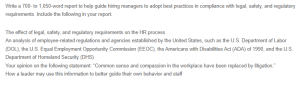
Write a 700- to 1,050-word report to help guide hiring managers to adopt best practices in compliance with legal, safety, and regulatory requirements. Include the following in your report:
Personnel Management Report
The effect of legal, safety, and regulatory requirements on the HR process
An analysis of employee-related regulations and agencies established by the United States, such as the U.S. Department of Labor (DOL), the U.S. Equal Employment Opportunity Commission (EEOC), the Americans with Disabilities Act (ADA) of 1990, and the U.S. Department of Homeland Security (DHS)
Your opinion on the following statement: “Common sense and compassion in the workplace have been replaced by litigation.”
How a leader may use this information to better guide their own behavior and staff
 Complete the order form and upload all of your files, including any instructions, rubrics, or other materials provided by your instructor.
  Complete the order payment after filling in the order form. We’ll receive your order and assign it to a writer.
 The assigned writer will complete your paper and forward it to our Editing Team for review and approval.
 Once approved by the editor, the completed paper will be uploaded to your account for you to download, review and approve.