
Personal Theoretical Models of Counseling
Basic Data
Client Demographics
The client selected for this presentation will be referred to as Marcus to protect his identity. Marcus is a 33-year-old African American male who identifies as male and uses he and him pronouns. He comes from a lower socioeconomic background and is currently unemployed, which he noted as one source of his stress. Marcus completed high school but did not pursue higher education due to early substance use and imprisonment in his twenties. He seeks to build a more stable life and is interested in getting his general educational development and pursuing trading.
Presenting Problem
Marcus presented to counseling at Serenity Recovery Centers following a court-mandated referral due to a second driving under the influence (DUI) charge within five years. He stated that he initially did not feel he had a problem but began questioning his substance use after losing contact with his daughter and facing possible jail time. While he was resistant at first, he shared during the intake session that he wanted to make changes to stay out of jail and possibly regain custody of his daughter. His presenting problem is centered around substance misuse, strained family relationships, and low motivation.
Social Context
In our initial conversation, Marcus described a strained relationship with his family, particularly with his mother and younger sister, with whom he used to live. He has a four-year-old daughter but has not seen her in over a year due to a protective order filed by the child’s mother. He stated that he has no close friends and often feels isolated. Marcus admitted that his former peer group consisted of individuals who also misused alcohol and drugs, which contributed to his behavior. He feels unsupported and is uncertain about rebuilding trust within his social circle.
General Impressions of the Client
Marcus presented generally untidily but was alert during the first session. He wore wrinkled clothing, had minimal eye contact, and seemed fatigued. His mood was subdued, and he often answered questions in a flat, almost detached tone, suggesting possible depressive symptoms. His effect was restricted, and while he did not express strong emotions verbally, his body language indicated discomfort. He initially appeared guarded but gradually opened up as rapport was built. Marcus is a voluntary client who agreed to attend sessions to comply with court requirements, though his motivation for personal change is slowly emerging.
Theoretical Orientation and Personal Models
In my journey with Serenity Recovery Centers, I have reflected on the ideas behind my approach to counseling. After learning through supervision and self-evaluation, I realized that Gestalt Therapy and Person-Centered Therapy are the models that match my approach the best. The fact that Gestalt Therapy looks at current experiences and offers experiential tools draws me closer to helping clients discover their behavior patterns (Ramu et al., 2025). At the same time, according to Yao and Kabir (2023), Person-Centered Therapy stresses empathy, congruence, and unconditional positive regard, all of which are important to my way of working in therapy.
I was able to relate to multiple aspects of both theories in similar but distinctive ways. According to the Gestalt approach, clients should directly notice their thoughts, feelings, and body sensations when they occur (Kaisler et al., 2023). As a result, they are able to accept responsibility for themselves and to feel stronger as individuals. Person-Centered Therapy offers emotional support that makes clients feel safe enough to share their thoughts with the therapist. I agree with these outcomes because they reflect how I instinctively support my clients by encouraging awareness and offering a nonjudgmental emotional presence.
When I initially reviewed the theoretical assessment tools, I expected results to indicate a humanistic leaning, particularly toward Person-Centered Therapy. However, I was pleasantly surprised by how much I also aligned with the experiential and directive nature of Gestalt techniques. Combining the two allows for emotional depth and active exploration, which feels both natural and effective (Roubal et al., 2021). Together, they support a counseling style that is both compassionate and action-oriented. This integration allows me to remain emotionally attuned while guiding clients through transformative experiences in the here and now. As such, my preferred model of counseling integrates these two approaches to create a flexible, present-focused, and relationally attuned style.
Integration of Theory with Counseling Focus
My preferred focus in counseling is on feelings, and both Gestalt Therapy and Person-Centered Therapy allow me to work in this domain effectively. With Person-Centered Therapy, I create a space that honors the client’s emotional world by offering empathy and a nonjudgmental attitude (Švab & Cerovečki, 2024). At Serenity Recovery Centers, many clients come in feeling ashamed or defeated by past behavior. Through unconditional positive regard, I help them reconnect with their inner worth and validate the full range of their emotions without trying to fix or suppress them.
Gestalt Therapy further supports emotional work by bringing unacknowledged feelings into the present moment. Techniques like the empty chair or two-chair dialogue can be used to externalize inner conflicts, allowing clients to fully experience and integrate their emotions (Ramu et al., 2025). This way of exploring feelings, together with the caring environment at Person-Centered Therapy, creates a more substantial impact. This combination allows me to focus on feelings and also helps the client gain helpful emotional understanding.
Application of Theoretical Model in Practice
Using Person-Centered and Gestalt therapies, I was able to use my integrated model with Marcus, one of my clients at Serenity Recovery Centers. After getting his second DUI offense, Marcus was referred by the court for counseling. In the beginning, I acted according to Person-Centered beliefs by helping to create a safe space based on empathy, honesty, and unconditional acceptance for the client. This encouraged Marcus, who was initially hesitant and suspicious, to take part more in the therapeutic relationship. Using this approach helped me build trust and set a foundation for more therapy sessions.
When trust improved, I introduced a few Gestalt interventions gradually to encourage Marcus to pay attention to what he was feeling at the moment. When he mentioned his daughter, I urged him to recall any immediate feelings and think about what those emotions meant for him. Using these methods, Marcus was able to bring his hidden feelings out and learn what his drug use did to his emotions. The presence of emotional safety and present-focused awareness enabled his counseling journey to be deeply meaningful (Pan & Wang, 2025). As a result, Marcus learned more about himself and actually wanted to make positive changes in his own life.
Reflections on Implementation and Effectiveness
I felt that using my personal theoretical model with Marcus made our work both genuine and productive. With Person-Centered principles, I helped provide a safe atmosphere in which Marcus felt comfortable sharing personal and suffering experiences. At first, he viewed counseling only as something required by law, but he later learned that therapy could assist him personally. When he felt guilty, sad, and lost, I introduced ways from Gestalt therapy to help him experience and deal with these emotions. As a result, our sessions became more active and exciting.
The approach proved helpful because Marcus became more willing to address painful moments from his past. One key moment happened when he imagined having a conversation with his daughter in his mind using the empty chair technique. While addressing the chair, his attitude, voice, and expression changed, making it evident that he was reaching out to emotions he did not want to feel before. As a result of this activity, he became more aware of himself and decided to work toward change. This also helped clarify internal conflicts and prompted discussions about what meaningful recovery could look like for him.
Sometimes, I had a hard time applying directive Gestalt strategies while still using the non-directive approach of Person-Centered Therapy. For example, during emotional moments, I found myself questioning whether to introduce a structured exercise or allow Marcus to guide the session. Such experiences made me understand how crucial both timing and intuition are. It became clear to me that combining these approaches needs care and understanding, especially during sessions with vulnerable or uncooperative clients. Selecting the appropriate time to move from exploring to intervening is significant.
If I were to make any adjustments, I would focus on how I switch from one therapeutic approach to another. While I understand that therapy changes as the needs do, I acknowledge that some changes need to be marked in the therapy. For instance, I might say, “Would you like to try something interactive that could help you understand how you feel?” As a result, the client can accept the change and continue to feel they are in charge. These small changes would help the session run smoothly and build a better relationship between the therapist and the client.
Conclusion
All in all, using my personal theoretical model based on Gestalt and Person-Centered therapies has contributed significantly to my growth during the clinical training practicum. With these approaches, I reflect my core beliefs as a counselor and I am able to work ethically and effectively. While at Serenity Recovery Centers, I have observed how therapeutic work is based on these theories. As I train further, I want to explore more experiential strategies, get better at timing my actions, and better understand how emotions affect how we behave.
References
Kaisler, R. E., Fede, M., Diltsch, U., Probst, T., & Schaffler, Y. (2023). Common mental disorders in gestalt therapy treatment: A multiple case study comparing patients with moderate and low integrated personality structures. Frontiers in Psychology, 14(1304726). https://doi.org/10.3389/fpsyg.2023.1304726
Pan, W.-J., & Wang, S.-F. (2025). Understanding patients’ emotional needs to strengthen therapeutic relationships: A deep insight into narrative nursing. World Journal of Psychiatry, 15(3). https://doi.org/10.5498/wjp.v15.i3.103093
Ramu, A., McNamara, S., & Gunturu, S. (2025, February 14). Gestalt therapy. StatPearls – NCBI Bookshelf. https://www.ncbi.nlm.nih.gov/books/NBK613291/
Roubal, J., Hytych, R., Čevelíček, M., & Řiháček, T. (2021). Personal therapeutic approach in Gestalt therapists working with clients suffering from medically unexplained psychosomatic symptoms. Research in Psychotherapy: Psychopathology, Process and Outcome, 24(3). https://doi.org/10.4081/ripppo.2021.535
Švab, I., & Cerovečki, V. (2024). Person-centred care, a core concept of family medicine. European Journal of General Practice, 30(1). https://doi.org/10.1080/13814788.2024.2393860
Yao, L., & Kabir, R. (2023). Person-centered therapy (Rogerian therapy). PubMed; StatPearls Publishing. https://www.ncbi.nlm.nih.gov/books/NBK589708/
ORDER A PLAGIARISM-FREE PAPER HERE
We’ll write everything from scratch
Question 
Personal Theoretical Models of Counseling
Overview:
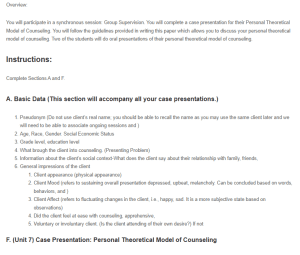
You will participate in a synchronous session: Group Supervision. You will complete a case presentation for their Personal Theoretical Model of Counseling. You will follow the guidelines provided in writing this paper which allows you to discuss your personal theoretical model of counseling. Two of the students will do oral presentations of their personal theoretical model of counseling.
Personal Theoretical Models of Counseling
Instructions:
Complete Sections A and F.
A. Basic Data (This section will accompany all your case presentations.)
- Pseudonym (Do not use client’s real name; you should be able to recall the name as you may use the same client later and we will need to be able to associate ongoing sessions and )
- Age, Race, Gender. Social Economic Status
- Grade level, education level
- What brough the client into counseling. (Presenting Problem)
- Information about the client’s social context-What does the client say about their relationship with family, friends,
- General impressions of the client
- Client appearance (physical appearance)
- Client Mood (refers to sustaining overall presentation depressed, upbeat, melancholy. Can be concluded based on words, behaviors, and )
- Client Affect (refers to fluctuating changes in the client, i.e., happy, sad. It is a more subjective state based on observations)
- Did the client feel at ease with counseling, apprehensive,
- Voluntary or involuntary client. (Is the client attending of their own desire?) If not
F. (Unit 7) Case Presentation: Personal Theoretical Model of Counseling
- As part of your training, learning, and development you will explore your personal theoretical model of counseling. Earlier you shared about how you believe a person changes and you considered the three focuses for facilitating change in clients: feelings, behaviors, and thinking. In the resource area you will find forms to assist you in discovering your personal model of counseling. These forms are just to aid you in determining your natural tendencies. You may not agree with the findings and that is okay. Some counselors, clinicians, and therapists may use be purists (Adlerian or use Individual Psychology), some may be integrative approaches such as merging Person Centered and Gestalt, while others may be more eclectic using what ever they believe work for each individual client.
Eclectic approaches take much skill and knowledge about how the theories and approaches work. For this case presentation, you will consider one or two approaches (theories /therapies).
- Complete the theoretical forms for identifying your
- Identify your focus: behavior, thinking,
- Be intentional during your next counseling sessions with
- Following your experience, you will complete this case
- What theory, theories, and/or therapies appeared to fit you? Do you agree or disagree and why? What did you expect the results to say about you and what theory do you mostly prefer?
- How do your theory, theories, and/or therapies integrate with your preferred focus (behavior, thinking, feeling)? Does it work with all of them or certain
- Describe your experience implementing your personal model with your clients. Did you try this with one or more clients?
- Discuss the experience in terms of what you learned: How easy was it to implement? Did it seem natural? Were you effective? What adjustments would you make?
- Some clinicians practice with their theoretical approach. Take your time to
 Complete the order form and upload all of your files, including any instructions, rubrics, or other materials provided by your instructor.
  Complete the order payment after filling in the order form. We’ll receive your order and assign it to a writer.
 The assigned writer will complete your paper and forward it to our Editing Team for review and approval.
 Once approved by the editor, the completed paper will be uploaded to your account for you to download, review and approve.