
Personal Statement – Social Work
Section A
My engrained passion for advocacy and social justice for underprivileged people motivated me to start a journey toward social work. As a child growing up in a not-so-rich background, I witnessed my less privileged neighbors, and friends lack access to quality care. The worst event I can remember was when I was in high school. My classmate’s mother, who had multiple chronic illnesses that affected her mental wellness, lacked access to quality care. Since they were immigrants, they experienced marginalization and prejudice first-hand that they had to send her back to her home country to get help. This and other experiences fueled my desire to help people in such situations. It was then that I learned that I could follow my passion for helping people through social work as a career. Through this work, I could provide direct support and challenge systemic barriers that hinder well-being and access to quality healthcare.
Social work differs from counseling and psychology, even though they may be in almost the same class. Social work differs because it incorporates a holistic, person-in-environment method. This approach aligns with my dedication to tackling individual social challenges. Most importantly, I find this career resonating well with my values because when it emphasizes social justice, empowerment, and policy change for the community’s well-being, it connects with my compassion, empathy, and kindness values. Unlike other professions that may focus on mental and emotional well-being, like psychology, social work creates a platform where I can integrate clinical practice with research, advocacy, and community-based treatments.
My career goal is to work in mental health, focusing on broadening access to culturally competent care for African Americans. I aim to become a licensed clinical social worker (LCSW). My area of specialty will be trauma-informed therapy and community outreach. Through graduate studies, I plan to polish my clinical expertise while expanding my understanding of macro-level change to bridge gaps in mental health services.
My successful completion of a bachelor’s degree is a strong foundation that has prepared me for graduate-level social work. My bachelor’s degree has strengthened my logical reasoning and broadened my understanding of prevailing systemic inequalities. My courses on social policy, race, ethnicity, and research methods have given me a firm foundation for addressing complex social problems. Moreover, my academic and fieldwork experience has reinforced my passion for this career. The same has affirmed my decision to pursue an MSW. I am excited to develop my clinical practice, advocacy, and policy work skills further, which I will use to create meaningful change in the lives of those I serve.
Section B: Case Review: River’s Concerns and Ethical Considerations
Firstly, all social workers are guided by the National Association of Social Workers (NASW) Code of Ethics. Therefore, from the NASW code of ethics, I apply the core values of dignity and worth of a person, competence, and justice. When examining the case, what comes out is a cultural issue (Ioakimidis & Sookraj, 2021). River’s concerns about the non-inclusive intake form show a dire need for cultural competence and the need to advocate for marginalized populations. It also shows that issues of gender diversity are not given priority. River’s identity must be affirmed as per the NASW ethical values of respect for the dignity and worth of a person. His concerns should also be addressed professionally and supportively.
As a social worker (SW), I would acknowledge River’s concerns and show empathy during this session. I would validate his feelings and assure him of respect for his identity. I would ask him to tell us the best pronouns and names to use and ensure he is reassured that he is valued and understood. I would not stop at that; I would go ahead and discuss the issue of depression to identify the symptoms that led to his referral, further explore the available resources for him, and affirm mental health support.
Once the session is over, I would share the client’s concerns with the clinic’s administrator and advocate for an update of the intake forms to ensure that his gender options are included. By doing this, I will be guided by the NASW Code of Ethics, which states that a SW should refute discrimination and uphold social justice (Standard 6.04) (Ioakimidis & Sookraj, 2021). This will be an important step in fostering a more inclusive environment.
From the analysis, this case raises the critical issues surrounding systemic barriers in the healthcare setting that confront gender-diverse individuals. As a professional social worker, I will continue to educate myself on LGBTQIA2S+ affirming practices, advocate for policy changes, and ensure that clients feel respected and supported. Through a mix of ethical principles and practice, I can help create a healthcare environment that is fair and inclusive for River and other clients.
Section C: Social Issues and Navigating Different Beliefs
The Case of Universal Health in the U.S.
According to the laws of the United States, access to healthcare is a fundamental right, but millions of Americans still lack health coverage. Implementing universal healthcare would be appropriate in addressing this disparity. This initiative would ensure that every American receives quality healthcare regardless of employment status, medical conditions, or any pre-existing circumstances. Studies confirm that universal healthcare systems enhance public health outcomes, lower healthcare costs, and extend life expectancy.
When comparing the U.S. to countries like the U.K. and Canada, one will see that these two have lower overall healthcare costs per capita compared with the U.S., but they still achieve better health outcomes (Verulava, 2021). Almost 25% of administrative costs in the U.S. go to the healthcare system (Verulava, 2021). This figure is much higher than that of other countries using a single-payer system. A universal healthcare system would enhance efficiency by simplifying financing, ultimately reducing patient and provider costs.
Additionally, putting in place universal healthcare is crucial because it promotes equity. Studies show that the minority population with low income in the U.S. is confronted with high rates of chronic illnesses because they cannot access healthcare (Verulava, 2021). Universal healthcare guarantees health coverage for everyone, reducing health disparities. It also ensures that medical treatment is no longer determined by financial capabilities but is accessed based on the needs. Some opponents to this approach argue that such a system only leads to longer wait times and increased government spending. These claims are refuted by studies like that of Verulava (2021), who shows that a universal healthcare system can effectively meet the healthcare demand in a country and still ensure quality healthcare.
Notably, transitioning to universal healthcare is not based on economic necessity alone but on moral imperatives. Verulava (2021) adds that a just society ensures that people are not at a crossroads, having to choose between financial stability and medical treatment. Universal healthcare in the U.S. would preserve lives, cut costs, and promote a healthier population.
Navigating Divergent Beliefs in a Professional Setting
Professionalism and ethical conduct are key in social work. Therefore, as a social worker, these two must guide my peer interactions. The two are even more vital when interacting with people holding divergent beliefs. “If a colleague made a derogatory remark about a social issue in front of clients, I would handle the situation professionally while ensuring the group’s well-being remains the top priority.
My first move would be to direct the conversation so that respect and a calm environment can prevail for all participants. For instance, I might say, “I see your perspective, but we all have different views, and it is important to remain inclusive and respectful to everyone.” This response is supported by the NASW Code of Ethics (2021), standards 1.01 and 1.05, which give priority to cultural competence, dignity, and respect.
After the session, I would speak to colleagues privately and address my concerns regarding the incident. During this private meeting, I emphasize the importance of professionalism. For example, “I noticed that your comment may have caused some client discomfort. As social workers, we aim to foster an environment where everyone feels heard and respected. How can we collaborate to ensure this in the future?” This approach encourages an open dialogue and upholds ethical principles.
Some key principles to consider when discussing divergent beliefs are cultural humility, listening, and maintaining professional boundaries. It is prudent for a social worker to model inclusivity and show respect even in cases where personal beliefs conflict. Maintaining a professional and neutral stance in client settings upholds ethical standards and fosters a supportive environment for those we serve.
References
Ioakimidis, V., & Sookraj, D. (2021). Global standards for social work education and training. International Social Work, 64(2), 161–174. https://doi.org/10.1177/0020872821989799
Verulava, T. . (2021). Access to healthcare as a fundamental right or privilege?. Siriraj Medical Journal, 73(10), 721–726. https://doi.org/10.33192/Smj.2021.92
ORDER A PLAGIARISM-FREE PAPER HERE
We’ll write everything from scratch
Question 
Personal Statement – Social Work
SECTION A
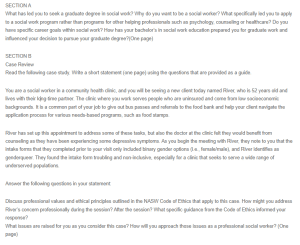
What has led you to seek a graduate degree in social work? Why do you want to be a social worker? What specifically led you to apply to a social work program rather than programs for other helping professionals such as psychology, counseling or healthcare? Do you have specific career goals within social work? How has your bachelor’s in social work education prepared you for graduate work and influenced your decision to pursue your graduate degree?(One page)
Personal Statement – Social Work
SECTION B
Case Review
Read the following case study. Write a short statement (one page) using the questions that are provided as a guide.
You are a social worker in a community health clinic, and you will be seeing a new client today named River, who is 52 years old and lives with their long-time partner. The clinic where you work serves people who are uninsured and come from low socioeconomic backgrounds. It is a common part of your job to give out bus passes and referrals to the food bank and help your client navigate the application process for various needs-based programs, such as food stamps.
River has set up this appointment to address some of these tasks, but also the doctor at the clinic felt they would benefit from counseling as they have been experiencing some depressive symptoms. As you begin the meeting with River, they note to you that the intake forms that they completed prior to your visit only included binary gender options (i.e., female/male), and River identifies as genderqueer. They found the intake form troubling and non-inclusive, especially for a clinic that seeks to serve a wide range of underserved populations.
Answer the following questions in your statement:
Discuss professional values and ethical principles outlined in the NASW Code of Ethics that apply to this case. How might you address River’s concern professionally during the session? After the session? What specific guidance from the Code of Ethics informed your response?
What issues are raised for you as you consider this case? How will you approach those issues as a professional social worker? (One page)
SECTION C
Social Issues and Navigating Different Beliefs
Take a position on a social issue of your choice (e.g., “The death penalty prevents violent crime”). Prepare one to two pages of argument, including facts/research in support of that position. You will be assessed on the quality of your argument, not on the position you have chosen to take on the social issue.
Imagine you are leading a group with another clinician from your agency. After the group ends, while clients are still in the room, the other clinician expresses an opinion about a social issue and denigrates people who hold the opposite opinion. In a brief statement (one to two pages), explain what you would say or do. What are important principles and practices to utilize when discussing different personal and/or professional beliefs? (One page)
 Complete the order form and upload all of your files, including any instructions, rubrics, or other materials provided by your instructor.
  Complete the order payment after filling in the order form. We’ll receive your order and assign it to a writer.
 The assigned writer will complete your paper and forward it to our Editing Team for review and approval.
 Once approved by the editor, the completed paper will be uploaded to your account for you to download, review and approve.