
Personal Professional Reflective Journal
This program has played an important role in my life as it has enabled me to perfect my skills as a nurse. Growing up, I always had a certain level of empathy and caring traits, and I knew then that my personality would be best suited if I pursued a course in nursing. I was not wrong about this, and this program has helped me discover so many things in nursing that I would love to put into practice. I have learnt various things, such as the need for providing person-centered care, engaging in inter-professional collaboration, using various technologies in healthcare, and ethical considerations while providing care. I believe that with the knowledge and skills gained, I will be a better nurse as I will be able to provide the proper and holistic care for patients, work collaboratively with colleagues, patients, and their families, alleviate the clients’ distress, and empower clients and their families on the best way to ensure they are healthier.
With the skills gained throughout this program, I will be able to perform my roles successfully. One of the things or new practice approaches I am passionate about is providing patient-centered care. Patient-centered care is defined by Kwame and Petrucka (2021) as providing care that is responsive to or respectful of the individual patient’s values, needs, and preferences and ensuring that the values of the patient guide every clinical decision. I have learned that in nursing, it is important to acknowledge the knowledge, stories, and experiences of the patient and offer care that respects and concentrates on the patient’s needs, preferences, and values.
One of the most important practices in nursing is interprofessional collaboration. Interprofessional collaboration is linked with lower medication errors, better patient experience, and better patient outcomes. Additionally, Busari et al. (2017) claim that interprofessional collaboration enhances the collective awareness of the skills and knowledge held among other nurses, physicians, and other healthcare workers. As a result, there is an improved quality of care obtained through perpetual enhancement in decision-making. Working with the interdisciplinary team allows the nurse and healthcare team members to be like-minded and focus on creating an atmosphere of autonomy for the patient and reducing mortality and comorbidities regarding the patient’s health. The program has practically and theoretically enabled me to gain the benefits of working collaboratively with others. Among the things that I found to be most important is communication. Poor communication is a major problem that causes obstacles among healthcare workers. Therefore, I should be able to communicate better as a nurse to facilitate better collaboration and patient outcomes. Having learned of my difficulty speaking my mind, I work towards enhancing my communication skills to enhance healthcare outcomes and improve my relations with colleagues.
As a nursing student, I realized that one of the major trends in healthcare is an increment in health care in the US. It is hoped that the new healthcare laws will lessen healthcare expenses while at the same time raising the standard of care. Attaining this balance might be difficult since higher expenses are always linked with a higher quality of care and vice versa. However, it is possible to deliver quality care at a low cost with the help of new technologies. Telehealth is a new trend likely to help the healthcare industry attain this balance. Telehealth makes it possible to keep track of the well-being of patients (Wang et al., 2019). Consultations are via phone or video that use a remote monitor. This provides the patients access to specialists and medical caregivers. Besides, telehealth visits can occur in any medical setting or wherever the staff uses telehealth. This is an optimal time to increase patient care, conduct sanity checks, and advance well-being. The VA system, in which I am doing my preceptorship, uses telehealth as the main source of reaching veterans who cannot or do not have the resources, such as transportation, to visit their appointments. This is a fantastic way to make the patient feel as if they are the only ones that the provider focuses on, and it allows the provider to see the patient in the comfort of their homes.
Another form of healthcare delivery is the use of artificial intelligence. A patient at our facility uses a brain stimulator to decrease his tremors from the effects of Parkinson’s disease. The patient has had the device for less than three months, and it has reduced his tremors significantly. The device is placed under the skin of his chest, and the electrodes are wired into his brain. This is just one of the few artificial intelligence methods that enhance patients’ quality of care.
As a nurse, one will always face various ethically challenging situations. In my case, one of the most sensitive ethical issues revolved around death and dying. The main ethical difficulty was about the decision on resuscitation, as the clients’ family members were at odds regarding this. Even though the ethics team resolved the issue, which allowed for natural death, I became even more aware of issues such as providing advance directives and the power of attorney documentation in such critical moments. Akdeniz et al. (2021) emphasize the need to protect the rights, dignity, and vigor of all parties involved in the clinical ethical decision-making process.
Nursing requires one to examine one’s faith, practices, and beliefs when caring for others who are different from them. The nurse must be culturally aware and realize that all persons should be treated with dignity and respect. Many facilities require that their employees attend cultural sensitivity training yearly. This equips the nurses with the knowledge to care for patients of diverse cultures and not place their beliefs or morals on them or their families. I encountered a Jehovah’s Witness patient who required a blood transfusion, but his faith did not permit this as it is considered sinful (Jehovah’s Witness, 2022). Knowing how important it is not to impose beliefs on patients, I advocated for using other options. Even though this could be futile, I understand that it is important to respect the faith and beliefs of a patient throughout the healthcare process.
One of my major interests as a nurse has been the healthcare disparities that exist among racial minority groups like African Americans and Latinos. The discrimination experienced by racial minorities has extended in health care, causing most minorities to fail to seek or obtain proper care. I continue to educate myself on how to be culturally aware. I realized that my biases are likely to get in the way of how I deliver health care services to individuals of different races and even sexuality. I continue to work on this. I also think that through better health policies and leadership, it will be possible to provide non-discriminatory healthcare services while advocating for the rights of different groups.
As a nurse, I believe that it is my duty to advocate for my patients, and I hope to fulfill this role to its fullest. I am also aware of the need to showcase proper leadership and ensure inclusivity, collaboration, effective communication, and cultural sensitivity in the healthcare setting. Managers should have a basic understanding and be aware of the needs of the community in which they serve, volunteering their time at health fairs, attending interdisciplinary meetings, and making rounds to assess the environment of the patient and the staff in the clinical setting.
References
Akdeniz, M., Yardimci, B., Kavukcu, E. (2021). Ethical considerations at end-of-life care. https://www.ncbi.nlm.nih.gov/pmc/articles/PMC7958189/#:~:text=The%20main%20situations%20that%20create,%2C%20and%20physician%2Dassisted%20suicide.
Busari, J. O., Moll, F. M., & Duits, A. J. (2017). Understanding the impact of interprofessional collaboration on the quality of care: a case report from a small-scale resource-limited health care environment. Journal of multidisciplinary healthcare, 10, 227.
Jehovah’s Witnesses. (2022). Why Don’t Jehovah’s Witnesses Accept Blood Transfusions? https://www.jw.org/en/jehovahs-witnesses/faq/jehovahs-witnesses-why-no-blood-transfusions/
Kwame, A., & Petrucka, P. M. (2021). A literature-based study of patient-centered care and communication in nurse-patient interactions: barriers, facilitators, and the way forward. BMC Nursing, 20(1), 1-10.
Wang, X., Zhang, Z., Zhao, J., & Shi, Y. (2019). Impact of telemedicine on the healthcare service system Considering patients’ choice. Discrete Dynamics in Nature and Society, 2019. https://doi.org/10.1155/2019/7642176.
ORDER A PLAGIARISM-FREE PAPER HERE
We’ll write everything from scratch
Question 
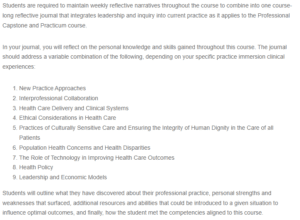
Students are required to maintain weekly reflective narratives throughout the course to combine into one course-long reflective journal that integrates leadership and inquiry into current practice as it applies to the Professional Capstone and Practicum course.
Personal Professional Reflective Journal
In your journal, you will reflect on the personal knowledge and skills gained throughout this course. The journal should address a variable combination of the following, depending on your specific practice immersion clinical experiences:
- New Practice Approaches
- Interprofessional Collaboration
- Health Care Delivery and Clinical Systems
- Ethical Considerations in Health Care
- Practices of Culturally Sensitive Care and Ensuring the Integrity of Human Dignity in the Care of all Patients
- Population Health Concerns and Health Disparities
- The Role of Technology in Improving Health Care Outcomes
- Health Policy
- Leadership and Economic Models
Students will outline what they have discovered about their professional practice, personal strengths and weaknesses that surfaced, additional resources and abilities that could be introduced to a given situation to influence optimal outcomes, and finally, how the student met the competencies aligned to this course.
 Complete the order form and upload all of your files, including any instructions, rubrics, or other materials provided by your instructor.
 Complete the order payment after filling in the order form. We’ll receive your order and assign it to a writer.
 The assigned writer will complete your paper and forward it to our Editing Team for review and approval.
 Once approved by the editor, the completed paper will be uploaded to your account for you to download, review and approve.