
Personal Mastery Reflection Paper
Lessons Learned While Determining the Appropriate Social and Emotional Power Skills
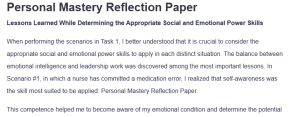
When performing the scenarios in Task 1, I better understood that it is crucial to consider the appropriate social and emotional power skills to apply in each distinct situation. The balance between emotional intelligence and leadership work was discovered among the most important lessons. In Scenario #1, in which a nurse has committed a medication error, I realized that self-awareness was the skill most suited to be applied: Personal Mastery Reflection Paper.
This competence helped me to become aware of my emotional condition and determine the potential effect on my reaction to the distress of the nurse. Self-awareness of emotions would allow me to decide not to react with frustration but with empathy, making the conversation more supportive and growth-focused. It was also a good illustration that effective leadership needs emotional control to suppress personal and team emotions, which would otherwise affect trust and morale (Younas et al., 2020).
Another important lesson was how social awareness is essential in overcoming conflict and communication obstacles, as in Scenario #3. In this instance, I used social awareness to determine that the patient suffered because of the language and cultural barrier. I also learned that being a leader does not only mean organizing and controlling the work; it also means being sensitive to social situations and reacting to emotional signals.
The knowledge of the impact of cultural and linguistic issues on communication allows me to approach the interaction with patients more effectively, ensuring that I establish trust and respect (Taylan & Weber, 2022). This event made me more confident in my understanding that being a leader implies having empathy, the skill of listening actively, and the readiness to adjust to the needs of other people.
Building Confidence in Leadership Abilities Through Strengths
Utilizing my strengths in these situations has been central to shaping my confidence as a leader. Indicatively, in Scenario #4, my strengths allowed me to engage in coaching and active listening to make a new nurse feel more confident in discussing topics in a team. By providing positive criticism in a non-threatening manner, I offered a non-judgmental environment where the nurse could raise concerns and participate in team discussions.
Not only did this boost the nurse’s confidence, but it also reminded me that I can mentor others. This experience increased my confidence and convinced me of the worth of empathetic leadership since I could see the practical effect of my coaching abilities on the development of the nurse.
In Scenario #2, I used self-management under stressful conditions, and it also supported my leadership skills. Although I was pressured to manage a staffing shortage, I remained calm and controlled my emotions, which relaxed the team. This situation made me understand that being emotionally led during crisis moments develops trust within the team and offers stability.
One of the most important things I did to create a productive environment was manage my emotions so the team members could feel supported instead of overwhelmed (Maldonado & Márquez, 2023). The experience instilled confidence in me concerning my capability to stay composed and functional in stressful encounters, which is essential in leadership.
Understanding My Leadership Style and Motivation Through Personal Mastery
The process of building personal mastery has played a central role in helping me develop an understanding of my leadership style and improve on it. When going through the scenarios in Task 1, I discovered that my leadership style is based on emotional intelligence. It is clear that being a good leader goes beyond getting things done; it entails developing meaningful emotional connections with others and ensuring that people feel understood, heard, and appreciated (Alsadaan, 2023). In Scenario #4, using my coaching strengths to assist a colleague in gaining team confidence allowed me to realize that my leadership style is focused on development, coaching, and belonging.
The personal mastery development has also encouraged me to be a more genuine leader. I now understand that being a true leader is about self-awareness, controlling one’s emotions, and being emphatically concerned about others. This knowledge about my feelings and their impact on my leadership style has given me the power to be an authentic leader driven by my values (Kleynhans et al., 2022). This congruence has strengthened my determination to provide an environment where team members are empowered to do their best.
References
Alsadaan, N. (2023). Impact of nurse leaders behaviors on nursing staff performance: A systematic review of literature. Inquiry: A Journal of Medical Care Organization, Provision and Financing, 60(60). https://doi.org/10.1177/00469580231178528
Kleynhans, D. J., Heyns, M. M., Stander, M. W., & de Beer, L. T. (2022). Authentic leadership, trust (in the leader), and flourishing: Does precariousness matter? Frontiers in Psychology, 13(798759). https://www.ncbi.nlm.nih.gov/pmc/articles/PMC9012166/
Maldonado, I. C., & Márquez, M.-D. B. (2023). Emotional intelligence, leadership, and work teams: A hybrid literature review. Heliyon, 9(10), 1–19. https://doi.org/10.1016/j.heliyon.2023.e20356
Taylan, C., & Weber, L. T. (2022). “Don’t let me be misunderstood”: Communication with patients from a different cultural background. Pediatric Nephrology, 38(3), 643–649. https://doi.org/10.1007/s00467-022-05573-7
Younas, A., Rasheed, S. P., Sundus, A., & Inayat, S. (2020). Nurses’ perspectives of self‐awareness in nursing practice: A descriptive qualitative study. Nursing & Health Sciences, 22(2), 398–405. https://doi.org/10.1111/nhs.12671
ORDER A PLAGIARISM-FREE PAPER HERE
We’ll write everything from scratch
Question 
Follow the instructions on the attachment
A. Write a two-page paper on personal mastery by doing the following:
- Describe lessons learned while determining the appropriate social and emotional power skills to address the scenarios in Task 1.

Personal Mastery Reflection Paper
- Discuss how the application of your strengths to the scenarios helped you build confidence in your leadership abilities. Include an example in your discussion.
- Explain how the path toward development of your personal mastery has helped you understand your leadership style and how developing personal mastery motivates you to become a stronger, more authentic leader.
- Include three relevant scholarly sources.
 Complete the order form and upload all of your files, including any instructions, rubrics, or other materials provided by your instructor.
  Complete the order payment after filling in the order form. We’ll receive your order and assign it to a writer.
 The assigned writer will complete your paper and forward it to our Editing Team for review and approval.
 Once approved by the editor, the completed paper will be uploaded to your account for you to download, review and approve.