
Personal Legislative Agenda & Action Plan
(Student’s Name)
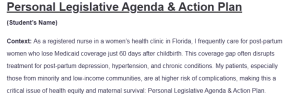
Context: As a registered nurse in a women’s health clinic in Florida, I frequently care for post-partum women who lose Medicaid coverage just 60 days after childbirth. This coverage gap often disrupts treatment for post-partum depression, hypertension, and chronic conditions. My patients, especially those from minority and low-income communities, are at higher risk of complications, making this a critical issue of health equity and maternal survival: Personal Legislative Agenda & Action Plan.
Problem: Among the states, Florida has among the worst maternal mortality rates, and more than one in three of its deaths happen more than 60 days post-partum. Without continuous care, women are less treated and have worsened health outcomes. This gap in Medicaid coverage disproportionally affects black and Latina mothers. Post-partum care would be comprehensive, and medically vulnerable periods would be covered, significantly reducing racial disparities in the case of this occurring over a 12-month post-partum extension.
Proposed State Legislation: SB 348 / HB 645: Medicaid Coverage for Post-Partum Women
My position: Support
Proposed Federal Legislation: H.R. 8181 – Helping MOMS Act of 2023
My position: Support
| Proposed Legislation | Summary/
Description |
Process &
Update |
My Advocacy Actions | Current
Status of Proposed Legislation |
Next Steps |
| State: State: SB 348 / HB 645 – Medicaid Coverage for Post-partum Women | Under this legislation, Florida Medicaid coverage for women after giving birth will be extended from the present 60 days to 12 months, maintaining access to physical and mental healthcare. It will help reduce emergency room visits to address racial and geographic disparities in maternal mortality and also enable continuity of care (Saldanha et al., 2023). | A legislative bill, SB 348, was introduced by Senator Lauren Book on 10/19/2023—11/14/2023. Representative Kelly Skidmore filed HB 645. On 1/9/2024, SB 348 was referred to the Senate Health Policy, Appropriations Subcommittee on Health and Human Services, and Appropriations. On 1/11/2024, HB 645 was referred to the Health Care Appropriations Subcommittee and Health & Human Services Committee. Awaiting dates of committee hearings.
|
I emailed Senator Book and Rep Skidmore expressing my appreciation for having filed the bills. I sent an email to my district legislators asking them to become co-sponsors of the bill, and to my surprise, my data from the Florida Department of Health on maternal Health did the rest. I also joined the Florida Nurses Association call that they held to organize a coalition. I also made a policy fact sheet and distributed it at my clinic. Moreover, in the social media accounts that are considered professional, I posted bill details and maternal health infographics (Chen & Wang, 2021). | The bill is waiting for review by the committee. Public hearings are anticipated as the legislative session has started. The Florida Nurses Association and March of Dimes have given it official support. With bipartisan interest in the bill, active constituent and stakeholder engagement will be needed to pass the bill. | I will work with other nurse advocates to prepare testimony. When I schedule the committee hearing, I will attend and contribute to petition drives, which Florida Voices will sponsor for Health. Additionally, I will put together a letter to local media calling on my colleagues to vote for this legislation that supports health equity and will prevent avoidable maternal deaths. |
| Federal: H.R. 8181 – Helping MOMS Act of 2023 | The enhanced federal matching funds offered by this federal legislation also encourage states to extend their Medicaid and CHIP coverage for post-partum individuals to 12 months. Since it does away with administrative burdens and offers a long-term option for states without having to ask for waivers, it is not surprising that several states are joining the plan. It is in line with wider aims to narrow racial disparities in maternal well-being (Herd & Johnson, 2024). | A bill that was introduced in 4/4/2023 for the House by Rep. Robin Kelly. He was referred to the House Energy and Commerce Committee. It was discussed during a session of the Subcommittee on Health regarding maternal mortality. A formal markup is still pending. The legislation was co-sponsored by both Democratic and Republican representatives and backed by professional organizations, such as the American Nurses Association and AWHONN. | To follow the bill’s progress, I used Congress.gov and sent an email to my federal representative, Rep. Frederica Wilson, requesting her to be a co-sponsor. At our clinic, I posted an informational flyer about the Helping MOMS Act. AWHONN held a webinar about maternal health advocacy at the federal level, which I attended. I also went on LinkedIn to connect with other nurses, share information, and coordinate letter-writing with Congress members. | The bill is getting bipartisan support, though a committee is still reviewing it. Over the last two months, national advocacy groups have rallied to ask for markup and floor consideration in 2024. Maternal health advocacy networks still see it as one of the top federal priorities (Okeke et al., 2023). | I will keep following Congress.gov and ANA alerts for further updates from committees in Congress. I plan to co-author a letter with some of my colleagues and submit it to the federal representatives supporting the bill. I will similarly run an educational session with local nursing students about federal legislation and maternal health outcomes. Also, I will advocate on social media using the hashtags #HelpingMOMS and #Medicaid4Moms. |
Connecting Kingdon’s Theory of Policy Change to My Personal Legislative Agenda & Action Plan
| Kingdon’s Three Streams | Relevance to My Personal Legislative Agenda & Action Plan |
| Problem | The problem of the high maternal mortality rate in Florida exists, in particular, among Black and Latina women, where there is a critical gap in post-partum care. However, today, Medicaid coverage for mothers is only 60 days after giving birth, even though CDC data shows that a large chunk of maternal deaths happen six weeks to a year after the birth (The Florida Maternal and Infant Health Crisis, 2024). This leads to an urgent public health problem that cannot be ignored anymore.
Thus, to place this problem on the policy agenda, I frame this issue as a crisis based on epidemiological data and patient testimonies. As a nurse, I use real and direct clinical experiences as well as state-level statistics to demonstrate how this problem unfairly affects underserved communities and leads to preventable deaths. I aim to reframe this as both a health equity issue and a cost-saving opportunity. |
| Politics | Florida has opportunities and challenges in the political environment. Although Medicaid expansion has generally been controversial in the state, increasing numbers across political parties are now willing to tackle maternal mortality since it affects families, newborns, and long-term public health costs. Bipartisan sponsors for legislative SB 348 and HB 645 indicate the possibility of a crack in the political stream.
In addition, broader public support is made by the Black Maternal Health Caucus and First Lady initiatives, which have brought national attention to maternal health disparities (Diouf et al., 2024). In this environment, I use their platform to communicate with the legislators, organize grassroots advocacy and deliver nonpartisan messages aimed at family well-being and economic efficiency. Additionally, I monitor public sentiment and the news media and adapt messages that resonate with Florida political values, such as community health, fiscal responsibility and child protection. |
| Policy | There are viable policy solutions already in hand for the problem. More than 30 states have enacted or approved 12-month post-partum Medicaid coverage. These models can be replicated in Florida with confidence and with the Helping MOMS Act funding that happens through the federal government. Politically and economically, it would be feasible, which makes the proposed state bill (SB 348 / HB 645) possible.
Collectively, I provide evidence proven by the CDC and CMS to back up the effectiveness of extended coverage as a nurse advocate (McHugh et al., 2021). In addition, I partner with professional organizations like the Florida Nurses Association and March of Dimes to get patient advocate legislation written and shaped pragmatically and inclusively based on implementation data from other states. It proves that strong technical feasibility, public value, and administrative clarity are all the key criteria for Kingdon’s policy stream. |
| Likelihood of Policy Change | While Florida’s 12 months of post-partum Medicaid coverage is still some way off, with a bi-partisan state commitment and federal incentives, the right elements are in place to enact the change. This initiative is aligning public health leaders, nurses and advocacy groups. Framing on issues of cost-effectiveness and infant outcomes is politically appealing based on party lines (Chiu et al., 2021). The bill’s continued success will require continuous advocacy, testimony and education for CM stakeholders, and there will also be work needed to ensure the bill’s activation and implementation in 2024. |
| Next Steps | I will go to local district office hours and speak with my local representative and senator to advocate co-sponsorship and support. Sharing guidance with other nurses, I will collect maternal health stories from our clinic to help me coordinate testimony submissions for the Health Policy and Appropriations Committees. An op-ed in a regional news outlet will be written and published, and a webinar regarding advocacy will be held for nursing students.
I will also attend upcoming Florida Nurses Association advocacy training and participate in organized lobbying days at the Capitol. I will continue to monitor the status of both SB 348 and H.R. 8181 through the Florida Senate Tracker and Congress.gov. I will respond immediately when opportunities arise to comment on bills or to appear at public hearings.
|
References
Chen, J., & Wang, Y. (2021). Social media usage for health purposes: Systematic review. Journal of Medical Internet Research, 23(5). https://doi.org/10.2196/17917
Chiu, P., Cummings, G. G., Thorne, S., & Makaroff, K. S. (2021). Policy advocacy and nursing organizations: A scoping review. Policy, Politics, & Nursing Practice, 22(4), 276–296. https://doi.org/10.1177/15271544211050611
Diouf, F., Thompson, T., Silesky, M., & Bonnevie, E. (2024). A call to action: Supporting Black maternal and infant health using the collective impact model. Maternal and Child Health Journal, 28. https://doi.org/10.1007/s10995-024-03937-z
Herd, P., & Johnson, R. A. (2024). Rationing rights: Administrative burden in Medicaid long-term care programs. Journal of Health Politics, Policy and Law. https://doi.org/10.1215/03616878-11567708
McHugh, K., Martinez, R. M., & Alper, J. (2021). Proceedings of a workshop. In www.ncbi.nlm.nih.gov. National Academies Press (US). https://www.ncbi.nlm.nih.gov/books/NBK575266/
Okeke, C., Uzochukwu, B., Shung-King, M., & Gilson, L. (2023). The invisible hands in policy making: A qualitative study of the role of advocacy in priority setting for maternal and child health in Nigeria. Health Promotion Perspectives, 13(2), 147–156. https://doi.org/10.34172/hpp.2023.18
Saldanha, I. J., Adam, G. P., Kanaan, G., Zahradnik, M. L., Steele, D. W., Chen, K. K., Peahl, A. F., Danilack-Fekete, V. A., Stuebe, A. M., & Balk, E. M. (2023). Health insurance coverage and post-partum outcomes in the US. JAMA Network Open, 6(6), e2316536–e2316536. https://doi.org/10.1001/jamanetworkopen.2023.16536
The Florida Maternal and Infant Health Crisis. (2024). The Florida Maternal and Infant Health Crisis. https://floridahealthjustice.org/wp-content/uploads/2024/04/2023.07.28_formattedfhjpmaternalhealth_v3-1.pdf
ORDER A PLAGIARISM-FREE PAPER HERE
We’ll write everything from scratch
Question 
Personal Legislative Agenda
How can you move a policy forward? What strategies need to be implemented, evidence compiled, or resources utilized? What is the plan for the legislative process?
For this Assignment, you will create a Personal Legislative Agenda in which you will detail your strategy for moving your policy through the legislative process.
Begin working in Week 5, it is not due until Week 7.
To Prepare
- Review the Personal Legislative Agenda and Action Plan Exemplar to demonstrate how you will construct your Personal Legislative Agenda for the state and federal proposed legislation.
- Review the Personal Legislative Agenda and Action Plan Exemplar to determine which approach might work best for advancing your policy initiatives at various stages of the legislative process.
Personal Legislative Agenda & Action Plan
Submit a Personal Legislative Agenda detailing your strategy for moving your policy through the legislative process, using the Personal Legislative and Agenda and Action Plan Exemplar as your template.In your Personal Legislative Agenda, choose from the strategies provided in Advocacy Toolkit resource that best suite moving your policies forward. Be sure to connect the strategies to the appropriate sections of the policy model you selected in Module 2.
(operating simultaneously in ways that mutually reinforce one another to shape opportunities that advance health equity or create).
 Complete the order form and upload all of your files, including any instructions, rubrics, or other materials provided by your instructor.
  Complete the order payment after filling in the order form. We’ll receive your order and assign it to a writer.
 The assigned writer will complete your paper and forward it to our Editing Team for review and approval.
 Once approved by the editor, the completed paper will be uploaded to your account for you to download, review and approve.