
Peer Responses-How Servant Leadership Can Be Applied When Going Through a Health Emergency
Thank you for your post. This is quite a good presentation of how servant leadership can be applied during a health emergency to inspire courage, self-sacrifice, and nobility in delivering patient care on the frontline. The COVID-19 pandemic period was a trying time for both nurses and nurse leaders. They were tasked as the forefront healthcare providers with the burden of restoring population and public health in environments that risked their health. Working during the COVID-19 period exposed nurses and other healthcare providers to greater health risks. Such healthcare delivery settings require the leadership to ensure the protection of the frontline care providers from any form of harm. The ability of servant leadership to manage and encourage nurses through such tough times is based on its approach to prioritizing the delivery of services for the greater good (Canavesi & Minelli, 2022).
The important part of servant leadership is that it leverages the leader’s self-efficacy in terms of their capabilities, attitudes, and willingness to inspire collaborative interprofessional practices to achieve excellent patient and health outcomes (Murphy et al., 2020). Servant leadership is focused on the wellness of the team and the organization rather than the leaders’ objectives. Its approach to allowing all healthcare staff to weigh in during decision-making makes them feel their input and efforts matter, therefore meeting their need to belong. It also makes the interprofessional team members have a shared responsibility; therefore, each individual feels they have a role to play. Employees in a servant leadership environment are more likely to feel that their voices are heard. This is a basic explanation of why servant leadership was so critical in the successes achieved in managing the pandemic and why it should be implemented across the entire healthcare system.
References
Canavesi, A., & Minelli, E. (2022). Servant Leadership: a Systematic Literature Review and Network Analysis. Employee Responsibilities and Rights Journal, 34(3), 267. https://doi.org/10.1007/S10672-021-09381-3
Murphy, C., Campbell, E., Boland, P., & Sick, B. (2020). The leadership baseline: Assessing servant leadership and leadership self-efficacy in first-year health professions students. Journal of Interprofessional Education & Practice, 20, 100354. https://doi.org/10.1016/J.XJEP.2020.100354
ORDER A PLAGIARISM-FREE PAPER HERE
We’ll write everything from scratch
Question 
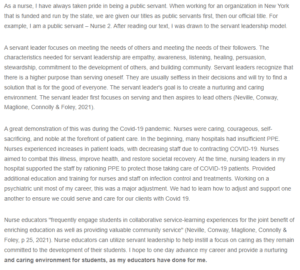
As a nurse, I have always taken pride in being a public servant. When working for an organization in New York that is funded and run by the state, we are given our titles as public servants first, then our official title. For example, I am a public servant – Nurse 2. After reading our text, I was drawn to the servant leadership model.
How Servant Leadership Can Be Applied When Going Through a Health Emergency
A servant leader focuses on meeting the needs of others and meeting the needs of their followers. The characteristics needed for servant leadership are empathy, awareness, listening, healing, persuasion, stewardship, commitment to the development of others, and building community. Servant leaders recognize that there is a higher purpose than serving oneself. They are usually selfless in their decisions and will try to find a solution that is for the good of everyone. The servant leader’s goal is to create a nurturing and caring environment. The servant leader first focuses on serving and then aspires to lead others (Neville, Conway, Maglione, Connolly & Foley, 2021).
A great demonstration of this was during the Covid-19 pandemic. Nurses were caring, courageous, self-sacrificing, and noble at the forefront of patient care. In the beginning, many hospitals had insufficient PPE. Nurses experienced increases in patient loads, with decreasing staff due to contracting COVID-19. Nurses aimed to combat this illness, improve health, and restore societal recovery. At the time, nursing leaders in my hospital supported the staff by rationing PPE to protect those taking care of COVID-19 patients. Provided additional education and training for nurses and staff on infection control and treatments. Working on a psychiatric unit most of my career, this was a major adjustment. We had to learn how to adjust and support one another to ensure we could serve and care for our clients with Covid 19.
Nurse educators “frequently engage students in collaborative service-learning experiences for the joint benefit of enriching education as well as providing valuable community service” (Neville, Conway, Maglione, Connolly & Foley, p 25, 2021). Nurse educators can utilize servant leadership to help instill a focus on caring as they remain committed to the development of their students. I hope to one day advance my career and provide a nurturing and caring environment for students, as my educators have done for me.
References
Neville, K., Conway, K., Maglione, J., Connolly, K. A., Foley, M., & Re, S. (2021).
Understanding Servant Leadership in Nursing: A Concept Analysis. International Journal for Human Caring, 25(1), 22–29. https://doi-org.usu.idm.oclc.org/10.20467/HumanCaring-D-20-00022
 Complete the order form and upload all of your files, including any instructions, rubrics, or other materials provided by your instructor.
 Complete the order payment after filling in the order form. We’ll receive your order and assign it to a writer.
 The assigned writer will complete your paper and forward it to our Editing Team for review and approval.
 Once approved by the editor, the completed paper will be uploaded to your account for you to download, review and approve.