
Peer Responses
Person 1
Hello,
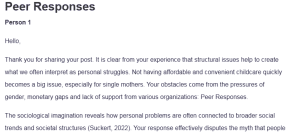
Thank you for sharing your post. It is clear from your experience that structural issues help to create what we often interpret as personal struggles. Not having affordable and convenient childcare quickly becomes a big issue, especially for single mothers. Your obstacles come from the pressures of gender, monetary gaps and lack of support from various organizations: Peer Responses.
The sociological imagination reveals how personal problems are often connected to broader social trends and societal structures (Suckert, 2022). Your response effectively disputes the myth that people with challenges are not motivated. A further analysis could ask: Does the presence of two parents in the home impact the handling of employment schedules and the use of leave?
Information about key trends can be found through a policy analysis or case study. From your story, I can tell that inequality keeps happening and that sociology is needed to fix these issues. Learning these patterns is very important if we want to encourage policies like subsidized childcare and fair wages.
References
Suckert, L. (2022). Back to the Future. Sociological Perspectives on Expectations, Aspirations and Imagined Futures. European Journal of Sociology, 1–36. https://doi.org/10.1017/s0003975622000339
Person 2
Hello,
Great post! You point out that unequal financial circumstances can significantly affect educational chances and results. You thought your problem was not trying your best enough when the lack of tutoring and technology support played a bigger role. Using the sociological imagination shows that larger social structures and forces shape many individual issues (Longo et al., 2021).
Your critique of the headline about students “not wanting to learn” is essential; it oversimplifies complex issues and ignores how poverty, mental health, and home life affect student engagement. How community school funding differences influence student support access is an additional question worth exploring. Interviews and school observations would help to observe the lived experiences of students.
As you noted, “Blaming it on the students is the LAZY way of thinking”. Your example deepens my understanding of how social class shapes access to opportunity and reinforces the importance of questioning surface-level claims through a sociological lens.
References
Longo, S. B., Isgren, E., Clark, B., Jorgenson, A. K., Jerneck, A., Olsson, L., Kelly, O. M., Harnesk, D., & York, R. (2021). Sociology for sustainability science. Discover Sustainability, 2(1). https://doi.org/10.1007/s43621-021-00056-5
ORDER A PLAGIARISM-FREE PAPER HERE
We’ll write everything from scratch
Question 
Instruction: respond to at least two of your classmates. Consider the following:
- What broader social forces might help explain the experiences or claims they describe?
- Are there other research questions or methods they could explore?
- How do their examples deepen your understanding of how the personal connects to the societal?
Person 1
As a single mother of a three-year-old daughter, I’ve experienced firsthand the challenges of balancing full-time parenting with school and part-time work. One moment that stands out is when I had to miss work because I couldn’t find last-minute childcare.
While this might seem like an individual problem, using the sociological imagination reveals broader structural issues at play such as the lack of affordable childcare options in the U.S., the economic pressures on single-parent households, and the gendered expectations that still place the burden of caregiving primarily on women.
My social position—as a working-class, young, Black woman—further complicates access to resources and support, and shapes how institutions like schools or workplaces respond (or fail to respond) to my needs.
A recent claim circulating on social media is: “If you really wanted to work, you wouldn’t be struggling. People are just lazy these days.” This statement reflects a widespread belief in individual responsibility without acknowledging structural barriers.
A sociologist might challenge this by asking: What systemic obstacles exist that prevent people from accessing stable employment? How do race, gender, parenthood, or access to education affect employment outcomes?
To investigate this claim, I would propose a mixed-methods study combining quantitative surveys (to assess how different groups experience barriers to employment) and qualitative interviews (to explore the lived experiences behind those numbers). Ethical considerations would include ensuring participant confidentiality, especially when discussing sensitive issues like financial hardship or discrimination.
My personal experience challenges the public claim that people are poor or struggling solely due to a lack of effort. Despite my strong work ethic and drive to pursue higher education, I still encounter institutional and social barriers that limit my opportunities. Thinking sociologically helps uncover how factors like childcare access, class status, and gender roles create unequal burdens.
Using both sociological imagination and research methods allows us to shift blame away from individuals and instead focus on the systems that perpetuate inequality. Understanding these patterns is essential if we hope to advocate for policies like subsidized childcare, livable wages, or flexible academic support for non-traditional students.
Peer Responses
Person 2
A personal experience that comes to mind for me is when I was in high school there were a lot of my classmates that talked about their parents buying them brand new laptops for college in the fall or how they were able to get a tutor to help them study for their ACT.
When it came to me I did not have the luxury of having my parents buying me a laptop, if I wanted something like that I had to save money for it, and I for sure couldn’t afford the extra help to hire a tutor, don’t get me wrong my friends and I helped me study but we were all for the most part at the same level.
I remember feeling frustrated that I wasn’t able to do the things that my “richer” peers were able to do/get I felt like maybe I could’ve done better if I was able to get that extra help or that I didn’t try hard enough. Thinking about the sociological imagination I can reflect on that experience now as not just a me “issue” but a bigger issue as in a economic inequality in education. For families that had more money could more money into their kids education as well as in their future.
But when it comes to families that are lower income they can’t always do that, they have to rely on their kids current education. I was in a family where it was a working class household, we focused more on the bills that needed to be paid over extra tutoring time.
If I wanted a tutor it was on me to save up the money for it, which in a way I am thankful for that because it taught me good work ethic and if I want something I have to work for it. I think my experience was shaped by social class.
What made me think about my experience is that I recently had a professional development day at the school I work at and we talked about a headline that read: “The real problem with schools is that kids just don’t want to learn anymore” we broke out in discussion groups and talked about how this headline puts blame on students “bad” attitudes, but completely blows past and ignores the bigger picture. Thinking about this and relating it back to what we have learned this week from a sociologists stand point, they wouldn’t look at this headline at face value.
I think they would ask questions about why some students look or seemed disengaged, what does their home life look like, what is their mental health like, or how does income, racism or other factors affect their motivation once they are in school? I think a way to collect data on this is to do direct interviews with a diverse group of students and ask these questions and truly get a better idea on what outside factors that they can’t necessarily control affect them once they get to school.
Another method that could be used is observations, looking at different schools and how teaching methods may differ from school to school to see if that has an affect on students motivation. Obviously if these research methods were conducted the students privacy is key and well as making sure any participation is voluntary and safe.
This connects to my experience in a big way because how I did in school wasn’t because I lacked motivation, I didn’t have the same resources as my peers. It was the lack of resources and opportunities for me, looking at the bigger picture of the barriers that may be blocking students to succeed instead of calling the kids lazy. Blaming it on the students is the LAZY way of thinking, as a society how can we change systems to give EVERYONE a fair chance?
less
 Complete the order form and upload all of your files, including any instructions, rubrics, or other materials provided by your instructor.
  Complete the order payment after filling in the order form. We’ll receive your order and assign it to a writer.
 The assigned writer will complete your paper and forward it to our Editing Team for review and approval.
 Once approved by the editor, the completed paper will be uploaded to your account for you to download, review and approve.