
Peer Responses
Responding to Stacey Agusta Hill
Hello,
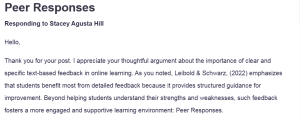
Thank you for your post. I appreciate your thoughtful argument about the importance of clear and specific text-based feedback in online learning. As you noted, Leibold & Schwarz, (2022) emphasizes that students benefit most from detailed feedback because it provides structured guidance for improvement. Beyond helping students understand their strengths and weaknesses, such feedback fosters a more engaged and supportive learning environment: Peer Responses.
The literature also points out that feedback helps students develop an attachment to the instructors, especially in online learning (Ryan, 2021). Therefore, do you agree that even the incorporation of points such as post-teaching follow-up or discussion-based feedback could improve the student-instructor bonds even better?
Another key aspect to consider is the role of feedback timing. Timely feedback allows students to process and apply suggestions while the material is still fresh in their minds (Ryan, 2021). On the other hand, delay in feedback creates frustration and demotivates the students or learners in a certain subject area.
Notably, when it comes to delayed feedback, most students been in a situation where they were crippled on how they can enhance their work on an assignment. Conceivably, investigating how often students receive feedback as well as when they receive feedback may also be more useful in the future.
References
Leibold, N., & Schwarz, L. M. (2022). Student Perceptions of Teacher Online Feedback. Journal of Effective Teaching in Higher Education, 5(2), 22–42. https://doi.org/10.36021/jethe.v5i2.302
Ryan, T. (2021). Designing video feedback to support the socioemotional aspects of online learning. Educational Technology Research and Development, 89(79). https://doi.org/10.1007/s11423-020-09918-7
Responding to Ebony Marie Trahan
Hello,
You present a strong argument about the role of text-based feedback in facilitating comprehension and deeper learning in online education. As Feng et al., (2025) points out, written feedback provides students with a clear structure to analyze their performance, which is particularly important in online settings where immediate instructor support is not available. Additionally, research shows that text-based feedback can be more effective than oral feedback because students can revisit and reflect on the comments at their own pace (Feng et al., 2025). Given this, do you think that integrating audio or video feedback alongside text-based feedback could further enhance comprehension and engagement for students?
Another interesting point is how personalized feedback impacts motivation and persistence in online learning. Studies suggest that students who receive individualized, constructive feedback are more likely to stay engaged and complete their courses successfully (Stephen & Rockinson-Szapkiw, 2021).
Since online students often face unique challenges, such as self-regulated learning and time management, effective feedback can serve as both an instructional and motivational tool. Can you recall a time when elaborated feedback boosted your self-confidence and overall result? Analysis of how feedback in the course influences student performance could also add to knowledge on best practices in online teaching.
References
Feng, Q., Li, W., Zhu, X., & Li, X. (2025). Exploring the effects of elaborated and motivational feedback on learning engagement in online scripted role discussion. International Journal of Educational Technology in Higher Education, 22(1). https://doi.org/10.1186/s41239-024-00499-6
Stephen, J. S., & Rockinson-Szapkiw, A. J. (2021). A high-impact practice for online students: the use of a first-semester seminar course to promote self-regulation, self-direction, online learning self-efficacy. Smart Learning Environments, 8(1). https://doi.org/10.1186/s40561-021-00151-0
ORDER A PLAGIARISM-FREE PAPER HERE
We’ll write everything from scratch
Question 
By Day 6
Respond to at least two colleagues by doing one of the following:
- Give feedback on their argument.
- Share insights on critical reading.
Note: Return to this Discussion in a few days to read the responses to your initial posting. Note what you have learned and/or any insights you have gained as a result of the comments your colleagues made.
Topic: Week 2: Discussion
Stacey Agusta Hill
Mar 6 8:52am
Grad Writing II – Discussion week 2
Based on reading this article presented from Gredler’s Article in 2018, I can argue that post-secondary online students generally prefer text-based feedback that is clear, specific, and focused on improvement because it helps them better understand their performance and fosters a more supportive learning environment.
I chose this argument because the article emphasizes how students in online learning environments value feedback that is both detailed and constructive as it provides clear guidance for improvement. As a critical reader, I recognize that the clarity and specificity of feedback directly impact students’ ability to understand their strengths and weaknesses which is crucial for their academic growth. Timely and supportive feedback is shown to increase student engagement and motivation, making it a key factor in enhancing their overall learning experience.
References:
Gredler, J.J. (2018). Postsecondary Online Students’ Preferences for Text-Based Instructor Feedback. International Journal of Teaching and Learning in Higher Education, 30(2), 195.206.
Peer Responses
ET Ebony Marie Trahan
An argument I can construct from Gredler’s (2018) article is that students in online postsecondary programs benefit most from text-based feedback, as it facilitates their comprehension and application of course materials.
I selected this argument due to Gredler’s findings which underscore the need for engagement and feedback clarity, particularly for online learners who do not have the cognitive support available in the physical classroom. Text feedback allows students to think about and analyze the comments made by the instructor, thereby encouraging deeper learning.
Also, as a critical reader, I find this idea interesting since it considers the difficulties of online students and proposes a specific way to help them achieve academically. The proposed perspective can inform effective ways to improve instructional practices in remote learning contexts.
Reference
Gredler, J. J. (2018). Postsecondary Online Students’ Preferences for Text-Based Instructor Feedback. International Journal of Teaching and Learning in Higher Education, 30(2), 195–206.
Patricia Diane Mote
Online postsecondary students strongly prefer personalized, constructive, and timely text-based feedback from instructors, which greatly improves their learning experience and academic success. (M)
I have chosen this argument because Gredler (2018) emphasizes the importance of aligning instructor feedback with student preferences to enhance learning outcomes. I believe, when students and instructors understand each other’s position, needs, and preferences they are in a better position to learn and be taught effectively.
Gredler (2018) further explains that proximal, detailed, and supportive feedback helped students improve their writing skills and understand assessment criteria more easily. I recognize that understanding these preferences is essential for educators to tailor their feedback methods effectively for their students, ultimately fostering a more supportive and engaging learning environment (Gredler, 2018).
Reference
Gredler, J. J. (2018). Postsecondary Online Students’ Preferences for Text-Based Instructor Feedback. International Journal of Teaching and Learning in Higher Education, 30(2), 195–206.
Article:
 Complete the order form and upload all of your files, including any instructions, rubrics, or other materials provided by your instructor.
  Complete the order payment after filling in the order form. We’ll receive your order and assign it to a writer.
 The assigned writer will complete your paper and forward it to our Editing Team for review and approval.
 Once approved by the editor, the completed paper will be uploaded to your account for you to download, review and approve.