
Peer Responses
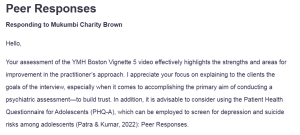
Responding to Mukumbi Charity Brown
Hello,
Your assessment of the YMH Boston Vignette 5 video effectively highlights the strengths and areas for improvement in the practitioner’s approach. I appreciate your focus on explaining to the clients the goals of the interview, especially when it comes to accomplishing the primary aim of conducting a psychiatric assessment—to build trust. In addition, it is advisable to consider using the Patient Health Questionnaire for Adolescents (PHQ-A), which can be employed to screen for depression and suicide risks among adolescents (Patra & Kumar, 2022): Peer Responses.
In light of Tony’s anger and disengagement from school, a further risk assessment and the Columbia-Suicide Severity Rating Scale (C-SSRS) would give a more accurate picture of the risks to the safety of the client (Bjureberg et al., 2021). Further, Multisystemic Therapy (MST) is valuable. In addition, since Tony’s anger issues and social withdrawal may be linked to emotional trauma, Trauma-Focused Cognitive Behavioral Therapy (TF-CBT) could help him process his experiences more effectively (Bjureberg et al., 2021).
References
Bjureberg, J., Dahlin, M., Carlborg, A., Edberg, H., Haglund, A., & Runeson, B. (2021). Columbia-suicide severity rating scale screen version: Initial screening for suicide risk in a psychiatric emergency department. Psychological Medicine, 52(16), 1–9. https://doi.org/10.1017/s0033291721000751
Patra, K., & Kumar, R. (2022). Screening for depression and suicide in children. PubMed; StatPearls Publishing. https://www.ncbi.nlm.nih.gov/books/NBK576416/
Responding to Andrea Sara Martinez
Hello Andrea,
Your response provides a thoughtful evaluation of the practitioner’s strengths and areas for improvement, particularly regarding the need to ask more follow-up questions about anger, substance use, and suicidal ideation. I agree that Mentalization-Based Therapy (MBT) is a strong approach, as adolescents often struggle with identity formation and emotional regulation (Wu et al., 2022). However, given Tony’s impulsivity and anger outbursts, Dialectical Behavior Therapy for Adolescents (DBT-A) may be more beneficial, as it includes mindfulness, emotion regulation, and distress tolerance techniques (Williams et al., 2020).
The Beck Depression Inventory (BDI) and Quick Inventory of Depressive Symptomatology (QIDS) are also excellent tools. Another option could be the Youth Self-Report (YSR). The YSR tool assesses internalizing and externalizing behaviors such as aggression, depression, and anxiety (Williams et al., 2020). This might provide additional insight into Tony’s underlying struggles.
References
Williams, Z. J., Everaert, J., & Gotham, K. O. (2020). Measuring depression in autistic adults: Psychometric validation of the Beck depression inventory–ii. Assessment, 28(3), 858–876. https://doi.org/10.1177/1073191120952889
Wu, T., Hu, J., Davydow, D., Huang, H., Spottswood, M., & Huang, H. (2022). Demystifying borderline personality disorder in primary care. Frontiers in Medicine, 9(1). https://doi.org/10.3389/fmed.2022.1024022
ORDER A PLAGIARISM-FREE PAPER HERE
We’ll write everything from scratch
Question 
Read a selection of your colleagues’ responses.
By Day 6 of Week 1
- Respond to at least two of your colleagues on 2 different days by offering additional insights or alternative perspectives on their analysis of the video, other rating scales that may be used with children, or other treatment options for children not yet mentioned. Be specific and provide a rationale with evidence.
Note: For this Discussion, you are required to complete your initial post before you will be able to view and respond to your colleagues’ postings. Begin by clicking on the Reply button to complete your initial post. Remember, once you click on Post Reply, you cannot delete or edit your own posts and you cannot post anonymously. Please check your post carefully before clicking on Post Reply!
Reading:
- Sadock, B. J., Sadock, V. A., & Ruiz, P. (2015). Kaplan & Sadock’s synopsis of psychiatry (11th ed.). Wolters Kluwer.
Feb 27 1:17am
Week 1 Discussion: YMH Boston Vignette 5 video
What did the practitioner do well? In what areas can the practitioner improve?
The practitioner in the YMH Boston Vignette 5 video had good interviewing skills by introducing herself and asking Tony what brought him in. This is a fundamental question, primarily if someone is being referred sometimes; they do not know why they were told to come and see you. So, it is imperative that you, as a provider and the patient, understand what brings them. The practitioner had good skills in rephrasing questions when she asked Tony about his mood.
Tony felt like his mood was good. However, when she rephrased the question and asked if he was feeling hopeless or had an urge to be angry, Tony opened up by saying that he always felt an urge to be angry and wanted to fight someone. The practitioner did well by asking open-ended questions, like asking Tony why he felt so angry and wanted to fight. Tony explained in detail that he started feeling angry and hopeless two months ago when his girlfriend broke up with him and that he does not like school anymore and is doing poorly in school.
He stopped doing his homework, and he was failing in his classes. When Tony told the Practitioner that he did not want to be alive. The practitioner demonstrated good interviewing skills when exploring more on Tony and whether he had any intentions of harming himself.
It is vital for the practitioner to ask open-ended questions as it will lead to patients providing detailed responses, allowing you to gain a deeper understanding of someone’s thoughts, feelings, and perspectives by enabling the patient to express themselves fully, rather than being limited to pre-defined answer choices.
The areas that the practitioner needed to improve were at the beginning of the interview when she introduced herself and asked him what brought him in. She should have explained who she was and what role she would play in trying to help Tony. She should have also asked Tony what questions she would be asking and what she would do with the information she collected.
She should have explained that the information she was going to gather would help her develop a treatment plan that he can utilize when he feels angry, wants to fight, or feels he has no interest in playing basketball that he used to enjoy. The Practitioner needs to explain what they do with the information they collect is crucial for building trust with the client, ensuring informed consent, and allowing the client to feel empowered and engaged in the therapeutic process by understanding their details will be used to support their treatment plan. When the patient understands the rationale behind the questions asked, it can strengthen the therapeutic relationship and foster collaboration.
My other concern was the lack of tools or assessment scales utilized during this interview; it would have been essential for the provider to know the severity of Tony’s depression so that he could come up with a better treatment plan tailored for Tony.
Compelling concerns? If so, what are they?
My compelling concern in this interview was Tony endorsing feeling hopeless and not wanting to live anymore. I would be concerned with Tony because he is an adolescent. It is documented that the suicide rate in the adolescent population is very high. Youth risk behavior survey data suggested that 17.7%US US high school-aged adolescents seriously consider suicide, and nearly 9% will make an attempt in a given year (Adrian et al., 20222).
What would be your next question, and why?
My next question would have been to ask Tony if he had any intentions or a plan to harm himself. As a provider, it is crucial when screening a patient for suicidal ideation that one must be straightforward with the patient in asking questions. It will be necessary for the provider to ask Tony what his plan is, how he intends to carry it, and when he will do it.
This is an essential part of screening because it determines the treatment plan that needs to be implemented. The suicide rate is very high in adolescent boys. It is also necessary for the provider during the assessment to identify whether the patient has a plan or means for attempting suicide.
Explain why a thorough psychiatric assessment of a child/adolescent is essential.
Assessment of adolescents can be challenging because, in most cases, the decision to see a clinician was made for them, and in most cases, it may be the parents or guardians who make that decision for them. Adolescents cannot be forthcoming with their symptoms if they are embarrassed. This will require their providers to gather information from multiple sources like their parents, guardians, teachers in school, or anyone involved in their care.
By understanding an adolescent’s specific needs and changes, providers can develop personalized treatment plans and interventions that are most likely to be effective. Considering that most psychiatric disorders are diagnosed by gathering comprehensive history and physical exams, clinicians must conduct thorough exams to come up with the correct diagnosis for the patient and treatment plans that are effectively in treating plans that are tailored for children and adolescents.
A thorough psychiatric assessment of a child or adolescent is essential because it provides the clinician with a comprehensive understanding of what is going on with the adolescent and can help with identifying emerging problems like depression, anxiety, learning difficulties, or substance use disorders. By identifying these problems, the clinician can develop the diagnosis and best treatment plan to treat what is happening. A study by Adrian et al. 2022 found that providers who utilized comprehensive assessment to come up with a diagnosis and treatment plans had the best treatment outcomes in managing psychiatric disorders, including decreasing suicidal ideations in teens and adolescents.
Describe two different symptom rating scales that would be appropriate to use during the psychiatric assessment of a child/adolescent.
The two symptom rating scales that are appropriate to use during the psychiatric assessment of a child or adolescent are the Children’s Depression Rating Scale-Revised (CDRS-R), a 17-item instrument administered by the clinician to the parent and child or adolescent. The clinician scores a rating for each item using the information from both the parent and the child. The scale assesses affective, somatic, cognitive, and psychomotor symptoms. An accumulative score of 40 is a marker for moderate depression, and a score of 45 or higher for significant depression (Boland et al., 2022)
The second scale that can be used as a Symptom Rating Scale for psychiatry is the Achenbach Child Behavior Checklist (ACBCL). This comprehensive tool evaluates children’s behavioral, emotional, and social difficulties. This two-version scale was completed by the teachers and another by the parents. The parent version has 118 items, while the teacher version excludes items that pertain to home life.
This scale is used in different settings, including health systems, schools, and mental health services. The scale is adequate for understanding and addressing children’s challenges. The checklist evaluates eight mental disorders, including depression, anxiety, social issues, and attention problems. The scale aligns with DSM-5 Categories, such as attention deficit disorder and oppositional defiant disorder (Achenbach et al., 2019).
Describe two psychiatric treatment options for children and adolescents that may not be used when treating adults.
The two psychiatric treatment options for children and adolescents that may not be used when treating adults include Play Therapy treatment and Multisystemic Therapy (MST). Multisystemic Therapy is an evidence-based, intensive, family-centered treatment model designed for adolescents with severe antisocial behaviors, such as delinquency, substance abuse, and violence. It aims to reduce these behaviors by addressing the multiple systems influencing the individual’s life, including school, family, peers, and community.
The main objective of MST is to work on decreasing behaviors such as substance abuse, aggression, and truancy. The therapy focuses on improving family dynamics and enhancing parenting skills by involving parents and caregivers. MST offers a structured way of addressing the underlying issues and promoting long-term behavioral change. This kind of therapy can be beneficial in addressing behavioral problems such as anger, violence, and alcohol use that Tony was struggling with.
Play Therapy is a therapy approach that utilizes a structured play session to help children express their life experiences, emotions, thoughts, and experiences in a safe environment. Play therapy is effective for younger children and those who struggle to communicate their feelings effectively. Play therapy is a form of psychotherapy that uses play and creative activities to help children express themselves and work through their challenges.
A wide range of issues can be addressed through play therapy, including behavioral issues, anxiety, depression, and difficulties in relationships (Boland et al., 2022). Studies have supported that clinicians who incorporated play therapy as part of a treatment therapy in children had better outcomes. They also gained more insight into what was going on in children’s lives (Shamabadit al., 2022).
Explain the role parents/guardians play in assessment.
Parents and guardians play a vital role during the assessment process of children and adolescents because they provide insight and gaps of what is missing in the child’s history. The parents and guardian can be instrumental in providing detailed accounts of events and information from pregnancy to birth and early development milestones of a child. Information from all these aspects helps the clinician comprehensively understand the child’s physical, emotional, and psychological development. (Pearson et al., 2020).
Parents play a key role in offering valuable insight that can significantly influence a child’s life by sharing details about family dynamics, any history of mental illness, medication they take, parenting styles, and copying skills used in the family. Obtaining information from multiple reliable sources provides a good picture of what is going on with a child.
Also, it helps to formulate the diagnosis and come up with a treatment plan that is patient-centered and tailored for that child or adolescent. A research study done by Pearson et al. (2020) found that Providers gathered comprehensive information from reliable sources such as parents, teachers, and guardians were able to come up with proper diagnoses and treatment plans that were patient-tailored and achieved good outcomes.
References
Adrian, M., Blossom, J. B., Chu, P. V., Jobes, D., & McCauley, E. (2022). Collaborative
assessment and management of suicidality for teens: A promising frontline intervention for addressing adolescent suicidality. Practice Innovations, 7(2), 154–167. https://doi.org/10.1037/pri0000156Links to an external site.
Boland, R. Verdiun, M. L. & Ruiz, P. (2022). Kaplan & Sadock’s synopsis of psychiatry (12th
ed.). Wolters Kluwer
Loades, M. E., Read, R., Smith, L., Higson-Sweeney, N. T., Laffan, A., Stallard, P., Kessler, D.,
& Crawley, E. (2021). How common are depression and anxiety in adolescents with chronic fatigue syndrome (CFS) and how should we screen for these mental health co-morbidities? A clinical cohort study. European Child & Adolescent Psychiatry, 30(11), 1733–1743. https://doi.org/10.1007/s00787-020-01646-w
Pearson, T., Wagner, S., & Schmidt, G. (2020). Parental perspective: Factors that played a role in
facilitating or impeding the parents’ understanding of their child’s developmental diagnostic assessment. Child: Care, Health & Development, 46(3), 320–326. https://doi.org/10.1111/cch.12751Links to an external site.
Shamabadi, R., Nosratabadi, M., Asgharinekah, S. M., & Banihashem, A. (2022). Effectiveness
of group play therapy based on choice theory on executive functions of children and adolescents with cancer. Journal of Fundamentals of Mental Health, 24(5), 341–347.
PDF REFERENCE SUPPORT
Peer Responses
Adrian, M., Blossom, J. B., Chu, P. V., Jobes, D., & McCauley, E. (2022). This was a peer-reviewed study. The authors are scholars and academics who have co-authored multiple psychiatry and behavioral sciences studies. The authors are scholars, and they listed their affiliations as Department of Psychiatry and Behavioral Sciences, University of Washington, Seattle, WA, US, The authors list the journals publication history First Posted: Aug 26, 2021; Accepted: Jun 4, 2021; Revised: Apr 16, 2021; First Submitted: Jan 4, 2021. The authors also include the name of the sponsor for the study funded the research study as Sponsor: Agency for Healthcare Research and Quality, Grant Number: K12HS022982, Recipients: Adrian, Molly
Boland, R. Verdiun, M. L. & Ruiz, P. (2022).
The 12th edition of this seminal textbook builds on the long-standing reputation of Kaplan & Sadock’s works. is Published by Wolters Kluwer, it remains an authoritative and updated resource for psychiatric education and practice.
Loades, M. E., Read, R., Smith, L., Higson-Sweeney, N. T., Laffan, A., Stallard, P., Kessler, D., & Crawley, E. (2021). This was a cohort study, it was peer-reviewed. The authors are scholars and academics who have co-authored multiple studies in psychiatry and behavioral sciences. This is a chronic cohort study. The authors also listed their affiliations as Department of Psychology, University of Bath, BA2 7AY, Bath, UK, Bristol Medical School, University of Bristol, Bristol, UK, Royal United Hospital, Bath, UK Department of Health, University of Bath, Bath, UK
NRNP 6665 Discussion WEEK 1-1.docx
Andrea Sara Martinez (She/Her)
Feb 26 10:51pm
Manage Discussion by Andrea Sara Martinez
Wk 1 DB original post
Comprehensive Integrated Psychiatric Assessment
Introduction
When conducting a comprehensive integrated psychiatric assessment on children and adolescents, it is important to be able to connect with the patient and collaborate with their caregivers to obtain a better understanding of the culture and environment (Sharma et al., 2019). This information can aid in the assessment and treatment of a child or adolescent, especially if they are diagnostically challenging and lack insight. Depression is a leading cause of disability and identifying risk factors in adolescent depression is important for early intervention (Ho et al., 2022).
This discussion board will discuss the strengths and weaknesses of the YMH Boston Vignette video 5 practioner interview as well as how to enhance the assessment. Additionally, this post will discuss concerns and what additional questions are necessary. Furthermore, this discussion post will discuss two rating scales, as well as treatment options that are appropriate for a child/adolescent and what role parents and guardians play.
YMH Boston Vignette 5 video
In this vignette, the practitioner presents a friendly and positive appearance with a calm tone. This can help the client feel safe and share their feelings. Additionally, this practitioner is engaging the client at the same eye level and interviewing the client separately from the parent or caregiver. Privacy is also beneficial, allowing the client to feel comfortable sharing their thoughts and feelings.
The practitioner does ask the client about the purpose of his visit and does ask about his mood but does not ask for consent to be evaluated or treated. She could improve the vibe of the interview by giving more time at the beginning of the interview to get to know the client. Consent and an ice-breaker question might help build a therapeutic relationship. The format of the interview could be improved by using open-ended questions instead of questions that could be leading or suggestive.
My main concerns about the interview revolve around safety. The practitioner did not stop and ask more questions about wanting to fight and substance use when the client mentioned drinking beer. My next question would ask about thoughts of hurting himself or others.
He mentioned not wanting to be alive, and it is important to ask more questions to determine if he is actively suicidal. The reason why I would focus on asking this is safety. His doctor is concerned and the client confirmed in his own words that he needs to be evaluated.
Psychiatric assessment of a child/adolescent
A psychiatric assessment needs to be specifically tailored to children and adolescents because it takes into consideration their brain development and uses language they can understand. The transition into adolescence is a particularly challenging time when depression can escalate (Morken et al., 2020). Two different rating scales that are appropriate for children and adolescents are the Beck Depression Inventory (BDI) and the Quick Inventory of Depressive Symptomology (QIDS).
BDI is a 21-item self-report rating inventory that measures symptoms and attitudes of depression. It is widely used from six to seventeen years of age. QIDS has mainly been used for adults but now has a 17-item adapted version for adolescents that measures depressive symptoms and severity of illness. The benefits of QIDS is that it has been widely translated and is also useful for tracking treatment responses.
Treatment options for children & adolescents
Two psychiatric treatment options for children and adolescents that may not be used when treating adults are play therapy and mentalization based therapy (MBT). Play therapy uses toys dolls, puppets, drawings or games to help children recognize, identify, and verbalize feelings. MBT involves working with children and adolescents who struggle with who they are and help them grow into healthy individuals.
Role of parents/guardians in assessment
Parents, guardians, and other caretakers of children and adolescents are an integral part in providing context to a situation when conducting a psychiatric assessment of a child or adolescent. Many times they can provide health history as well as details when clients lack insight or have not yet become comfortable enough to share their problems. Both assessment and treatment will need to be a multidisciplinary effort and obtaining information from multiple settings and sources is necessary to provide comprehensive care(Sharma et al., 2019).
Conclusion
Ensuring safety, privacy, and competent treatment can be a challenging balance. Advanced practice psychiatric providers will need to develop their interview skills to effectively work with all populations, including children and adolescents. In conclusion, providing safe and effective care should be collaborative and comprehensive in nature.
 Complete the order form and upload all of your files, including any instructions, rubrics, or other materials provided by your instructor.
  Complete the order payment after filling in the order form. We’ll receive your order and assign it to a writer.
 The assigned writer will complete your paper and forward it to our Editing Team for review and approval.
 Once approved by the editor, the completed paper will be uploaded to your account for you to download, review and approve.