
Patient, Family, or Population Health Problem Solution – Antibiotic Resistance
Antimicrobial resistance has increasingly gained recognition across global healthcare systems. Global efforts to curb this problem are increasingly focusing on preventive approaches, emphasizing the need to control its spread. However, the success of these efforts will depend on individuals’, caregivers’, and organizational commitment to controlling this problem. This paper outlines the role of leadership, healthcare collaborations, nursing standards, policies, and technology in addressing antibiotic resistance.
I selected this health issue because of the urgency it attracts. Antimicrobial resistance remains a leading cause of morbidity and mortality. It also threatens healthcare advances attained over the past decades. As antibiotic resistance continues to spread and cause problems for healthcare systems worldwide, nurses are implored to take a much more active role in ending this problem. As a nurse, I feel it is my professional mandate and my moral and ethical obligation to protect and promote community lives by joining the fight against antibiotic resistance. Community members also have a role to play. Their collective effort towards ending this problem ensures a better guarantee of success.
The role of Leadership and Change management in Addressing Antibiotic Resistance
Leadership plays a role in guiding the development of infection control improvement standards. To excel in these roles, leaders must demonstrate effective leadership strategies such as being good communicators, having good interpersonal skills, and maintaining transparency when engaging their subjects. As a nurse leader, I plan to utilize these strategies when developing an intervention plan against antibiotic resistance. Through these approaches, I will be able to influence other nurses and patients to join the fight against antibiotic resistance. Effective leadership is augmented by utilizing effective change management strategies when implementing the change processes. These strategies include establishing a clear organizational vision, supporting employees through the change process, and ensuring two-way communication between the organizational leadership and employees. For this reason, I will consider these change management strategies when developing a plan to address antibiotic resistance.
Nursing ethics guide nurses’ clinical decision-making process and nursing roles in healthcare. The ethical principle of beneficence, which requires nurses to do good, remains pivotal in designing health promotion plans on antibiotic resistance. It enables caregivers to make decisions that promote the welfare and safety of their patients. By developing standards that guide infection control improvements, I will be promoting my patients’ welfare and well-being as per the provisions of the ethical principle of beneficence.
Developing and optimizing infection control improvement standards remains an important plan addressing antibiotic resistance. This plan draws caregivers, healthcare agencies, and communities. It is a multi-directional approach that targets everyone who uses antibiotics. The goal is to ensure the prudent use of antibiotics by both caregivers and patients to slow the emergence and spread of antibiotic resistance patterns. I intend to educate other nurses and caregivers on the significance of developing and optimizing infection control improvement standards. Through this approach, nurses and other caregivers will be informed about standards that guide infection control, the judicious use of antibiotics, and the significance of this approach to the fight against antibiotic resistance.
Strategies for Communicating and Collaborating with the Patient, Family, or Group to Improve Outcomes Associated with Antibiotic Resistance
The impact of antibiotics cuts across communities and may affect anyone within these settings. Esme et al. (2019) report that older adults are more susceptible to infections from antibiotic-resistant strains because of their high frequency of hospital visitation, high pill burden, and comorbidity. This warrants a multimodal approach to their management. Working with older groups and their families is thus an important strategy for minimizing the development of antibiotic resistance. This engagement is significant in establishing a good therapeutic relationship between caregivers and these groups. This will ensure caregivers gather input from these groups and understand their perspectives on aspects of their management.
Patients’ participation in therapeutic processes remains important. Varghese et al. (2020) report that the inclusion of patients and their families in the therapeutic processes ensures patients’ satisfaction with the care process. It also increases their knowledge of presentation aspects and their role in disease management. Through these engagements, caregivers can gather information on the patient’s perspectives on antibiotic use and educate them on the rational use of these medications to preserve community lives.
For successful patient-caregiver engagements and subsequent improvements in clinical outcomes, best practices in communicating and collaborating with patients and their families are warranted. Tailoring the message to individual patients, maintaining clarity, active listening, maintaining attentiveness, and using “I” statements are some of the effective communication strategies valuable when engaging patients (Mheidly & Fares, 2020). Team collaboration is also necessary when engaging patients and their families. Information sharing through patients’ educational approaches, respect, communicating effectively, and cooperating with the patients will ensure effective collaborations between the patients and their caregivers (McLaney et al., 2022). I intend to use these strategies when engaging and communicating with my patients. Through these approaches, I can develop a good therapeutic relationship with them. This will enable me to inform them about infection control standards and how they can be accountable when taking antibiotics.
How State Board Nursing Practice Standards and/or Organizational or Governmental Policies Guided the Development of Proposed Intervention
State board nursing standards guide professional nursing practice and define their scope of practice. Nurses’ use of their nursing knowledge and best practices to inform their clinical decision-making, ethical practice, and professional accountability are significant in professional nursing practice as directed by these standards. Van Huizen et al. (2021) note the effectiveness of nursing advocacy and patient education roles as the core functionality of nurses. While this affirms their collective responsibility and ethical obligation to do good, nursing advocacy allows nurses to make positive changes within their communities. It is my understanding of nurses’ significance in promoting positive changes within the community that guides my plan. Through advocacy and patient education, I can influence communities to be better accountable when using antibiotics. This will lessen the emergence of resistance and, in turn, protect them from antibiotic-resistant strains.
How the Proposed Intervention will Improve the Quality of Care, Enhance Patient Safety, and Reduce Costs to the System and Individual
The race toward antibiotic stewardship requires the utilization of best practices in infection management to prevent the emergence of antibiotic-resistant strains. The proposed intervention is to educate the elderly groups and their families on infection control standards. These standards include rational use of antibiotics and frequent communication with caregivers on their medications and aspects of their disease to prevent misuse. By educating these communities on these measures, they will remain accountable when using antibiotics, improving their safety and preventing them from incurring costs that they would have incurred treating antibiotic-resistant infections. Iwu-Jaja et al. (2021) note that standards that improve infection control by encouraging the prudent use of antibiotics considerably lessen the emergence of antibiotic-resistant strains. This ensures a better guarantee of patient safety and quality care as healthcare systems and organizations will no longer be confronted with complex presentations that are out of reach for most conventional antibiotics. Additionally, administrative costs accustomed to these complex presentations will considerably be lessened, thereby lowering healthcare costs.
Resources from reputable journals and guidelines from reputable agencies such as the CDC are benchmark data sources on antibiotic resistance. The provisions from these resources informed, in part, the plan I proposed to address antibiotic resistance. These resources detail resistance patterns, exemplify resistant strains, and outline address measures. Information obtained from these resources can be used to inform antibiotic stewardship programs to enhance patients’ safety and quality of care. Healthcare organizations can, therefore, leverage these resources to guide their efforts in managing this problem.
How Technology, Care Coordination, and the Utilization of Community Resources Can be Applied in Addressing Antibiotic Resistance
Technological advances in healthcare have considerably revolutionized care operationalizations. These technologies have found considerable use in addressing antibiotic resistance. Innovative vaccine technologies such as reverse vaccinology can boost the development of vaccines against multi-drug resistant strains. Diagnostic technologies at the point of care can also allow for the tailoring of antibiotics used, thereby eliminating antibiotic overexposure typical of radical infection control (Colson et al., 2021). These strategies are likely to lessen the emergence of antibiotic-resistant strains and protect communities from the harmful health effects of these strains. Coordinated care utilizing collaborative paradigms is also effective in addressing antibiotic resistance. This approach provides the groundwork for patients, monitoring, tracking antibiotic use, and educating the patients on the prudent use of antibiotics (Mendelson et al., 2020). This will enhance patients’ accountability toward the effective use of antibiotics. Community resources such as the CDC are also valuable in this regard. They inform communities about antibiotic resistance, including its harmful effects and the interventions to lower the emergence and spread of antibiotic-resistant strains of bacteria (Yau et al., 2021). This underpins their significance in the healthcare landscape.
Addressing antibiotic resistance remains a priority within the global healthcare system. The proposed plan provides a framework for addressing antibiotic resistance. Organizational leadership plays a role in guiding healthcare interventions addressing this issue. Their success depends on using best practices in communicating and collaborating with healthcare stakeholders. For this reason, I intend to utilize best practices in communication and collaboration when educating my patients and other caregivers on infection control standards. Technology and coordinative approaches also play a role in addressing antibiotic resistance. Healthcare technologies, community resources, and a coordinated care approach can significantly make a difference in the fight against antibiotic resistance, highlighting their necessity.
References
Chaghari, M., Saffari, M., Ebadi, A., & Ameryoun, A. (2017, January). Empowering education: A new model for in-service training of Nursing staff. Journal of advances in medical education & professionalism. https://www.ncbi.nlm.nih.gov/pmc/articles/PMC5238493/
Colson, A. R., Morton, A., Årdal, C., Chalkidou, K., Davies, S. C., Garrison, L. P., Jit, M., Laxminarayan, R., Megiddo, I., Morel, C., Nonvignon, J., Outterson, K., Rex, J. H., Sarker, A. R., Sculpher, M., Woods, B., & Xiao, Y. (2021). Antimicrobial resistance: Is Health Technology Assessment part of the solution or part of the problem? Value in Health, 24(12), 1828–1834. https://doi.org/10.1016/j.jval.2021.06.002
Esme, M., Topeli, A., Yavuz, B. B., & Akova, M. (2019). Infections in the elderly critically-ill patients. Frontiers in Medicine, 6. https://doi.org/10.3389/fmed.2019.00118
Iwu-Jaja, C. J., Jaca, A., Jaja, I. F., Jordan, P., Bhengu, P., Iwu, C. D., Okeibunor, J., Karamagi, H., Tumusiime, P., Fuller, W., Yahaya, A. A., Wiysonge, C., & Gahimbare, L. (2021). Preventing and managing antimicrobial resistance in the African Region: A scoping review protocol. PLOS ONE, 16(7). https://doi.org/10.1371/journal.pone.0254737
McLaney, E., Morassaei, S., Hughes, L., Davies, R., Campbell, M., & Di Prospero, L. (2022). A framework for Interprofessional team collaboration in a hospital setting: Advancing Team Competencies and Behaviours. Healthcare Management Forum, 35(2), 112–117. https://doi.org/10.1177/08404704211063584
Mendelson, M., Morris, A. M., Thursky, K., & Pulcini, C. (2020). How to start an antimicrobial stewardship program in a Hospital. Clinical Microbiology and Infection, 26(4), 447–453. https://doi.org/10.1016/j.cmi.2019.08.007
Mheidly, N., & Fares, J. (2020). Leveraging media and health communication strategies to overcome the COVID-19 infodemic. Journal of Public Health Policy, 41(4), 410–420. https://doi.org/10.1057/s41271-020-00247-w
van Huizen, P., Kuhn, L., Russo, P. L., & Connell, C. J. (2021). The nurses’ role in antimicrobial stewardship: A scoping review. International Journal of Nursing Studies, 113, 103772. https://doi.org/10.1016/j.ijnurstu.2020.103772
Varghese, M., Kirpekar, V., & Loganathan, S. (2020). Family interventions: Basic principles and Techniques. Indian Journal of Psychiatry, 62(8), 192. https://doi.org/10.4103/psychiatry.indianjpsychiatry_770_19
Yau, J. W., Thor, S. M., Tsai, D., Speare, T., & Rissel, C. (2021). Antimicrobial stewardship in rural and Remote Primary Health Care: A narrative review. Antimicrobial Resistance &Infection Control, 10(1). https://doi.org/10.1186/s13756-021-00964-1
ORDER A PLAGIARISM-FREE PAPER HERE
We’ll write everything from scratch
Question 
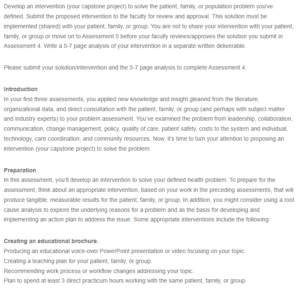
Develop an intervention (your capstone project) to solve the patient, family, or population problem you’ve defined. Submit the proposed intervention to the faculty for review and approval. This solution must be implemented (shared) with your patient, family, or group. You are not to share your intervention with your patient, family, or group or move on to Assessment 5 before your faculty reviews/approves the solution you submit in Assessment 4. Write a 5-7 page analysis of your intervention in a separate written deliverable.
Patient, Family, or Population Health Problem Solution – Antibiotic Resistance
Please submit your solution/intervention and the 5-7 page analysis to complete Assessment 4.
Introduction
In your first three assessments, you applied new knowledge and insight gleaned from the literature, organizational data, and direct consultation with the patient, family, or group (and perhaps with subject matter and industry experts) to your problem assessment. You’ve examined the problem from leadership, collaboration, communication, change management, policy, quality of care, patient safety, costs to the system and individual, technology, care coordination, and community resources. Now, it’s time to turn your attention to proposing an intervention (your capstone project) to solve the problem.
Preparation
In this assessment, you’ll develop an intervention to solve your defined health problem. To prepare for the assessment, think about an appropriate intervention, based on your work in the preceding assessments, that will produce tangible, measurable results for the patient, family, or group. In addition, you might consider using a root cause analysis to explore the underlying reasons for a problem and as the basis for developing and implementing an action plan to address the issue. Some appropriate interventions include the following:
Creating an educational brochure.
Producing an educational voice-over PowerPoint presentation or video focusing on your topic.
Creating a teaching plan for your patient, family, or group.
Recommending work process or workflow changes addressing your topic.
Plan to spend at least 3 direct practicum hours working with the same patient, family, or group.
In addition, you may wish to complete the following:
Review the assessment instructions and scoring guide to ensure you understand the work you will be asked to complete and how it will be assessed.
Conduct sufficient scholarly and professional literature research to inform your work and meet scholarly expectations for supporting evidence.
Note: As you revise your writing, check out the resources on the Writing Center’s Writing Support page.
Instructions
Complete this assessment in two parts: (a) develop an intervention to solve the problem and (b) submit your proposed intervention, with a written analysis, to your faculty for review and approval.
Part 1
Develop an intervention to solve the problem based on your assessment and supported by data and scholarly, evidence-based sources.
Incorporate relevant aspects of the following considerations that shaped your understanding of the problem:
Leadership.
Collaboration.
Communication.
Change management.
Policy.
Quality of care.
Patient safety.
Costs to the system and individual.
Technology.
Care coordination.
Community resources.
Part 2
Submit your proposed intervention to your faculty for review and approval.
Write a 5–7 page analysis of your intervention in a separate written deliverable.
Summarize the patient, family, or population problem.
Explain why you selected this problem as the focus of your project.
Explain why the problem is relevant to your professional practice and the patient, family, or group.
In addition, address the requirements outlined below. These requirements correspond to the scoring guide criteria for this assessment, so be sure to address each main point. Read the performance-level descriptions for each criterion to see how your work will be assessed. In addition, note the additional requirements for document format, length, and supporting evidence.
Define the role of leadership and change management in addressing the problem.
Explain how leadership and change management strategies influenced the development of your proposed intervention.
Explain how nursing ethics informed the development of your proposed intervention.
Include a copy of the intervention/solution/professional product.
Propose strategies for communicating and collaborating with the patient, family, or group to improve outcomes associated with the problem.
Identify the patient, family, or group.
Discuss the benefits of gathering their input to improve care associated with the problem.
Identify best-practice strategies from the literature for effective communication and collaboration to improve outcomes.
Explain how state board nursing practice standards and/or organizational or governmental policies guided the development of your proposed intervention.
Cite the standards and/or policies that guided your work.
Describe research that has tested the effectiveness of these standards and/or policies in improving outcomes for this problem.
Explain how your proposed intervention will improve the quality of care, enhance patient safety, and reduce costs to the system and individuals.
Cite evidence from the literature that supports your conclusions.
Identify relevant and available benchmark data sources on care quality, patient safety, and costs to the system and individual.
Explain how technology, care coordination, and the utilization of community resources can be applied to address the problem.
Cite evidence from the literature that supports your conclusions.
Write concisely and directly, using active voice.
Apply APA formatting to in-text citations and references.
Additional Requirements
Format: Format the written analysis of your intervention using APA style. APA Style Paper Tutorial [DOCX] is provided to help you write and format your paper. Be sure to include:
A title page and reference page. An abstract is not required.
Appropriate section headings.
Length: Your paper should be approximately 5–7 pages long, not including the reference page.
Supporting evidence: Cite at least five sources of scholarly or professional evidence that support your central ideas. Resources should be no more than five years old. Provide in-text citations and references in APA format.
 Complete the order form and upload all of your files, including any instructions, rubrics, or other materials provided by your instructor.
 Complete the order payment after filling in the order form. We’ll receive your order and assign it to a writer.
 The assigned writer will complete your paper and forward it to our Editing Team for review and approval.
 Once approved by the editor, the completed paper will be uploaded to your account for you to download, review and approve.