
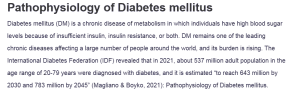
Pathophysiology of Diabetes mellitus
Diabetes mellitus (DM) is a chronic disease of metabolism in which individuals have high blood sugar levels because of insufficient insulin, insulin resistance, or both. DM remains one of the leading chronic diseases affecting a large number of people around the world, and its burden is rising. The International Diabetes Federation (IDF) revealed that in 2021, about 537 million adult population in the age range of 20-79 years were diagnosed with diabetes, and it is estimated “to reach 643 million by 2030 and 783 million by 2045” (Magliano & Boyko, 2021): Pathophysiology of Diabetes mellitus.
The disease is classified into various forms, the most frequent being the type 1 diabetes mellitus (T1DM) and the type 2 diabetes mellitus (T2DM). T1DM is a self-attacking disease of the body’s immune system on the insulin-producing beta cells of the pancreas, which results in a lack of insulin production. T2DM results from insulin resistance combined with a gradual decline in beta-cell activity and is responsible for about 90% of all diabetes cases. Another type of diabetes is gestational diabetes mellitus (GDM) and a few other rare monogenic forms of diabetes that are known as maturity-onset diabetes of the young (MODY).
Diabetes mellitus has severe consequences if left untreated or poorly managed. Hyperglycemia, if sustained over a long period, results in complications such as cardiovascular disease, nephropathy, and retinopathy, hence raising morbidity and mortality levels. Specific short-term complications include diabetic ketoacidosis (DKA) with T1DM and hyperosmolar hyperglycemic state (HHS) with T2DM, which may be fatal.
Risk factors for developing diabetes vary with the type (Gosmanov et al., 2021). T1DM is largely associated with genetic predisposition and environmental factors, and T2DM is associated with obesity, physical inactivity, inappropriate diet, genetic predisposition, and increased age. Early diagnosis and good management are crucial for preventing issues and enhancing the quality of life in diabetic individuals.
Normal Anatomy of Major Body System
The pancreas is an endocrine system organ in charge of the metabolism of glucose. It is situated beneath the stomach in the abdominal cavity and is an exocrine and endocrine gland. The acinar cells that make up the exocrine part secrete digestive enzymes into the small intestine to aid in digestion. The islets of Langerhans comprise the endocrine component, which is comprised of different cells that secrete hormones.
There are beta cells, which form 60-80% of the islets and secrete insulin, a blood glucose-lowering hormone (Campbell & Newgard, 2021). Alpha cells secrete glucagon, which elevates blood sugar levels, and somatostatin is secreted by delta cells, which suppress insulin and glucagon activity. Pancreatic polypeptide-producing (PP) cells aid in regulating digestive functions.
In addition to the pancreas, a number of other organs are involved in glucose metabolism. Glucose is stored in glycogen form in the liver and mobilized to blood in fasting states. Skeletal muscles are significant in glucose uptake and utilization, and most crucial following meals. Storage and mobilization of free fatty acids is carried out by adipose tissue.
Glucose and insulin transport to tissues is achieved through the circulatory system to establish metabolic homeostasis (Nakrani et al., 2023). Normal glucose levels are maintained through effective communication between organs. This system can be disrupted to result in metabolic imbalance, as in diabetes mellitus.
Normal Physiology of Major Body Systems
Blood glucose regulation is a tightly regulated process mediated by insulin and glucagon. With the consumption of food, blood sugar levels rise, and pancreatic beta cells release insulin. Insulin facilitates glucose entry into cells, most prominently muscle and adipose tissue, through inducing translocation to the cell membrane of glucose transporter proteins such as GLUT4. This facilitates glucose entry into cells, where either energy is utilized in glycolysis or is stored within the muscles and liver as glycogen (Chadt & Al-Hasani, 2020). Insulin inhibits gluconeogenesis, in which liver glucose is synthesized from sources other than carbohydrates, and hence prevents excess glucose production.
In fasting conditions, blood glucose levels drop, and glucagon is released from alpha cells in the pancreas. Glucagon initiates glycogen degradation in liver cells (glycogenolysis) and activates gluconeogenesis to maintain a constant glucose level in all essential organs, most prominently the brain. Other hormones, besides insulin and glucagon, aid in glucose control in states of stress: cortisol, epinephrine, and growth hormone (Campbell & Jialal, 2022).
Maintenance of a balance between these hormonal responses provides normal blood glucose levels, typically between 70 and 140 mg/dL. Disturbation in this fine balance, for example, insulin resistance or beta-cell failure, results in impaired glucose homeostasis and diabetes mellitus.
Mechanism of Pathophysiology
Diabetes mellitus is a result of disturbances in insulin secretion, insulin action, or both and is characterized by chronic hyperglycemia. T1DM and T2DM have different underlying pathophysiology. In T1DM, beta cells in the pancreas undergo autoimmune destruction, resulting in absolute insulin deficiency. This process is achieved by autoreactive T lymphocytes that can attack the beta-cell antigens, thus causing inflammation that ends up killing the beta-cells.
With reduced insulin production, the glucose transport into muscle and adipose tissue decreases, and this causes hyperglycemia (Zhu, 2022). Lack of insulin also inhibits lipolysis, and consequently, free fatty acids and the formation of ketone bodies increase. If not managed, it progresses to diabetic ketoacidosis (DKA), which is a complicated disease type that is described by high blood sugar levels or hyperglycemia, acidosis, and dehydration.
T2DM is characterized by resistance to insulin, a condition in which peripheral tissues fail to respond to insulin effectively. This resistance is often linked with obesity since the adipose tissue produces inflammatory cytokines that interfere with insulin signalling. At first, pancreatic beta cells respond through the release of insulin in higher amounts. However, with time, the beta cells are impaired, and insulin production is reduced, resulting in the worsening of hyperglycemia (Goyal et al., 2023).
Further to this, dysregulated gluconeogenesis leads to the enhanced production of glucose in the liver, which worsens the metabolic situation. Unlike in T1DM, however, ketoacidosis is uncommon in T2DM but can develop in severe hyperglycemia, leading to a hyperosmolar hyperglycemic state (HHS). Long-term hyperglycemia damages blood vessels, nerves, and organs and results in complications.
Diabetic retinopathy, nephropathy, and neuropathy are microvascular complications, and macrovascular complications predispose to cardiovascular disease, stroke, and peripheral artery disease. Impaired healing and increased susceptibility to infections are other problems.
Prevention
Prevention of diabetes mellitus is a multi-faceted process with varied strategies according to type. T1DM prevention is still a challenge as it is greatly determined by autoimmunity. However, current scientific investigations continue to look for other immunosuppressive approaches for treating diabetic at-risk patients so as to slow or prevent the loss of beta cells. T2DM prevention is longer developed and more directed toward changes in lifestyle.
As for diet, one should consume whole grain products, vegetables, lean meat, fish, nuts, and seeds to lower HbA1c levels and stabilize glucose levels. Exercise also improves the body’s tolerance for insulin and helps to maintain a healthy weight and avoid insulin resistance (Institute for Quality and Efficiency in Health Care, 2023). Since the disease is associated with excessive sugar consumption, the avoidance of sugar and processed foods is also effective.
Lifestyle modification or early pharmacological intervention with metformin in people with prediabetes has been proven to delay the progression of T2DM. Education, community-oriented programs, and workplace wellness programs that are available in the public domain are critical in raising awareness of and promoting preventive strategies for diabetes (Institute for Quality and Efficiency in Health Care, 2023). Screening check-ups help in the early identification of health issues that, if not attended to in time, can cause complications in the long run.
Treatment
Diabetes mellitus is a chronic condition that has to be treated with individual patient-oriented strategies that involve changes in lifestyles, pharmacologic therapy, and, if necessary, surgical procedures. T1DM is a life-long condition that can only be managed by insulin administered either through multiple injections or through an insulin pump (Subramanian & Baidal, 2021). The primary initial management of T2DM involves some form of lifestyle changes, including dietary changes, exercises, and weight management.
If there is poor control of glycemia, pharmacological treatment is started. The first step usually comprises metformin, which lowers the rate of hepatic glucose generation and enhances insulin sensitivity. Other classes of drugs are used to address glycemia and cardiovascular impact, including “sodium-glucose co-transporter-2 (SGLT2) inhibitors, glucagon-like peptide-1 (GLP-1) receptor agonists and dipeptidyl peptidase-4 (DPP-4) inhibitors” (Wilcox et al., 2020).
More severe cases require insulin therapy. Nursing interventions are crucial in diabetes care. Education to the patient regarding blood glucose monitoring, drug adherence, and lifestyle modification is crucial. Nurses assist with insulin injections, wound care, and management of diabetes complications. Emotional and psychological management is crucial as individuals with diabetes can experience distress and mental illness.
Conclusion
Diabetes mellitus is a complex metabolic disorder with significant health implications. It disrupts glucose homeostasis either by insulin deficiency or insulin resistance and results in both acute and chronic complications. While T1DM is largely a result of autoimmune beta-cell destruction, T2DM is largely influenced by lifestyle and genetic factors.
Lifestyle modifications are the pillar for prevention, and management is a combination of pharmacologic and nonpharmacologic interventions. Nurses play a crucial role in management and education to bring about better health and good quality of life in diabetic patients.
References
Campbell, J. E., & Newgard, C. B. (2021). Mechanisms controlling pancreatic islet cell function in insulin secretion. Nature Reviews Molecular Cell Biology, 22(2), 142–158. https://doi.org/10.1038/s41580-020-00317-7
Campbell, M., & Jialal, I. (2022). Physiology, endocrine hormones. PubMed; StatPearls Publishing. https://www.ncbi.nlm.nih.gov/books/NBK538498/
Chadt, A., & Al-Hasani, H. (2020). Glucose transporters in adipose tissue, liver, and skeletal muscle in metabolic health and disease. Pflügers Archiv – European Journal of Physiology, 472(9), 1273–1298. https://doi.org/10.1007/s00424-020-02417-x
Gosmanov, A. R., Gosmanova, E. O., & Kitabchi, A. E. (2021). Hyperglycemic crises: Diabetic ketoacidosis (DKA) and hyperglycemic hyperosmolar state (HHS). National Library of Medicine; Endotext. https://www.ncbi.nlm.nih.gov/books/NBK279052/
Goyal, R., Jialal, I., & Singhal, M. (2023). Type 2 diabetes. National Center for Biotechnology Information; StatPearls Publishing. https://www.ncbi.nlm.nih.gov/books/NBK513253/
Institute for Quality and Efficiency in Health Care. (2023, December 18). Type 2 diabetes: Learn more – How can you prevent type 2 diabetes? In www.ncbi.nlm.nih.gov. Institute for Quality and Efficiency in Health Care (IQWiG). https://www.ncbi.nlm.nih.gov/books/NBK361018/
Magliano, D. J. & Boyko, E. J. (2021). IDF diabetes atlas. In PubMed (10th ed.). International Diabetes Federation. https://www.ncbi.nlm.nih.gov/books/NBK581934/
Nakrani, M. N., Wineland, R. H., & Anjum, F. (2023). Physiology, glucose metabolism. PubMed. https://www.ncbi.nlm.nih.gov/books/NBK560599/
Subramanian, S., & Baidal, D. (2021, May 22). The management of Type 1 diabetes. Endotext – NCBI Bookshelf. https://www.ncbi.nlm.nih.gov/books/NBK279114/
Wilcox, T., De Block, C., Schwartzbard, A. Z., & Newman, J. D. (2020). Diabetic agents, from metformin to SGLT2 inhibitors and GLP1 receptor agonists. Journal of the American College of Cardiology, 75(16), 1956–1974. https://doi.org/10.1016/j.jacc.2020.02.056
Zhu, B. T. (2022). Pathogenic mechanism of autoimmune diabetes mellitus in humans: Potential role of streptozotocin-induced selective autoimmunity against human islet β-cells. Cells, 11(3), 492. https://doi.org/10.3390/cells11030492
ORDER A PLAGIARISM-FREE PAPER HERE
We’ll write everything from scratch
Question 
TOPIC:
- Diabetes mellitus
APA 7th edition Title page:
- This is a separate page by itself, with the following information centered in the middle of the page: course title, paper title, student’s name, instructor’s name, and date.
Description of Pathology:
- Start the paper on a new page.
- In this section, you will describe the pathology (statistics about it, background information, etc.). Give as much information as you can about it but be sure it is relevant information and not just filler. It should be a comprehensive introductory section of the condition in one to two paragraphs.
Normal anatomy of the major body system affected: In this section, you will describe what is considered normal anatomy for your particular pathophysiology. For example, if you are discussing a disease related to the brain, explain what is normal for the brain from an anatomical standpoint. You should show comprehensive knowledge of the fundamental concepts and communicate information using scientific vocabulary. There should be little to no discussion of the condition itself in this section.
Normal physiology of the major body system affected: In this section, you will be discussing physiology. Keep in mind that when describing physiology, it isn’t enough to merely provide a list of functions of the body system (Ex: Neurons send signals throughout the body), instead, you need to be able to describe how it does it. The how is the physiology. There should be little to no discussion of the condition itself in this section
Mechanism of Pathophysiology: This section is likely going to be the most in-depth and longest section. In this section, you will explain your particular pathophysiology from a scientific standpoint. In the previous two sections, you explained what is considered normal, in this section, you should describe what the pathophysiology is doing that is causing these issues, how the normal anatomy & physiology is affected/different in a person with your condition.
Pathophysiology of Diabetes mellitus
You should show a thorough understanding of the anatomical and physiological changes contributing to the disease. Some good keywords to search for when doing your research might be “Pathology of __________”, Pathophysiology of __________.”
Prevention: In this section, you will explain how your pathophysiology could be prevented. This should outline possible prevention protocols, or clearly indicate if none is available based on the current scientific literature.
Treatment: In this section, you will explain how your pathophysiology is commonly treated. Provide possible treatment protocols for the condition based on current scientific literature. Be sure to bring in nursing relevant information and how you might be involved in the treatment of the condition.
Conclusion: Finally you should summarize your findings. All good research papers should include a conclusion where you wrap up and summarize all of the important points made in your paper.
References:
- As with the Title page, this should be a separate page by itself.
- All references should be included in correct and complete APA format.
- All references must be cited appropriately in the paper using APA-style in-text citations.
- A minimum of three reputable sources are required for this assignment.
 Complete the order form and upload all of your files, including any instructions, rubrics, or other materials provided by your instructor.
  Complete the order payment after filling in the order form. We’ll receive your order and assign it to a writer.
 The assigned writer will complete your paper and forward it to our Editing Team for review and approval.
 Once approved by the editor, the completed paper will be uploaded to your account for you to download, review and approve.