
Pathophysiological Processes Paper: Alzheimer’s Disease (AD)
Alzheimer’s disease (AD) is a progressive and irreversible neurodegenerative disease that significantly impacts the cognition, memory, behavior, and functional capacity of an individual (Porsteinsson et al., 2021). AD, being a progressive and degenerative disease, is majorly characterized by gradual brain cell death. This gradual death of the brain cells results in the progressive decline in the cognitive abilities of the patient, leading to impairment of daily functioning and eventual loss of autonomy (Tahami Monfared et al., 2022). AD is the leading cause of dementia and most prevalent among other types of dementia globally. It is estimated that the condition accounts for up to 60-80% of all dementia cases (Tahami Monfared et al., 2022), with up to 0.7% or 51.6-55 million people globally living with AD (Javaid et al., 2021). WHO further estimates that ten million new cases of AD emerge each year (Javaid et al., 2021). Its prevalence is expected to be higher if AD is defined based on biological factors rather than the clinical approach used to define it. In addition, it is estimated that Europe will experience double cases of AD and that they will triple globally by 2050 (Scheltens et al., 2021).
Etiology and Risk Factors
Although the exact cause of AD is not clearly known, the disease develops as a result of an interaction between genetic, environmental, and lifestyle factors. The most common risk factors for AD include age, genetics, gender, and a combination of environmental and lifestyle factors. Age has been identified as a leading risk factor for the development of AD due to condition-based or natural neurodegeneration, with most cases being reported in people aged 65 years and above (Tahami Monfared et al., 2022). Being female is also linked to higher risks of developing AD. Notably, the risk of AD and prevalence of the condition is 41.9% among women as compared to 33.6% among men (Tahami Monfared et al., 2022).
Besides gender and age, the environment and genetic factors immensely contribute to the development of AD. Aging people who have lived in conditions that have exposed them to toxins or have suffered head traumas are more likely to have an increased risk of developing AD. Although arguable, genetics are the leading cause of the condition. Recent evidence shows that 60–80% of the risk of developing AD is linked to heritable factors, with most cases associated with mutations in the APP, PSEN1, PSEN2, and APOE alleles (Scheltens et al., 2021). Lifestyle factors further exacerbate the risk of developing AD. Sedentary lifestyles, poor dieting, and smoking increase the risk of AD. Also, having a low social and cognitive capacity contributes to the development of AD (Tahami Monfared et al., 2022).
Pathophysiological Processes
The pathophysiological processes leading to AD are gradual and progressive. Such changes occur at the cellular level within the brain. Such pathophysiological changes begin earlier before symptoms occur as extracellular amyloid-β (Aβ) plagues and neurofibrillary tangles of hyperphosphorylated tau protein develop (Porsteinsson et al., 2021; Tahami Monfared et al., 2022). These extracellular bodies disrupt neural communication combined with associated inflammatory response, causing neuronal death and loss of synapses within the hippocampus and cerebral cortex (Tahami Monfared et al., 2022). The brain adapts to such pathological changes by reducing brain tissue and increasing ventricular volume. Such changes are largely associated with manifested symptoms such as impaired judgment, loss of memory, reduced functional capacity, and cognitive decline as the changes progress.
Clinical Manifestations and Complications
The main clinical manifestations of AD include memory loss, loss of focus, language difficulties, poor functioning of daily activities, and making decisions, changes in behavior and personality. It is the progression of these symptoms that contributes to the diagnosis of AD. In most cases, the diagnosis is based on the progressive cognitive decline affecting functionality, including forgetting what the individual was doing, inability to correctly perform activities of daily living, repeating statements or questions, and associated complications such as depression and malnutrition. If untreated, these complications can lead to impairment of functionality, total loss of functioning, and death. People living with AD report a significantly reduced quality of life (Javaid et al., 2021).
Diagnostics
The common lab and diagnostic tests for diagnosing AD include the Montreal Cognitive Assessment (MoCA), Mini-Mental State Examination (MMSE), PET scans, MRIs, and blood tests (Tahami Monfared et al., 2022). These tests help determine the stage of AD, the type of dementia, and the effective intervention to be employed.
Interview Responses
- The interviewee is a 74 y/o female and a family friend. She is not sure about how long she has had the disorder but estimates six years.
- The interviewee experiences shaking hands, cannot remember a conversation we had, and needs to be assisted to move around. Symptoms align with what has been said in the reviewed resources.
- The individual cannot be left alone; she lacks the capacity to care for herself.
- She has HTN and diabetes. HTN can exacerbate AD symptoms.
- She needs to be assisted to move around, and her activities, including eating and bathing, are restricted.
- She feels overburdened and has no desire to live anymore
- AD not only takes a toll on the individual but also the entire family taking care of the patient.
References
Javaid, S. F., Giebel, C., Khan, M. A., & Hashim, M. J. (2021). Epidemiology of Alzheimer’s disease and other dementias: Rising global burden and forecasted trends. F1000Research 2021 10:425, 10, 425. https://doi.org/10.12688/f1000research.50786.1
Porsteinsson, A. P., Isaacson, R. S., Knox, S., Sabbagh, M. N., & Rubino, I. (2021). Diagnosis of early Alzheimer’s disease: Clinical Practice in 2021. The Journal of Prevention of Alzheimer’s Disease, 8(3), 371–386. https://doi.org/10.14283/JPAD.2021.23
Scheltens, P., De Strooper, B., Kivipelto, M., Holstege, H., Chételat, G., Teunissen, C. E., Cummings, J., & van der Flier, W. M. (2021). Alzheimer’s disease. The Lancet, 397(10284), 1577–1590. https://doi.org/10.1016/S0140-6736(20)32205-4
Tahami Monfared, A. A., Byrnes, M. J., White, L. A., & Zhang, Q. (2022). Alzheimer’s disease: Epidemiology and clinical progression. Neurology and Therapy, 11(2), 553–569. https://doi.org/10.1007/S40120-022-00338-8/TABLES/4
ORDER A PLAGIARISM-FREE PAPER HERE
We’ll write everything from scratch
Question 
Pathophysiological Processes Paper: Alzheimer’s Disease (AD)
Purpose
This project is an in-depth investigation of a health condition. It will allow for the expansion of knowledge and the ability to generalize larger concepts to a variety of health conditions.
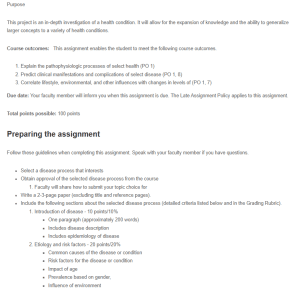
Pathophysiological Processes Paper – Alzheimer’s Disease (AD)
Course outcomes: This assignment enables the student to meet the following course outcomes.
- Explain the pathophysiologic processes of select health (PO 1)
- Predict clinical manifestations and complications of select disease (PO 1, 8)
- Correlate lifestyle, environmental, and other influences with changes in levels of (PO 1, 7)
Due date: Your faculty member will inform you when this assignment is due. The Late Assignment Policy applies to this assignment.
Total points possible: 100 points
Preparing the assignment
Follow these guidelines when completing this assignment. Speak with your faculty member if you have questions.
- Select a disease process that interests
- Obtain approval of the selected disease process from the course
- Faculty will share how to submit your topic choice for
- Write a 2-3-page paper (excluding title and reference pages).
- Include the following sections about the selected disease process (detailed criteria listed below and in the Grading Rubric).
- Introduction of disease – 10 points/10%
- One paragraph (approximately 200 words)
- Includes disease description
- Includes epidemiology of disease
- Etiology and risk factors – 20 points/20%
- Common causes of the disease or condition
- Risk factors for the disease or condition
- Impact of age
- Prevalence based on gender,
- Influence of environment
- Genetic basis of disease
- Lifestyle influences
- All information supported by current literature
- Pathophysiological processes – 20 points/20%
- Describes changes occurring at the cellular, tissue, and/or organ level that contribute to the disease process.
- Describes adaptation of the cells and body in response to the
- Relates disease processes to manifested signs and
- Clinical manifestations and complications – 20 points/20%
- Describes the physical signs and symptoms that are important in considering the presence of the
- Identifies signs that contribute to diagnosis of the condition
- Identifies symptoms that contribute to diagnosis of the
- Identifies complications of the
- Discusses the implications to the patient when complications are left
- Diagnostics – 10 points/10%
- Includes list of common laboratory and diagnostic tests used to determine the presence of the
- Introduction of disease – 10 points/10%
- Discusses the significance of test findings in relation to the disease
- Interview – 10 points/10%
- Once the student has become familiar with the disorder, it is their responsibility to locate an individual living with the disease process to interview (interviewee). It is recommended that you find an individual first, then complete research and writing on the topic prior to performing the interview.
- The interviewee must be at least 18 years old and able to answer questions by themselves
- The interviewee must currently have the chronic disease/disorder. If an interviewee has been diagnosed with a disease/disorder but has NO manifestations or complications related to the disorder they DO NOT qualify for the assignment.
- Acute infections/diseases DO NOT qualify (pneumonia, urinary tract infection, flu, colds).
- The interviewee cannot be a patient from the clinical setting or a patient from your work environment (hospitals, doctor’s office, LTC facility, home health, etc.)
- The interviewee may be a relative, friend, colleague, or stranger.
- Please use the individual’s own words in relation to their experience with the disease/disorder.
- NOTE: This assignment is for educational purposes only. Students are NOT to provide any medical/nursing advice or education to interviewees. Refer interviewee questions to their physician.
- Interview Questions
- What is the age of the individual being interviewed? What is the relationship of the individual to you? How long have they had the disorder?
- What clinical manifestations of the disorder does the individual experience? How does it compare to what you discovered in your resources?
- What complications of the disorder does the individual experience? How does this compare to what you discovered in your resources?
- What other medical conditions/disorders has the individual been diagnosed with? Do their other medical conditions have any effect on the chosen disorder?
- How does the disease affect the individual’s daily living/activities? (repeat hospitalizations, has to take a lot of meds, any activity restrictions, a lot of appointments?)
- How does the disease/disorder affect the individual’s outlook on life? (Feel like a burden to family, do they have good family support, feel hopeless, optimistic, good coping mechanisms?)
- What did you learn from interviewing the individual?
- Once the student has become familiar with the disorder, it is their responsibility to locate an individual living with the disease process to interview (interviewee). It is recommended that you find an individual first, then complete research and writing on the topic prior to performing the interview.
- APA Style and Organization – 10 points/10%
- References are submitted with assignment.
- Uses current APA format and is free of errors.
- Grammar and mechanics are free of errors.
- Paper is 2-3 pages, excluding title and reference pages.
- At least two (2) scholarly, primary sources from the last 5 years, excluding the textbook, are provided.
For writing assistance, visit the Writing Center.
Please note that your instructor may provide you with additional assessments in any form to determine that you fully understand the concepts learned.
 Complete the order form and upload all of your files, including any instructions, rubrics, or other materials provided by your instructor.
  Complete the order payment after filling in the order form. We’ll receive your order and assign it to a writer.
 The assigned writer will complete your paper and forward it to our Editing Team for review and approval.
 Once approved by the editor, the completed paper will be uploaded to your account for you to download, review and approve.