
Organizational Crisis Response Analysis
Racist Abuses toward Black Players in the England Football Team Squad
Three key players in the English Football team faced racist attacks following their loss to the Italian national team in the EURO 2020 championships. Some English fans located in England and overseas directed racist attacks toward Jadon Sancho, Bukayo Saka, and Marcus Rashford after their penalty misses (Morse, 2021). The Italy versus England final game, which marked England’s first final appearance in 50 years, was understandably a high-stakes game for English national team followers and fans. After the game ended in a draw in regular and extra time, it headed into penalties. Unfortunately, Sancho, Rashford, and Saka, who are black players, faced racist abuse on social media platforms. Morse (2021) avers that key football stakeholders, including England’s football association (FA), responded by condemning the attacks and calling for authorities to take disciplinary action against the perpetrators.
In response to the attacks, the FA embraced high-profile press in its attempt to condemn the racist abuses directed toward the three players. The association called for the immediate arrest and arraignment of the perpetrators (Morse, 2021). By condemning the perpetrators and calling for their arrest, the association made a point that racial abuse is intolerable. Also, the coach of the English national team was quick to condemn the attacks. In a notable shift from the tradition of calling for unity and understanding during such tense moments, Southgate proclaimed that the abuses are unforgivable (Morse, 2021). This was a good way to demonstrate empathy toward the abuse victims and encourage strong anti-racist policing. Given that the UK has a specialized football policing unit, such statements go a long way to encourage action and discourage the normalization of racial abuse via social media platforms. While condemning the abusers, Gareth Southgate was quick to appreciate the fans who brought positivity despite the negative energy. Avoiding blanket condemnation of fans was critical in encouraging respectful fans to maintain their positive energy.
The posture by the England FA and the English team focused on fostering partnerships with key partners to punish perpetrators and avert future racism cases. For instance, local authorities were swift in pinning the perpetrators and bringing them to book. Although it emerged that some of the abusers do not reside in the UK, local authorities managed to locate some of the bullies who reside in the UK. The invitation of local authorities aligns with recommendations of the Football Taskforce of 1998, which calls for localized action according to the specific culture of the target population. It is worth noting that racist cultures are specific to certain fan populations; hence, the need for a targeted response. Although the attacks in the aforementioned cases happened virtually, dealing directly with the local population plays a key role in averting similar cases in the future.
Following the anti-racial stance by the English Football Association and England national team coach, the issue attracted the attention of the then-UK prime minister. As a result, a multi-agency team collaborated and established that 34 of the abusers reside in the UK (Bradbury, 2011). Arrests followed, with some of the perpetrators facing court sentences.
Going forward, there is a need for football associations and respective national teams and football clubs to collaborate with community-based anti-racial agencies. Such collaboration will facilitate evaluation of local interest in racism cases and evaluating the best response mechanisms (Bradbury, 2011). By involving the local community and other partners, there is a high chance of implementing effective anti-racist responses. Also, such collaboration ensures that all parties implement uniform interventions; hence, consistency.
Ivan Toney’s Betting Suspension
Ivan Toney’s suspension from football following findings that he was involved in illegal betting escalated to crisis levels. As a matter of principle, players participating in the English Premier League (EPL) are barred from any form of football betting. Playing at Brentford at the time, Ivan was cited for committing 232 breaches, including betting that his team would lose and on his performances. Following a thorough investigation, Ivan was found culpable and handed an 8-month suspension, besides incurring £50,000 in fines. Toney faced the risk of a lifetime suspension if it were not for the fact that he attributed the breaches to a personal struggle with gambling addiction. Initially, the governing body had handed the player a 15-month suspension before reducing it to eight months after realizing that the player had a lifelong struggle with gambling addiction. The suspension ran from May 2023 to January 2024. The punishment meted out to Ivan Toney not only demonstrates FA’s stringent guidelines against gambling but also the personal side of the association following its attention to the reality of individual betting addiction.
The Brentford club football stakeholders undertook some PR initiatives in an attempt to resolve the crisis. It is worth noting that Ivan’s case risked subjecting his team to a bad image among its fans and the general football fanbase, considering that he bet on his team to lose. In such a case, questions arise, given the fact that he placed a bet, yet he had the chance to influence the game.
Following the punishment meted out on Ivan Toney, the Brentford football club was quick to offer a statement that it would offer Ivan and his family support as they deal with the repercussions of the ban. The statement was key at this time since it captured public sympathy, given that many people in society struggle with addiction. Therefore, offering Toney a second chance and recommending gambling addiction rehabilitation would help him to reform. On the other hand, the Professional Football Association (PFA) offered a statement that they would move in to educate players on existing anti-gambling guidelines and the consequences for breaching the guidelines. Besides, the PFA stated that there are frameworks to rehabilitate players who are addicted to gambling.
The measures implemented by PFA and the Brentford football club were appropriate given the problem at hand. From the outset, athletes in the UK are disproportionately exposed to the gambling problem, given the conditions that surround the game. For instance, games like football and cricket draw significant attention from gambling communities, including betting companies and members of the public who gamble (Daniel et al., 2014). As a result, players may end up resorting to gambling since they are the center of attention in such circumstances. In the same breath, gambling addiction can potentially result from peer influence, as these players spend most of their time together and with demographics who participate in sports betting (Daniel et al., 2014). As a result, treating breaches as fraudulent activity and punishing players through lifetime bans from football may not resolve the root cause of the problem. As a result, offering rehabilitation initiatives would help players deal with root causes and eliminate the problem for good.
Going forward, the PFA should consider implementing continuous awareness interventions for players on the risks that they would face if they are found guilty. Such awareness campaigns should also offer players struggling with gambling addiction an opportunity to enter rehabilitation. Besides, PFA should consider extending an amnesty window to gambling addicted athletes. During the amnesty window, athletes who face gambling addiction may come forward to be rehabilitated.
Barcelona’s Financial Turmoil
Barcelona, the La Liga titans, have seen their financial health spiral out of control over the past few years. The club’s financial troubles emanate from poor financial decisions made during the presidency of Josep Maria Bartomeu. The former president is accused of lavish spending and poor financial decisions. Among others, President Bartomeu approved exorbitant salaries for players such as Messi, who earned over €100 million after taxes annually (OneFootball, 2024). Besides, the then-president approved signings with exaggerated price tags. Although it was extremely expensive to sign players likes Ousmane Dembele, Philippe Coutinho, and Antoine Griezmann, the players failed to live up to expectations, raising questions about whether such players were worth their price tags. Further, the COVID-19 pandemic exacerbated the situation. With fans not able to access the stadium during the period, the club lost the much-needed ticket revenue. By the time Bartomeu was exiting the club in 2020, Barcelona’s debt had accumulated to €1.35 billion, raising serious sustainability concerns.
Financial health is key to sustainability and the image of a football organization like Barcelona. In particular, fans get hugely invested in the wellness of a club and its long-term sustainability. Therefore, by appearing to be financially struggling, the club emerged as mismanaged in the eyes of the fans. The fact that financials were run down to the extent that the club was almost running bankrupt reflected a bad image. Considering the emotional attachment that the fans have to the club, any discussions about potential bankruptcy subjected them to ‘embarrassment.’
Following Laporta’s entry into the club, multiple interventions were implemented to stave the club off bankruptcy. Laporta implemented financial levers. Among others, the strategy involved selling off the club’s future TV rights and selling off part of the assets owned by the club. By implementing financial levers, Barcelona was able to initially raise €800 million, an amount of which was utilized to pay off the debt accrued during Bartomeu’s reign (OneFootball, 2024). However, it is worth noting that these initiatives did not come without risk. For instance, in 2023, the club borrowed an additional €1.5 billion to finance the long-anticipated renovation of the Camp Nou Stadium (OneFootball, 2024). The project has increased the club’s loan obligations and cut an anticipated €150 million in revenue from ticket sales since the club had to relocate to a smaller stadium.
Arguably, President Laporta’s financial recovery strategies are appropriate and have been largely successful. One of the hardest decisions the president had to make after taking over was to sell the club’s iconic player, Messi. By selling Messi, the club saved significantly on wage expenditure, and this money has since been redirected to cater to the club’s huge debt. Besides, the club has adopted sustainability reporting since Laporta’s entry. Sustainability reporting helps a football club to measure its expenditures against revenue for the leadership to make appropriate financial decisions (Fernández-Villarino, 2021). Going forward, the Barcelona football club should change its scouting strategy for new players. Instead of going for established and highly paid players, the club should scout talent from among youngsters and football academies to avert high signing fees and exorbitant wages.
References
Bradbury, S. (2011). It’s not as simple as black and white: Challenging racism in professional football through locally grounded multi-agency collaboration. In Sport and Challenges to Racism (pp. 199–213). Palgrave Macmillan. https://doi.org/10.1057/9780230305892_13
Daniel, O’Brien, K., Jowett, S., & Greenlees, I. (2014). Problem gambling among athletes in the United Kingdom. Palgrave Macmillan UK EBooks, 127–139. https://doi.org/10.1057/9781137272423_6
Fernández-Villarino, R. (2021). Sustainability in the football industry: An approach to the gap between theoretical formulation and practical application, through the results of the social fair play project. Heliyon, 7(6), e07318. https://doi.org/10.1016/j.heliyon.2021.e07318
Morse, B. (2021, July 12). Racist abuse directed at England players after Euro 2020 final defeat is described as “unforgivable” by manager Gareth Southgate. CNN. https://edition.cnn.com/2021/07/12/football/england-racist-abuse-bukayo-saka-jadon-sancho-marcus-rashford-euro-2020-final-spt-intl
OneFootball. (2024, September 29). Barcelona’s financial crisis: The real cost of big-money transfers. OneFootball. https://onefootball.com/id/berita/barcelonas-financial-crisis-the-real-cost-of-big-money-transfers-39874700
ORDER A PLAGIARISM-FREE PAPER HERE
We’ll write everything from scratch
Question 
Overview
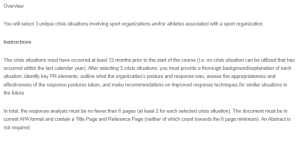
You will select 3 unique crisis situations involving sport organizations and/or athletes associated with a sport organization.
Instructions
Organizational Crisis Response Analysis
The crisis situations must have occurred at least 12 months prior to the start of the course (i.e. no crisis situation can be utilized that has occurred within the last calendar year). After selecting 3 crisis situations, you must provide a thorough background/explanation of each situation, identify key PR elements, outline what the organization’s posture and response was, assess the appropriateness and effectiveness of the response postures taken, and make recommendations on improved response techniques for similar situations in the future.
In total, the response analysis must be no fewer than 6 pages (at least 2 for each selected crisis situation). The document must be in current APA format and contain a Title Page and Reference Page (neither of which count towards the 6 page minimum). An Abstract is not required.
 Complete the order form and upload all of your files, including any instructions, rubrics, or other materials provided by your instructor.
  Complete the order payment after filling in the order form. We’ll receive your order and assign it to a writer.
 The assigned writer will complete your paper and forward it to our Editing Team for review and approval.
 Once approved by the editor, the completed paper will be uploaded to your account for you to download, review and approve.