
NUR 4327 – Deliverable 2 – Policy Briefing Document
Assembly Bill 395 was signed in 1999 by the California Governor, Gary Davis. This bill established minimum nurse-to-patient staffing ratios for hospital settings (McHugh et al., 2011). This law was established due to a growing concern for patient safety, knowing that patient care was becoming more complex.
It was stated in the California Nurses Association that nurses were taking care of such a large number of patients that their skill level was becoming less professional and safe.
Part One – Process of Legislation
The California Department of Health Services spent two years holding meetings and inviting stakeholders to assist in coming up with a conclusion for safe nurse-patient ratios. According to the California legislative website, the process of the bill is as follows. First, in February of 1999, the bill was read. From February to June of 1999, the bill was read thrice until it was passed into the Senate; after being read three more times while in the Senate’s hands, it was then sent for enrollment in August of 1999. The governor then reviewed the bill and approved it in October of 1999. In January 2004, after further evaluation of nursing rations, the bill was enacted and presented with safe nurse-to-patient rations within hospitals
(McCormick, E. (n.d.)).
Part Two – Outcome of Legislation
Studies in California were performed in observance of nurses in hospitals. Once the bill was enacted, there was an increase in the number of staff nurses in hospitals, with a decrease in staff turnover. An increase in productivity and skill sets of the nurses were also demonstrated. Hospital nurse staffing ratios mandated in California are associated with lower mortality and nurse outcomes predictive of better nurse retention in California (Aiken et al., 2010).
The nurse leader would be for this legislation recommendation as it helps with patient safety and staff retention. The increased patient-to-nurse ratio would induce nurses’ intention to leave their jobs due to personal burnout, client-related burnout, and job dissatisfaction (Chen et al., 2019). A nurse leader will be more successful if she has a dependable team that works under her. This reassures the leader that her staff is satisfied with their job, leading to better patient outcomes. Safe nurse-to-patient ratios increase patient and staff satisfaction (Chen et al., 2019).
NUR 4327 – Deliverable 2 – Policy Briefing Document
Recommendations
Pros on recommendation
#1 Safe nurse-to-patient ratios yield better patient outcomes
- If a nurse has a safe ratio of patients, she is able to spend more time assessing and reviewing each patient’s chart. This prevents burnout, which assists with more quality care the nurse provides.
#2 Staff turnover will be decreased.
- Staff are more likely to stay with a facility if they don’t feel overwhelmed. Safe ratios help protect the nurse’s license, along with their sanity. If nurses feel they cannot safely care for their patients and don’t see a change, they will likely leave the hospital.
Cons on recommendation
#1: Longer wait times
Limiting the number of patients a nurse can take means longer wait times for patients. For example, if the nurses in the ED have a set limit of patients they can have, the other patients will have to wait longer in the waiting room to get seen. Also, if nurses on the floor are at maximum capacity, patients in the emergency department may have to be held longer before getting a room.
#2 Need for more nurses when there is a nursing shortage
As we are faced with today, there are nursing shortages everywhere.
With ratios, a nurse can’t take more than a certain number of patients; therefore, more staff is needed. Traveling nurses may need to be called in to assist with staffing ratios until enough hospital staff is hired on. More nurses will be needed to cover the number of hospital beds and help with patient acuity.
References
Aiken, L. H., Sloane, D. M., Cimiotti, J. P., Clarke, S. P., Flynn, L., Seago, J. A., Spetz, J., & Smith, H. L. (2010). Implications of the California Nurse Staffing Mandate for other states. Health services research, 45(4), 904-921. https://doi.org/10.1111/j.1475-6773.2010.01114.x
Chen, Y.-C., Guo, Y.-L. L., Chin, W.-S., Cheng, N.-Y., Ho, J.-J., & Shiao, J. S.-C. (2019,
November 29). The patient-nurse ratio is related to nurses’ intention to leave their jobs through mediating factors of burnout and job dissatisfaction. International journal of environmental research and public health. Retrieved May 29, 2022, from https://www.ncbi.nlm.nih.gov/pmc/articles/PMC6926757/
McCormick, E. (n.d.). AB-394 Health facilities: nursing staff. Bill History. Retrieved May
11, 2022, from https://leginfo.legislature.ca.gov/faces/billHistoryClient.xhtml? bill_id=199920000AB394.
McHugh, M. D., Kelly, L. A., Sloane, D. M., & Aiken, L. H. (2011). Contradicting fears, California’s nurse-to-patient mandate did not reduce the skill level of the nursing workforce in hospitals. Health affairs (Project Hope), 30(7), 1299-1306. https://doi.org/10.1377/hlthaff.2010.1118
ORDER A PLAGIARISM-FREE PAPER HERE
We’ll write everything from scratch
Question 
NUR 4327 – Deliverable 2 – Policy Briefing Document
Explain the process of policy-making in healthcare delivery.
- Transferable Skill

NUR 4327 – Deliverable 2 – Policy Briefing Document
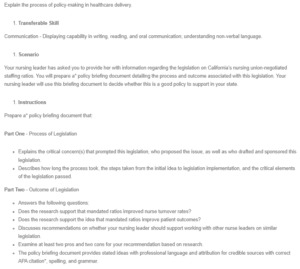
Communication – Displaying capability in writing, reading, and oral communication; understanding non‐verbal language.
- Scenario
Your nursing leader has asked you to provide her with information regarding the legislation on California’s nursing union-negotiated staffing ratios. You will prepare a policy briefing document detailing the process and outcome associated with this legislation. Your nursing leader will use this briefing document to decide whether this is a good policy to support in your state.
- Instructions
Prepare a* policy briefing document that:
Part One – Process of Legislation
- Explain the critical concern(s) that prompted this legislation, who proposed the issue, and who drafted and sponsored this legislation.
- Describes how long the process took, the steps taken from the initial idea to legislation implementation, and the critical elements of the legislation passed.
Part Two – Outcome of Legislation
- Answers the following questions:
- Does the research support that mandated ratios improved nurse turnover rates?
- Does the research support the idea that mandated ratios improve patient outcomes?
- Discusses recommendations on whether your nursing leader should support working with other nurse leaders on similar legislation.
- Examine at least two pros and two cons for your recommendation based on research.
- The policy briefing document provides stated ideas with professional language and attribution for credible sources with correct APA citation*, spelling, and grammar.
 Complete the order form and upload all of your files, including any instructions, rubrics, or other materials provided by your instructor.
  Complete the order payment after filling in the order form. We’ll receive your order and assign it to a writer.
 The assigned writer will complete your paper and forward it to our Editing Team for review and approval.
 Once approved by the editor, the completed paper will be uploaded to your account for you to download, review and approve.