
NU552 journal assignment
| Unit 8/Module 4 Journal NU552 | ||||
| Date Student Name:
Complete patient information below. |
||||
| Part I
Complete the physical assessment documentation per the sports physical requirements. Part I is not performed in the video submission but for your learning practice on sports physical documentation: NU552 journal assignment.
Place N in the Normal Column. Place AB in the Abnormal column with a comment if you choose. There does not need to be abnormal findings. If so you must comment.
You must add comments in the heart and genitalia sections (as if for a male). This is for your learning.
The patient History is completed by the parent first, then an ROS; which are not a part of this journal exercise. |
||||
| SYSTEM | Patient Name Sex M
HT 5/10 WT 190
T- 98 P-70 R-15 B/P110/7 |
N | AB | COMMENTS |
| HEAD | Hair, scalp, masses, injuries | N | ||
| EYES | Proptosis, conjunctivae, sclera, EOMI,
pupillary size, reaction to light, peripheral vision, |
N | ||
| EARS | Gross hearing/ TMs/ Discharge | N | ||
| NOSE | Septum, mucosa, sinuses | N | ||
| THROAT/MOUTH | Teeth condition, tongue, tonsils, lesions | N | ||
| NECK | Thyroid, vessels, range of motion, adenopathy, masses, voice abnormalities | N | ||
| THORAX/LUNGS | Shape, expansion, deformities, rhonchi, wheezes, rales | N | ||
| HEART | PMI, sounds, thrills, murmurs, gallops, | N | ||
| LYMPHATICS | Cervical, axillary | N | ||
| ABDOMEN | Organ enlargement (liver, spleen, etc.), masses, tenderness, hernias, scars | N | ||
| GENITALIA | Scrotum, testicles, lesions, discharge, hernias
(female deferred) |
N | ||
| UPPER EXTREMITIES | Range of motion, joint stability, muscle strength, limitations, effusion, ecchymoses, atrophy, deformities, edema, clubbing, pulses, veins, injuries | N | ||
| LOWER EXTREMITIES | Range of motion, joint stability, muscle strength, limitations, effusion, ecchymoses, atrophy, deformities, edema, clubbing, pulses, veins, injuries | N | ||
| BACK | Flexion, extension, scoliosis, kyphosis, excessive lordosis, injuries | N | ||
| NEUROLOGICAL | Cranial nerves, reflexes, motor, gait, balance, sensory | N | ||
| SKIN | Texture, striae, rash, acne | N | ||
| MENTAL STATUS | Affect, hostility, agitation | N | ||
| OBJECTIVE
Part II Complete the MS and Peripheral Vascular exam documentation as in a physical exam for this component of a sport physical exam with detail and specifics as would be appropriate for this specialty exam. This should be more than Normal or Abnormal for this journal exercise. Sign the form by typing your name or using the draw feature. |
||||
| Musculoskeletal
· Neck: Full ROM in flexion, extension, and lateral bending, bilateral muscle bulk and tone, no pain observed during rotation · Shoulders: Full abduction, adduction, flexion, extension, internal and external rotation, no pain or tenders to palpation · Elbows & Wrists: Full ROM in flexion, extension, underpronation, and pronation, no pain or joint tenderness observed during all exams. No deformities on the elbow and wrist joints. · Entire arm: Symmetrical muscle bulk and tone observed on biceps, triceps, and forearm bilaterally. 5/5 muscle strength on all points. · Hips & Knees: Full ROM during flexion and extension. No limitations or discomfort observed. No knee pain, warmth, or tenderness. Symmetrical muscle bulk and tone observed bilaterally. Able to squat and do lunges without hip and knee pain or limitation. · Ankles: Full ROM on dorsiflexion, plantarflexion, inversion, and eversion. No pain and tenderness over the joints bilaterally. · Entire leg: Symmetrical muscle bulk and tone observed on quadriceps, hamstrings, and calves bilaterally. Quadriceps, hamstrings, and calf strength 5/5 bilaterally. Able to toe and heel walk without pain or deficits · Spine: Posture is erect, no tenderness or pain along the vertebrae Peripheral Vascular · Skin: No varicosities. Skin color is appropriate for ethnicity at the extremities bilaterally. No edema on all extremities · Pulse: 2+ all through brachial, radial, femoral, popliteal, posterior tibial, and dorsalis pedis bilaterally. · Capillary refill: <2 seconds |
||||
| Approved Y/ N Provider Signature ____________________________________________ | ||||
| How might diagnostic reasoning and clinical judgment be used to move toward a diagnosis during this assessment? Include 2-3 evidence based resources about sports physical exam considerations; at least one of which is a clinical guideline for a condition that may be a differential if any abnormalities were found. Use an example. Word count 75-100 | ||||
| Diagnostic errors have been noted to be common in musculoskeletal care settings (Flemming et al., 2023). In such settings, diagnostic reasoning can be applied to enable physicians to combine history, symptoms, and examination findings to make decisions during assessments.
For instance, physicians can make use of a patient’s history with musculoskeletal pain and combine it with diagnostic imaging to make clinical decisions that correctly diagnose such musculoskeletal pain conditions (Cuff, 2024). For the above case, a physician can use the clinical guidelines for practice provided by the American Academy of Orthopaedic Surgeons (n.d.) to best assess the athlete and guide further decisions, including clearing her to participate in sports or identifying any at-risk conditions early that may threaten her performance. |
||||
References
American Academy of Orthopaedic Surgeons. (n.d.). AAOS clinical practice guidelines. AAOS. https://www.aaos.org/quality/quality-programs/clinical-practice-guidelines/
Cuff, A. V. (2024). Understanding the use of diagnostic imaging and its role in decision-making in musculoskeletal pain conditions affecting the lower back, knee, and shoulder [Doctoral thesis, Manchester Metropolitan University]. https://e-space.mmu.ac.uk/id/eprint/634014
Flemming, D. J., White, C., Fox, E., Fanburg-Smith, J., & Cochran, E. (2023). Diagnostic errors in musculoskeletal oncology and possible mitigation strategies. Skeletal Radiology, 52(3), 493–503. https://doi.org/10.1007/S00256-022-04166-7/METRICS
ORDER A PLAGIARISM-FREE PAPER HERE
We’ll write everything from scratch
Question 
This competency assessment assesses the following Outcome(s):
- Formulate a systematic and defendable approach to nursing practice decisions for a patient examination, based on individual patient needs.
You will use a live person volunteer, not a patient, and conduct the physical examination as a professional medical provider. During your examination you should verbalize for the evaluator what you are doing and why. “Assessing muscle strength.” “Assessing ROM.” “Assessing knee and meniscus” “Assessing for scoliosis.” Your comments are your choice, demonstrating your understanding of the assessment and the purpose.
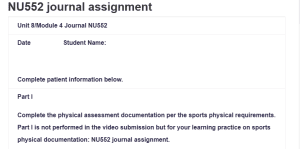
NU552 journal assignment
There are two parts.
- Part I is the physical assessment documentation you will complete. This is for your learning. See directions in the template for how to complete.
- Part II is the Musculoskeletal and Peripheral Vascular Video assessment with documentation. Be sure to use appropriate techniques addressed in the text.
You will have to practice several times to be sure your skills are honed, smooth, and that you are not looking at directions during assignment. Demonstrate professional communication with your patient.
Cite every paragraph or at end as deemed appropriately.
- My name is X, NP student
- I will do the Video
- Patient volunteer: Jane 23 year female
 Complete the order form and upload all of your files, including any instructions, rubrics, or other materials provided by your instructor.
  Complete the order payment after filling in the order form. We’ll receive your order and assign it to a writer.
 The assigned writer will complete your paper and forward it to our Editing Team for review and approval.
 Once approved by the editor, the completed paper will be uploaded to your account for you to download, review and approve.