
Mixed Method Research
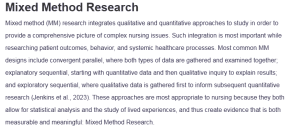
Mixed method (MM) research integrates qualitative and quantitative approaches to study in order to provide a comprehensive picture of complex nursing issues. Such integration is most important while researching patient outcomes, behavior, and systemic healthcare processes. Most common MM designs include convergent parallel, where both types of data are gathered and examined together; explanatory sequential, starting with quantitative data and then qualitative inquiry to explain results; and exploratory sequential, where qualitative data is gathered first to inform subsequent quantitative research (Jenkins et al., 2023). These approaches are most appropriate to nursing because they both allow for statistical analysis and the study of lived experiences, and thus create evidence that is both measurable and meaningful: Mixed Method Research.
Paradigms play a crucial role in MM research since they determine the lens through which researchers view information. Quantitative research typically follows a positivist paradigm, focusing on objectivity, measurement, and generalizability. Qualitative research operates on a constructivist paradigm, focusing on meaning, context, and subjective comprehension.
Mixed methods operate under pragmatism, seeking practical answers and allowing for the inclusion of various perspectives in solving real-life world problems (Trujillo et al., 2021). Literature reviews also differ, with qualitative reviews collating themes and participant views, quantitative reviews presenting outcomes and measures, while MM reviews must skillfully synthesize both types of evidence into a single narrative.
The economic environment for MM nursing research has grown more favorable. The NIH and AHRQ, among others, support MM research because of its potential to provide richer, more informative information. In terms of dissemination, poster presentations are quick, visual data that are appropriate for conferences; podium presentations stimulate conversation and person-to-person exchange; and manuscripts are thorough, peer-reviewed contributions to the literature, albeit more effort and time-consuming (Trujillo et al., 2021). Proper format is a function of audience, breadth of findings, and eventual research goal.
References
Jenkins, A. M., Bayer, N. D., Yousefi Nooraie, R., & Fiscella, K. (2023). Putting the mix in mixed methods research. Hospital Pediatrics, 13(12), e411–e415. https://doi.org/10.1542/hpeds.2022-007110
Trujillo, C. C., Calvo, L. C., Gil, D. G., & Valles, C. B. (2021). Mixed methods research in service-learning: An integrative systematic review. Quality & Quantity, 56, 2361–2386. https://doi.org/10.1007/s11135-021-01218-3
ORDER A PLAGIARISM-FREE PAPER HERE
We’ll write everything from scratch
Question 
Purpose: This discussion aims to deepen your understanding of mixed method (MM) research and its relevance in nursing by exploring different types, paradigms, literature review processes, funding outlook, and dissemination mediums.
Instructions:
Answer the following questions concisely in a traditional discussion post (typed responses with references):
- Describe different types of mixed method (MM) research.
- Why do paradigms matter in MM research? Share your thoughts.
- How does conducting a literature review differ between qualitative, quantitative, and MM research?
- What is the current outlook for funding MM research in nursing?
- Discuss the advantages and disadvantages of various mediums for disseminating data (poster presentation, podium presentation, manuscript).

Mixed Method Research
Post Requirements:
- Be concise and to-the-point. This post should be 250 words or less.
- Review the rubric for grading.
- Check your posts for grammar, spelling, and sentence construction.
- Follow APA guidelines for referencing.
Textbook:
 Complete the order form and upload all of your files, including any instructions, rubrics, or other materials provided by your instructor.
  Complete the order payment after filling in the order form. We’ll receive your order and assign it to a writer.
 The assigned writer will complete your paper and forward it to our Editing Team for review and approval.
 Once approved by the editor, the completed paper will be uploaded to your account for you to download, review and approve.