
Mini-Project One
Part 1: Chevrolet and Coca-Cola Advertisements
Chevrolet Advertisement Analysis

The Chevrolet advert from Appendix A adopts various logical appeals to persuade the audience to buy its vehicle. In the advertisement, a Chevrolet pickup truck is shown in challenging terrain. Notably, this implies the truck’s durability and strong performance. The terrain implies that customers can rely on the truck to tackle real-world challenges. The tagline “OUR COUNTRY OUR TRUCK” suggests that everyone in the country has relied on the truck for a long period. Moreover, the visual connotations show that because the truck is made of silver, it is attractive to all people. It is therefore reasonable for anyone to buy the truck. The advert implies that one can take on difficult tasks and exploration with a Chevrolet truck since the company has built the vehicle to accomplish such activities. Thus, it can be concluded that logical reasoning is employed in the advert to convince the audience that the buyer plan will meet their pragmatic needs by purchasing a Chevrolet truck.
Implied Conditional Statement: If you drive a Chevrolet, you will have a long-lasting, dependable vehicle that won’t disappoint you.
Coca-Cola Advertisement Analysis

The Coca-Cola advertisement is based on the subtle logic of the product’s association with positive feelings and experiences. The advertisement could make people see a person with a Coke, and the famous slogan, “open a Coke, open happiness.” The slogan is a perfect set up of a cause-and-effect relationship between opening a bottle of Coke and resulting in a happy and refreshed person. The picture serves as visual evidence of this assertion and further inspires the notion that Coca-Cola is joyful. As a result, the ad convinces the audience by an unwritten promise: when you consume Coca-Cola, you will be happy. It does not lean on statistics or numbers but on the logic based on the universal urge to be happy and refreshed (Angel & Porter, 2012). The coded placement of Coca-Cola identifies the company as the solution to the universal problem of body dehydration; thus, the choice appears quite rational. Notably, this simple logic of drinking Coke and resulting in feeling good is conveyed in the ad to make the product desirable (Fatmawati et al., 2024). Essentially, this positioning manipulates the audience’s mind as it implies that buying Coca-Cola is an emotional decision and a rational way to achieve a good result (feeling happy).
Implied Conditional Statement: You will feel refreshed and happy if you drink Coca-Cola.
Part 2: Tesla Advertisement
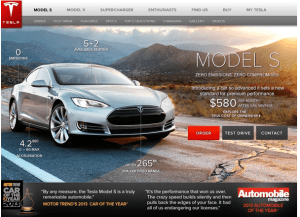
The Tesla Model S advert shown above is highly laced with rationality to convince the audience of the novel features of this car. In the advertisement, a smooth Tesla is prominently featured with a headline, “ZERO EMISSIONS, ZERO COMPROMISES,” emphasizing its innovative aspect. The headline is a rather tight logical argument since it tells the consumer that going green (zero emissions) means there is no need to compromise quality and performance (zero compromise). This ad appeals to two logical aspects: environmental (no emissions, good to the planet) and practical (no need to buy gasoline). Similar facts, such as a range per charge or the rapid acceleration of the vehicle, are also provided in the ad to make the audience believe in the high performance and efficiency of the car. The Tesla ad appeals to the rational mind of the reader by presenting facts and comparisons (fuel cost saving and the superior technical nature of electric drive). It states that, individually, people who are not behind the times should buy a Tesla because they will have the best performance, save money on gas, and heal the world in one swoop (Sander et al., 2021). Such application of logic places Tesla not only as a luxury, but as a logical decision based on innovation and practical advantages. The company makes a subtle argument that if one wants a car that performs and is environmentally friendly, then the Tesla Model S is the car one needs. It also implies that using Tesla is a choice that a rationally thinking, responsible person is bound to make.
Implied Conditional Statement: If you drive a Tesla, you will enjoy a high-performance ride while never paying for gas or polluting the environment.
Part 3: Original Advertisement
Name: SpeedX
My Product: New smartphone
Written Advertisement:
Conditional Statement in My Ad: “If you switch to SpeedX, then you will experience lightning-fast performance.”
The advertisement’s conditional statement states, “If you switch to SpeedX, then you will experience lightning-fast performance.” It is a direct promise of benefit tied to a condition. That if-then structure links the product to a desirable outcome: switching to SpeedX will give the user superior performance. Conditionally presenting the message clarifies the reasoning and provides the reader with evident, sound reasons to purchase the phone. Notably, this makes it sound like a guarantee to the consumer, which is compelling since there is presumptive reduction of uncertainty, and the customer can be assured of the reward that will come with purchase. It appeals to reasoning: any person willing to have improved speed of performance can safely reason that, provided they purchase this phone, they will enjoy these advantages. Essentially, this creates the viewer’s attitude by making the phone seem like a remedy that can deliver results.
Disjunction Statement in My Ad: “Do not settle for slow when you can have it all with SpeedX.”
The advertisement’s line displays a disjunction. The ad implies that the product works everywhere and at all times in the consumer’s life. The fact that this makes the phone perceived as versatile and capable to the audience is notable. It puts its customers at rest and will not make them compromise their way of life (whether work or play), as the phone will suit them well.
The combination of a conditional promise and inclusive disjunction puts the ad under consideration on a much higher persuasiveness level. The condition provides a specific motivation to the audience by ensuring that there is a reward when the audience purchases the product. In contrast, the disjunction appeals to a wider audience by demonstrating that the phone would be more effective under various conditions. Combining these rational aspects helps the audience understand SpeedX as a product that every person can implement in their lifestyle because it meets their expectations. Viewers get a sense that buying this smartphone is attractive, excellent, and rather reasonable.
Other Logical Statement: Speedx will have a long-lasting battery despite the efficiency.
Written Ad: “If you switch to SpeedX, then you will experience lightning-fast performance. Do not settle for slow when you can have it all with SpeedX.”
Graphics:

References
Angel, A. R., & Porter, S. R. (2012). A survey of mathematics with applications (p. 1072). Pearson Addison Wesley.
Fatmawati, E., Syathroh, I. L., Siagian, C. B., Anggraini, D. F., & Herman, H. (2024). Understanding the meaning of an advertisement text through interpersonal function analysis. Anglophile Journal, 4(1), 30–37. https://doi.org/10.51278/anglophile.v4i1.875
Sander, F., Föhl, U., Walter, N., & Demmer, V. (2021). Green or social? An analysis of environmental and social sustainability, advertising, and its impact on brand personality, credibility, and attitude. Journal of Brand Management, 28, 429–445. https://link.springer.com/article/10.1057/s41262-021-00236-8
ORDER A PLAGIARISM-FREE PAPER HERE
We’ll write everything from scratch
Question 
Creating a course project will display your learning in this course. It is important because it allows you an opportunity to apply the concepts you are studying in a real-world context and, in this way, you can display your understanding of the course material. Think critically and creatively. This project is an opportunity for you to showcase your knowledge and demonstrate how you can use what you have learned in practical, meaningful ways. Do your best as this is one part of your assessment for this course.
Mini-Project One
Directions: Select one of the mini-project choices below. You must complete all parts for whichever min-project you choose. Each project has multiple parts and requires the submission of all parts in order to obtain full credit. Submit the project work in a Word document. Please be sure to label each part. Please cite any sources.
Mini-Project One
Part 1: (40 points)
Select two of the advertisements shown in Appendix A and, in a paragraph of no less than five sentences for each, discuss how logic is used to persuade the reader. Write a conditional statement that is implied by each of the advertisements that you use.
Part 2: (10 points)
Find an advertisement (online, newspaper ad, …). Discuss how logic is used to persuade the reader. Write a conditional statement that is implied by the advertisement.
Note: For full credit, the advertisement must be included with your submission.
Part 3: (50 points)
Design an advertisement for a product or service of your choice using logical statements (e.g., conjunctions, disjunctions, conditionals). Include at least one conditional statement and one disjunction in the ad. Explain how you are using these logical operators to persuade your audience. How do these logical statements impact the way the audience perceives the product?
Example for Part 3:
Create an ad for a fitness app that uses a conditional statement like “If you track your workouts with our app, then you will see measurable progress.” Also, include a disjunction, such as “You can work out at home or at the gym with our app.” This is one idea. Your task is to come up with your own.
Name: ______________________________________
My Product: ________________________________________
Conditional Statement in my Ad: ____________________________________
Disjunction Statement in my Ad: _____________________________________
Other logical statements:______________________________________________ __________________________________________________________________
Written Ad:
 Complete the order form and upload all of your files, including any instructions, rubrics, or other materials provided by your instructor.
  Complete the order payment after filling in the order form. We’ll receive your order and assign it to a writer.
 The assigned writer will complete your paper and forward it to our Editing Team for review and approval.
 Once approved by the editor, the completed paper will be uploaded to your account for you to download, review and approve.