
Mini Lesson Presentation
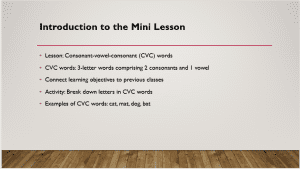
The learning activity in this lesson aims to develop spelling skills. We will focus on consonant-vowel-consonant (CVC) words. CVC words are three-letter words made up of two consonants and one vowel in a consonant-vowel-consonant pattern. To effectively identify the letters in each word, we will incorporate previous knowledge of letter sounds. At this point, we are all familiar with letter sounds. The letter sounds will help us break down the letters in the CVC words and build the words by combining the letters according to the sounds pronounced in the word. Some of the CVC words include cat, mat, dog, and bat. This lesson will equip us with essential skills for correct spelling practices, even for more complex words.
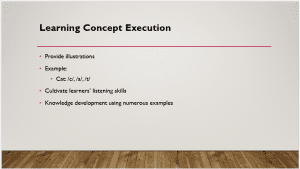
Before you engage in the activity, I will demonstrate how we will incorporate letter sounds to identify the correct letters in different words. To begin with, I have written the word ‘cat’ on the whiteboard. The teacher will guide the students to read the word repeatedly before breaking down the letter sounds in it. The word ‘cat’ is a single-syllable word made up of the sounds /c/, /a/, and /t/. The students will read the sounds in the word as the teacher directs them. The teacher will attract students’ attention by encouraging them to contribute verbally to the activity. I will provide various illustrations to separate the letter sounds in different CVC words, enhancing students’ skills and knowledge development regarding the spelling concept.
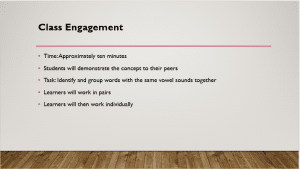
The teacher will give students around ten minutes to actively participate in the activity. The teacher will write a word on the whiteboard, such as mat, and select students randomly to identify the sounds as the teacher notes them down. The teacher will engage different students in the session. Then, the teacher will pair students so they can work in groups, identifying and grouping words with the same vowel sounds together. For instance, words such as man, bat, cat, and pan will be grouped together, while words like bed, pen, bet, and den will form another category. Later, the students will work independently to identify the letters in words, applying their letter-sound knowledge. Additionally, the teacher will assign some words for students to work on at home with their parents’ support.
It is essential to help students understand the relevance and value of learned concepts in future endeavors. Often, students question the significance of a class in their future learning journey or in their lives. Hence, it is important to inform them how the lesson activities will benefit them in their future learning. Students tend to see and appreciate the value of the knowledge acquired during the learning activity. In this regard, recognizing letter-sounds in a word is paramount for correct spelling, enabling students to engage in national spelling competitions. Additionally, linking the lesson to future learning activities motivates learners, increasing their concentration and attention to all learning concepts. Once students acknowledge the impact of the concepts on their future, it encourages self-assessment, helping them identify areas for improvement and avoiding future challenges. It is important to address a challenge at its primary stage rather than waiting to revisit it when one must deal with multiple and more complex concepts.
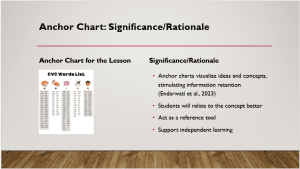
Kindergarten students learn best when visual tools are incorporated into their learning activities. In this case, a “CVC Words List” anchor chart will be used for the lesson. Notably, anchor charts support the learning process by visualizing ideas and concepts, stimulating information retention, as noted by Endarwati et al. (2023). Young learners have a lower capacity to recall ideas presented verbally or orally. As such, when concepts are presented using visual tools, they have a higher ability to relate to the ideas based on how they were presented. For instance, they use anchor charts as points of reference to help them revisit the concepts after engaging in different activities. Anchor charts promote independent learning among learners. After the lesson, students interact with the content on the charts independently, encouraging them to learn and build their skills on the concepts learned.
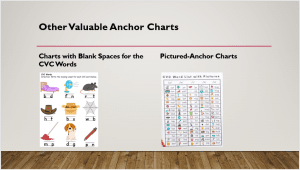
Pictorial charts also play a pivotal role in the effectiveness of executing the learning concepts. Kindergarten students are more attracted to visual tools. The charts should use colored pictures representing each word being taught. The combination of the images and various colors captures the learners’ attention, increasing their concentration on the learning concept. Additionally, using charts with blanks where students participate in filling in the spaces promotes a culture of engagement and participation in the learning activity. It is essential for teachers to identify effective and supportive learning materials that align with the learners’ needs to enhance an inclusive and collaborative learning culture.
Endarwati, E., Anwar, K., & Maruf, N. (2023). Exploring the challenges faced by teachers in teaching writing skills and how anchor charts can address them. English Review: Journal of English Education, 11(3), 629–640. https://doi.org/10.25134/erjee.v11i3.8421
ORDER A PLAGIARISM-FREE PAPER HERE
We’ll write everything from scratch
Question 

Mini Lesson Presentation
This presentation isn’t complete. You need to make sure the slides have all been completed. You need to record your voice over each slide, explaining each part of the lesson in Part 1. Make sure the presentation lasts at least 8-10 minutes. Make sure to explain the anchor chart and what other anchor charts can be used as well.
 Complete the order form and upload all of your files, including any instructions, rubrics, or other materials provided by your instructor.
  Complete the order payment after filling in the order form. We’ll receive your order and assign it to a writer.
 The assigned writer will complete your paper and forward it to our Editing Team for review and approval.
 Once approved by the editor, the completed paper will be uploaded to your account for you to download, review and approve.