
Midterm Exam: Who Would Jesus Kill
Both Urban II and Bernard of Clairvaux preached in favor of the Crusades and believed they were religiously justified. First, choose either Urban II or Bernard of Clairvaux, and explain their argument in favor of Crusade. Second, look at the scriptural passages from Module 2 and select one from the Old Testament and one from the New Testament. Are these calls for Crusade supported by Scripture? Challenged by Scripture? Evaluate the calls for Crusade in light of these two scriptural texts.
Urban II urged Christians to join a holy war at the Council of Clermont to liberate Jerusalem and to help the Christians of the East. He established this campaign as a moral undertaking and guaranteed absolution of sin for those who enrolled (Tyerman, 2006). Urban II presented his argument in the form of a theological discourse, which described the Muslim forces as heretics. He used this argument to identify the Crusade as an act of love and defense of fellow Christians. According to Urban II, those who participated in the Crusade would be fulfilling God’s intended purpose and engaging in a holy war.
One may consider Deuteronomy 20 and Matthew 5-7 to determine the biblical validity of Urban’s appeal in attracting others. In Deuteronomy 20, God issues the commandment of war to Israelites, which includes the destruction of cities that reverence other gods: “However, in the cities of the nations the Lord your God is giving you as an inheritance, do not leave alive anything that breathes. Completely destroy them…as the Lord your God has commanded you” (New International Version, 2011, Deut. 20:16-17). This is a divine injunction that presents the concept of war as a means of purifying the land and also serves to safeguard Israel against idolatry. This is aligned with the notion that religion-based violence had a precedence in the world.
On the contrary, the Sermon on the Mount (Matthew 5-7) disapproves of any justification for violence. Jesus asks people to make peace and not to retaliate or to love their enemies: “You have heard that it was said, ‘Eye for eye, and tooth for tooth.’ But I tell you…If anyone slaps you on the right cheek, turn to them the other cheek also” (New International Version, 2011, Matt. 5:38-39). “Love your enemies and pray for those who persecute you” (New International Version, 2011, Matt. 5:44). The teachings focus on mercy, peace, and nonviolence; therefore, the concept of a holy war can never go together with the message of Christ. Those radical teachings invert traditional assumptions of morality and oppose the reason of retaliation or armed justice. Jesus represents the love of God when He calls Christians to serve one another through forgiveness and self-sacrifice, rather than promoting violence in the name of righteousness. The Sermon on the Mount establishes a moral agenda centered on reconciliation, humility, and faith in God’s justice, rather than seeking retaliation through human means. Against that background, holy war conflicts with the core of Jesus’ ethical teachings and the kingdom He preaches.
In conclusion, the message of the Crusade, as propagated by Urban II, is validated by the Old Testament stories, particularly the story of the seizure of Canaan. However, it is refuted by the New Testament doctrines, which dwell upon peacemaking, humbleness, and forgiveness. Urban applied the Scripture to encourage action, but against Jesus and His extremely radical statement to love even enemies. Urban focused on military victory as well as vengeance, which is diametrically opposite to the word of Jesus.
The pacifist thinkers we have read in class were Tertullian, Origen of Alexandria, and Dorothy Day. Choose one of these thinkers and briefly summarize their argument for pacifism. Then, analyze their argument in light of Allman’s different types of pacifism in Who Would Jesus Kill pp. 63-69. Finally, explain which of the moral methods Allman describes in Chapter 1 (for example, divine command deontology, rule utilitarianism, etc.) best describes your thinker’s argument.
Tertullian was much opposed to the idea of Christians engaging in war. He posed the question of how the Christians could justify the shedding of blood, which Christ prohibited. Tertullian believed that violence was not allowed by the teachings of Christ. In his opinion, Christians should not use the sword even in situations when they would be persecuted or killed. He claimed that war went against the example and message of peace that Jesus preached.
The argument presented by Tertullian aligns well with the doctrines of faith-based pacifism, as outlined by Allman (2008). Faith-based pacifism posits that it is the calling of Christians to follow the example of nonviolence preached by Christ, regardless of the political and personal implications that may arise. Tertullian does not argue out of a matter of effectiveness or politics, but out of spiritual wholesomeness of being a follower of Jesus. His perspective is that Christian identity cannot be practiced together with war because the soul is tainted by engaging in violence, and this goes against the Gospel. This view emphasizes obedience to Christ rather than loyalty to worldly powers. To Tertullian, discipleship is to be called where one will have to shun all manner of violence, even when the state condones it. His argument presents a radical interpretation of Jesus’ teachings, as found in the Sermon on the Mount.
Tertullian’s pacifism can be classified under the divine command deontology, as Allman (2008) categorizes moral theories in Chapter 1. This ethical thought holds that any action is right as long as God commands the action. Tertullian believes that whatever Jesus taught is inflexible—a Christian must follow it without question. The commandment of loving enemies (Matt. 5:44) and offering the other cheek does not allow any compromise. In this kind of moral reasoning, obedience takes precedence over the consequences.
The pacifism exhibited by Tertullian would have been radical in the Roman world, which cherished military service and civic engagement. However, he insisted that God should always be supported as the Christian subject of his kingdom, rather than earthly kingdoms. He has a strong belief in divine justice and not human strength in his moral system. This view emphasizes obedience to Christ over adherence to earthly powers. To Tertullian, the way to discipleship means discarding any violence, even in cases where the state promotes it. His argument is an extreme one in terms of adherence to Jesus’ teachings, especially the Sermon on the Mount. He believes that spilling blood even during a war was something that was not supposed to be done by a follower of Christ, since there was no bloodshed at all in the gospels. Also, Tertullian does not accept the possibility of Christians severing their work in the world from their religious faith. In his writings, he suggests that people should prioritize their loyalty to Christ over their national or military commitments.
In conclusion, Tertullian is a thoroughgoing pacifist whose ideas are grounded in moral theology and Scripture. He denies violence as a matter of principle and prioritizes loyalty to Christ above civil duty or the duty to live. His teachings provide what is possibly one of the earliest and most articulate expressions of Christian ethics of nonviolence.
Dorothy Day wrote that “The pacifist in the next war must be ready for martyrdom.” How does this claim connect to the idea of persecution presented in the New Testament passages we read from 1 John, 1 Peter, and Revelation? Be sure to explain what Day means by her claim, and be sure to reference, explain, and cite from two of those three New Testament texts.
Dorothy Day wrote, “The pacifist in the next war must be ready for martyrdom.” This quote exemplifies Day’s unwavering commitment to the principles of nonviolence and Christian discipleship, to the extent of even risking violence or death. To her, pacifism was not a passive way of avoiding war, but it took an active stand against war and oppression, since the person doing this might suffer or die (Klejment, 2009). This vision of pacifism greatly influenced Day because of her interpretation of the life of persecution as a sign of faithfulness in the New Testament. This thought coincides with the theme in 1 Peter 2. Peter says, “But if you suffer for doing good and you endure it, this is commendable before God” (New International Version, 2011, 1 Pet. 2:20). He persuades Christians to emulate Christ who suffered unjustly and instead of retaliating he had paid no one back: “When they hurled their insults at him, he did not retaliate; when he suffered, he made no threats. Instead, he entrusted himself to him who judges justly” (New International Version, 2011, 1 Pet. 2:23). Day views these passages as a service of perseverance and faithful presence to await the persecution with patience and the love of Christ not the twisting of vengeance and violence.
Revelation 67 also has some biblical basis for Dorothy’s vision. In Rev. 6, the martyrs at the altar lament that justice is long overlooked: “How long, Sovereign Lord… until you judge the inhabitants of the earth and avenge our blood?” (New International Version, 2011, Rev. 6:10). It is the witness and the sacrifice that make these martyrs the honored martyrs and not the ones who fight back. Revelation 7 introduces an innumerable multitude of people who “have come out of the great tribulation” and are now at the presence of God (New International Version, 2011, Rev. 7:14-15). The images depict martyrdom as a testament to and a victory for religion. Day thought that being a real pacifist needs the heart to accept pain and be ready to die instead of sacrificing Christian love. In her statement, she urges Christians to take up the cross and have faith that God will transform their suffering into redemption. When they oppose violence, pacifists give the world a strong witness of the kingdom of God and what it stands for.
In conclusion, the New Testament’s view of martyrdom aligns with Dorothy Day’s perspective. Rather than justifying war, these scriptures emphasize the benefits of nonviolent witness, which can sometimes result in persecution. Day’s theology reminds that the Christian faith can cost the ultimate price, but also promises individuals eternal life.
References
Allman, M. (2008). Who would Jesus kill?: War, peace, and the Christian tradition. Saint Mary’s Press.
Klejment, A. (2009). The spirituality of Dorothy Day’s Pacifism. U.S. Catholic Historian, 27(2), 1–24. https://doi.org/10.1353/cht.0.0009
The Holy Bible: New International Version (NIV). (2011). Biblica, Inc. (Original work published 1973).
ORDER A PLAGIARISM-FREE PAPER HERE
We’ll write everything from scratch
Question 
Midterm Exam: Who Would Jesus Kill
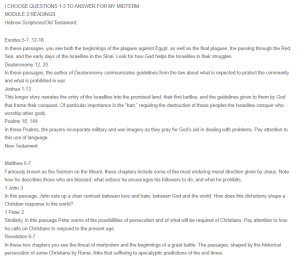
I CHOOSE QUESTIONS 1-3 TO ANSWER FOR MY MIDTERM
MODULE 2 READINGS:
Hebrew Scriptures/Old Testament:
Midterm Exam – Who Would Jesus Kill
Exodus 5-7, 12-18
In these passages, you see both the beginnings of the plagues against Egypt, as well as the final plagues, the passing through the Red Sea, and the early days of the Israelites in the Sinai. Look for how God helps the Israelites in their struggles.
Deuteronomy 12, 20
In these passages, the author of Deuteronomy communicates guidelines from the law about what is expected to protect the community and what is prohibited in war.
Joshua 1-13
This longer story narrates the entry of the Israelites into the promised land, their first battles, and the guidelines given to them by God that frame their conquest. Of particular importance is the “ban,” requiring the destruction of those peoples the Israelites conquer who worship other gods.
Psalms 18, 144
In these Psalms, the prayers incorporate military and war imagery as they pray for God’s aid in dealing with problems. Pay attention to this use of language.
New Testament:
Matthew 5-7
Famously known as the Sermon on the Mount, these chapters include some of the most enduring moral direction given by Jesus. Note how he describes those who are blessed, what actions he encourages his followers to do, and what he prohibits.
1 John 3
In this passage, John sets up a clear contrast between love and hate, between God and the world. How does this dichotomy shape a Christian response to the world?
1 Peter 2
Similarly, in this passage Peter warns of the possibilities of persecution and of what will be required of Christians. Pay attention to how he calls on Christians to respond to the present age.
Revelation 6-7
In these two chapters you see the threat of martyrdom and the beginnings of a great battle. The passages, shaped by the historical persecution of some Christians by Rome, links that suffering to apocalyptic predictions of the end times.
 Complete the order form and upload all of your files, including any instructions, rubrics, or other materials provided by your instructor.
  Complete the order payment after filling in the order form. We’ll receive your order and assign it to a writer.
 The assigned writer will complete your paper and forward it to our Editing Team for review and approval.
 Once approved by the editor, the completed paper will be uploaded to your account for you to download, review and approve.