
Mental Health Care for Adolescence and Children Discussion
Attention Deficit Hyperactivity Disorder (ADHD) is characterized by symptoms such as easy distractibility, impulsivity, and hyperactivity. In this scenario provided, Ryan could not remain in one place for more than a minute or two (Preszler & Burns, 2019). He also had difficulty following rules and instructions, a sign of impulsivity. Oppositional Defiant Disorder (ODD) is characterized by a pattern of disobedient, defiant, and hostile behavior toward authority figures. Ryan continues to refuse to listen to adults. Furthermore, he does not comply with the rules, which indicates ODD.
If Ryan’s behavior worsens and he starts to violate the rights of others, he may be diagnosed with Conduct Disorder (CD). CD is a mental health disorder characterized by a persistent pattern of aggressive, defiant, and antisocial behavior that violates the rights of others (Fairchild et al., 2019). This can include bullying, physical aggression, property damage, and violation of rules and laws. The diagnosis is given when these behaviors are more severe and persistent than what is typically seen in children and adolescents with ODD. A qualified mental health professional diagnoses CD after a thorough evaluation, typically including a detailed history, observation, and interviews with the child, parents, and teachers.
One of the management options for ADHD and ODD is pharmacological therapy. Stimulants such as methylphenidate and dextroamphetamine are commonly used to treat ADHD and can also be effective in reducing impulsivity and aggression in individuals with ODD (Retz et al., 2021). Atypical antipsychotics, such as Risperidone and Aripiprazole, have also been effective in reducing ODD and aggression symptoms.
Therapy for the parents is important because it can help them develop the skills and strategies needed to manage Ryan’s behavior effectively. One rationale for this is that therapy can provide parents with a better understanding of ODD and how it can affect behavior (Dopfner et al., 2021), which can help them identify triggers for Ryan’s negative behavior and develop appropriate responses. Another rationale is that therapy can also help parents address their feelings and reactions to Ryan’s behavior and learn how to respond calmly and consistently.
References
Döpfner, M., Liebermann-Jordanidis, H., Kinnen, C., Hallberg, N., Mokros, L., Benien, N., … & Dose, C. (2021). Long-term effectiveness of guided self-help for parents of children with ADHD in routine care—an observational study. Journal of Attention Disorders, 25(2), 265-274. https://doi.org/10.1177/1087054718810797
Fairchild, G., Hawes, D. J., Frick, P. J., Copeland, W. E., Odgers, C. L., Franke, B., … & De Brito, S. A. (2019). Conduct disorder. Nature Reviews Disease Primers, 5(1), 43. https://doi.org/10.1038/s41572-019-0095-y
Preszler, J., & Burns, G. L. (2019). Network analysis of ADHD and ODD symptoms: Novel insights or redundant findings with the latent variable model? Journal of Abnormal Child Psychology, 47, 1599-1610. https://doi.org/10.1007/s10802-019-00549-y
Retz, W., Ginsberg, Y., Turner, D., Barra, S., Retz-Junginger, P., Larsson, H., & Asherson, P. (2021). Attention-Deficit/Hyperactivity Disorder (ADHD), antisociality, and delinquent behavior over the lifespan. Neuroscience & Biobehavioral Reviews, 120, 236-248. https://doi.org/10.1016/j.neubiorev.2020.11.025
ORDER A PLAGIARISM-FREE PAPER HERE
We’ll write everything from scratch
Question 
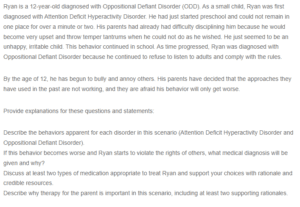
Ryan is a 12-year-old diagnosed with Oppositional Defiant Disorder (ODD). As a small child, Ryan was first diagnosed with Attention Deficit Hyperactivity Disorder. He had just started preschool and could not remain in one place for over a minute or two. His parents had already had difficulty disciplining him because he would become very upset and throw temper tantrums when he could not do as he wished. He just seemed to be an unhappy, irritable child. This behavior continued in school. As time progressed, Ryan was diagnosed with Oppositional Defiant Disorder because he continued to refuse to listen to adults and comply with the rules.
Mental Health Care for Adolescence and Children Discussion
By the age of 12, he has begun to bully and annoy others. His parents have decided that the approaches they have used in the past are not working, and they are afraid his behavior will only get worse.
Provide explanations for these questions and statements:
Describe the behaviors apparent for each disorder in this scenario (Attention Deficit Hyperactivity Disorder and Oppositional Defiant Disorder).
If this behavior becomes worse and Ryan starts to violate the rights of others, what medical diagnosis will be given and why?
Discuss at least two types of medication appropriate to treat Ryan and support your choices with rationale and credible resources.
Describe why therapy for the parent is important in this scenario, including at least two supporting rationales.
 Complete the order form and upload all of your files, including any instructions, rubrics, or other materials provided by your instructor.
 Complete the order payment after filling in the order form. We’ll receive your order and assign it to a writer.
 The assigned writer will complete your paper and forward it to our Editing Team for review and approval.
 Once approved by the editor, the completed paper will be uploaded to your account for you to download, review and approve.