
Medication errors
Regarding patient care, dozens of options are available, from potions to lotions to herbs and other medications for treating various conditions and illnesses. With the availability of these many options, it is highly likely for medical practitioners to make medication errors. Medication errors may happen at several junctions: when dispensing or prescribing, during documentation, transcription, monitoring, or during the administration of the drugs. However, most medication errors happen when defining and allocating (Tariq et al., 2022). Consistently, some measures could be adopted to reduce these errors. Additionally, patients subjected to suffering due to negligence by healthcare providers by giving the wrong medication should be given special treatment. However, I don’t think the healthcare providers responsible for the errors should be personally liable for the mistakes.
Hire our assignment writing services if your assignment is devastating you.
Measures to reduce the overall drug error rate in the hospital.
The rate of drug errors in the hospital can be reduced by taking measures such as the staff properly communicating drug orders since miscommunication causes errors. Secondly, the provider should also be specific about the drug indication, which means writing the drug’s intended use because most drugs have more than one use. Thirdly, the provider should also double-check the dosage and frequency of the medication at all times. Lastly, the hospital should also make sure to hire persons with the right qualifications and enough experience.
Unique benefits that should be given to the patients who have suffered due to negligence by the hospital staff
The patients suffering from medical errors by medical staff should be compensated adequately, including the medical and rehabilitation expenses. In addition, if the patient loses the capacity to make a living from the incident, they should be compensated. The hospital should also provide the care needed to minimize or reverse the effect for free to the affected patient.
Should the hospital staff responsible for the dispensing errors be held personally liable for the mistakes?
I think the hospital staff responsible for the dispensing errors should not be personally liable. According to Ellsworth et al. (2016), humans make errors, which are often unintentional; they may happen because the healthcare provider has been faced with a challenging population of patients or a medically complex patient. Additionally, the hospital staff may be burnt out from working too many hours without breaks, resulting in inefficiency because the hospital is understaffed. In conclusion, Medication errors account for about seven to nine thousand deaths in the United States; therefore, more lives would be saved if medication errors were reduced. This is because some of these errors are preventable.
References
Ellsworth, M., Aakre, C., Dziadzko, M., Peters, S., Pickering, B., & Herasevich, V. (2016). Early Computerization of Patient Care at Mayo Clinic. Mayo Clinic Proceedings, 91(7), e93-e101. https://doi.org/10.1016/j.mayocp.2016.04.001
Tariq, R., Vashisht, R., Sinha, A., & Scherbak, Y. (2022). Medication Dispensing Errors And Prevention. Ncbi.nlm.nih.gov. Retrieved 5 September 2022, from https://www.ncbi.nlm.nih.gov/books/NBK519065/.
ORDER A PLAGIARISM-FREE PAPER HERE
We’ll write everything from scratch
Question 
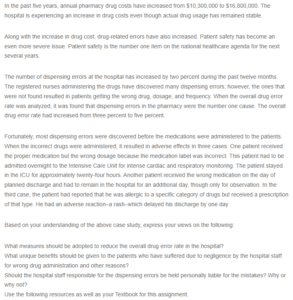
In the past five years, annual pharmacy drug costs have increased from $10,300,000 to $16,800,000. The hospital is experiencing an increase in drug costs even though actual drug usage has remained stable.
Medication errors
Along with the increase in drug cost, drug-related errors have also increased. Patient safety has become an even more severe issue. Patient safety is the number one item on the national healthcare agenda for the next several years.
The number of dispensing errors at the hospital has increased by two percent during the past twelve months. The registered nurses administering the drugs have discovered many dispensing errors; however, the ones that were not found resulted in patients getting the wrong drug, dosage, and frequency. When the overall drug error rate was analyzed, it was found that dispensing errors in the pharmacy were the number one cause. The overall drug error rate had increased from three percent to five percent.
Fortunately, most dispensing errors were discovered before the medications were administered to the patients. When the incorrect drugs were administered, it resulted in adverse effects in three cases. One patient received the proper medication but the wrong dosage because the medication label was incorrect. This patient had to be admitted overnight to the Intensive Care Unit for intense cardiac and respiratory monitoring. The patient stayed in the ICU for approximately twenty-four hours. Another patient received the wrong medication on the day of planned discharge and had to remain in the hospital for an additional day, though only for observation. In the third case, the patient had reported that he was allergic to a specific category of drugs but received a prescription of that type. He had an adverse reaction–a rash–which delayed his discharge by one day.
Based on your understanding of the above case study, express your views on the following:
What measures should be adopted to reduce the overall drug error rate in the hospital?
What unique benefits should be given to the patients who have suffered due to negligence by the hospital staff for wrong drug administration and other reasons?
Should the hospital staff responsible for the dispensing errors be held personally liable for the mistakes? Why or why not?
Use the following resources as well as your Textbook for this assignment.
 Complete the order form and upload all of your files, including any instructions, rubrics, or other materials provided by your instructor.
  Complete the order payment after filling in the order form. We’ll receive your order and assign it to a writer.
 The assigned writer will complete your paper and forward it to our Editing Team for review and approval.
 Once approved by the editor, the completed paper will be uploaded to your account for you to download, review and approve.