
Marketing Plan – BarkBox
Overview
Bark Inc. delivers the BarkBox bundle to passionate pet owners through a monthly subscription business model. The monthly offerings are designed as a surprise, with the company incorporating a range of toys, treats, and props for dog owners to take photos with their pets. Each month has a unique theme, but the contents are designed to suit customers’ preferences and interests. Bark’s target audience is not just pet owners but those willing to pamper and spoil their pets. These passionate owners love their pets to the extent of treating them like their children. Since customers cannot find their preferred treats and toys in a single store, Bark Inc. fills the gap by collecting and packaging a wide range of treats from different suppliers.
Product Strategies
One of the product elements that has given BarkBox a competitive edge is that the company creatively designs its packages by displaying what is inside the package. The company leverages different themes, including Barfest in Bed, Lick or Treat, and Chewrassic, to attract customers. These themes are attractive to customers to the extent that customers keep sharing unboxing videos after receiving their offerings. Therefore, apart from providing customers’ dogs with treats, the company also seeks to keep the customers engaged through entertainment.
Notably, Bark Inc. will position itself as a company that cares about its clients’ needs through personalization. This is based on the fact that dogs have varying needs, hence the need for special attention. Among others, the contents of subscription packages will be packaged while paying attention to a dog’s needs, including chewing intensity, allergies, and size. For instance, some dogs do not consume chicken. Once a customer provides information that their dogs may not be comfortable with chicken treats, the company will ensure the package does not include such treats. Besides, significantly large dogs will receive plus-size Backboxes because they consume more.
Pricing Strategies
BarkBox’s pricing strategy is designed to attract and maintain loyal customers. From the outset, subscribing to monthly offerings provides cost savings for the customer. The total cost of buying the bundled products from Bark is significantly lower than the overall cost of purchasing the products individually. Besides, loyalty grants further cost savings, and the longer the customer maintains an active subscription service, the more cost savings they make. A one-time purchase of the BarkBox costs $35. However, if a customer commits to a six-month subscription service, they will receive each BarkBox for $26. Those who commit to a one-year subscription receive the BarkBox at $23 per month. Thus, the company’s pricing strategy is designed to keep customers loyal.
Bark will provide post-purchase discounts to encourage customer loyalty and brand awareness. For instance, if a customer purchases from Bark consistently, they will be offered discounts on future purchases. This is because discounts have consistently shown a positive impact on sales (Bonyuet, 2019). On the other hand, those who refer others will receive bonuses that can be used to purchase a BarkBox. To encourage more customer loyalty and attract new customers, the company will continue offering discounted offerings.
However, it is worth noting that setting prices to appease customers can be detrimental to business. The quest to maintain promises can hurt profitability. For instance, Bark reported a $15.4 million loss in the first quarter of 2022 owing to its commitment to a huge subscriber market (Bark Inc., 2022). The company has over 2 million active subscribers, with 96% of them reporting satisfaction. Since these customers are committed to staying at the company, there is a need to slightly revise the BarkBox prices to ensure business sustainability.
Promotional Strategies
BarkBox will leverage social media channels to reach its target audience. This is informed by the fact that BarkBox’s primary target customers are regular social media users. The company will connect with its customers, create brand awareness, and drive sales by leveraging different social media platforms.
One way the company will bolster brand awareness on social media platforms such as Instagram and Facebook is by creating engaging content that resonates with the target audience. Among others, the company will post funny and cute videos, memes, and photos of people playing with dogs to engage passionate dog owners and create awareness about the brand. Also, BarkBox will collaborate with popular influencers with a huge social media following to create content that directs the target audience to the company’s products. Social media influencers tend to influence the lifestyle of their followers; hence, using them for marketing will significantly bolster the Bark brand and drive sales (Antczak, 2024). Also, Barkbox will leverage user-generated content by encouraging customers to make videos of themselves with their pets and post them on their social media platforms. While at it, the customers will be encouraged to tag the company or include hashtags such as #BarkBox to redirect target audiences to the company’s platforms. Antczak (2024) avers that Facebook and Instagram are effective channels for customer engagement because they are frequented by young middle-aged urban dwellers, a primary target of BarkBox.
Another promotional strategy likely to attract customers and enhance brand awareness is post-purchase customer engagement via email. Engaging customers via email after purchases will build brand loyalty and encourage repeat purchases (Antczak, 2024). For instance, sending a thank-you message after a customer makes a purchase will make them feel recognized. Also, the company will engage with customers via email to gather their feedback through customer surveys. Apart from gathering customer feedback, follow-up surveys show customers that the company cares about their needs; hence, the customers are likely to stay loyal.
Place Strategies
Bark can leverage retail storage with customer pick-up to enhance distribution. Under this strategy, customers will place their orders online and then come to pick up their orders later. This strategy is suitable for customers interested in one-time orders, complementing the door-to-door delivery for long-term subscribers. Bark can collaborate with dog trainers and veterinarians who can recommend their offerings to customers whenever they have sessions. One of the distribution channels the company may exploit is the manufacturer’s storage with direct shipping, whereby, as a retailer, BarkBox will take orders and have one-time deliveries done directly to the customer. Also, the company will leverage the services of logistics companies, which will pick up orders from the company’s stores and deliver directly to customers.
Conclusion
In summary, Bark Inc., a leader in the US pet products industry, stands to benefit from the bustling market if it implements effective product, promotional, pricing, and distribution strategies. One product strategy that will go a long way to drive up sales is embracing product personalization, where products are curated to align with customers’ needs. To enhance brand awareness and customer loyalty, the company will leverage email and social media channels to connect with and engage its customers and target audience. On the other hand, offering discounted offerings will come in handy to encourage long-term subscriptions.
References
Antczak, B. O. (2024). The influence of digital marketing and social media marketing on consumer buying behavior. Journal of Modern Science, 56(2), 310–335. https://doi.org/10.13166/jms/189429
Bark Inc. (2022). BARK reports first quarter fiscal year 2022 results. Bark.co. https://investors.bark.co/news/news-details/2021/BARK-Reports-First-Quarter-Fiscal-Year-2022-Results/default.aspx
Bonyuet, D. (2019). Price delegation and the impact on customer loyalty. Journal of Instructional Pedagogies, 22. https://files.eric.ed.gov/fulltext/EJ1216829.pdf
ORDER A PLAGIARISM-FREE PAPER HERE
We’ll write everything from scratch
Question 
Marketing Plan – BarkBox
Topic: Barkbox
Task
Write a 3–5-page paper addressing the following sections. Include headings, sub-headings, and references.
Develop strategies for each element of the marketing mix as outlined below.
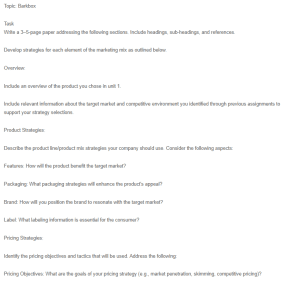
Marketing Plan – BarkBox
Overview:
Include an overview of the product you chose in unit 1.
Include relevant information about the target market and competitive environment you identified through previous assignments to support your strategy selections.
Product Strategies:
Describe the product line/product mix strategies your company should use. Consider the following aspects:
Features: How will the product benefit the target market?
Packaging: What packaging strategies will enhance the product’s appeal?
Brand: How will you position the brand to resonate with the target market?
Label: What labeling information is essential for the consumer?
Pricing Strategies:
Identify the pricing objectives and tactics that will be used. Address the following:
Pricing Objectives: What are the goals of your pricing strategy (e.g., market penetration, skimming, competitive pricing)?
Pricing Tactics: What specific tactics will you implement to achieve these objectives (e.g., discounts, bundling, psychological pricing)?
Promotion Strategies:
Provide a detailed plan for promoting the product, including:
Marketing Channels: Identify two marketing channels you will use (e.g., social media, email marketing, influencer partnerships).
Channel Description: Describe each channel and explain why it will be effective for reaching your target market.
Place Strategies:
Outline the distribution strategy for getting the product to the consumer, considering the following:
Supply Chain: How will the company efficiently supply the product/service to consumers?
Retailers/Resellers: Are there specific types of retailers or resellers you will partner with?
Market Changes: What market changes should be considered in your distribution strategy?
Distribution Channel: Define the distribution channel(s) you will use.
Format:
This assignment should be double spaced, 12-point Arial or Times New Roman Font
Include references and in-text citations
Assignment will be 3-5 pages not including the title page or reference list
 Complete the order form and upload all of your files, including any instructions, rubrics, or other materials provided by your instructor.
  Complete the order payment after filling in the order form. We’ll receive your order and assign it to a writer.
 The assigned writer will complete your paper and forward it to our Editing Team for review and approval.
 Once approved by the editor, the completed paper will be uploaded to your account for you to download, review and approve.