
Locating Credible Databases and Research – Chronic Obstructive Pulmonary Disease
“Evidence-based practice (EBP) integrates the clinical expertise, the latest and best available research evidence, as well as the patient’s unique values and circumstances” (Abu-Baker et al., 2021, p. 1). As a baccalaureate-prepared professional nurse, the implementation of EBP is not only expected, but it also serves as a leadership responsibility whenever one is training other staff members. Chronic obstructive pulmonary disease (COPD)—an inflammatory lung disease that requires intervention to control the exacerbations and complications. This paper also seeks to give direction to a new nurse on where to find evidence on COPD, specify the research areas and sources, and explain why the chosen information hubs are ideal.
Communication and Collaboration Strategies
When a newly hired nurse expresses uncertainty regarding COPD, a constructive, supportive response fosters learning and collaboration. I would initiate the conversation with affirming language such as, “I appreciate your initiative to seek more knowledge; let’s work together to find reliable evidence on COPD care.” This conveys encouragement, builds rapport, and reinforces a culture of professional inquiry. “Respectful communication between nurses and patients can reduce uncertainty, enhance greater patient engagement in decision making, improve patient adherence to medication and treatment plans, and increase social support, safety, and patient satisfaction in care” (Kwame & Petrucka, 2021, p. 2).
To collaborate effectively, I would apply the PICO (Population, Intervention, Comparison, Outcome) framework to help the nurse develop targeted clinical questions—such as “In adults with COPD (P), how effective is inhaled corticosteroid therapy (I) compared to bronchodilators alone (C) in preventing exacerbations (O)?” I would offer a guided tutorial on using databases such as PubMed and CINAHL, demonstrating Boolean operators and filters to streamline searches. Moreover, I would schedule follow-up discussions to co-review articles and assess their quality using critical appraisal tools, such as the CASP checklists.
An additional strategy would involve structured mentorship, where experienced nurses guide new staff in evidence-based inquiry. Regular sessions could include article discussions, critical appraisal, and database navigation practice. This mentorship approach encourages confidence, fosters reflective thinking, and promotes independent research habits. Through supportive relationships, nurses not only build EBP skills but also develop stronger clinical judgment and professional identity within a collaborative, evidence-informed care environment.
Optimal Research Locations in the Healthcare Setting
Ideal research locations include nurse workstations, clinical education rooms, and EBP resource centers with databases such as PubMed, CINAHL, and hospital policy repositories. These sources meet the CRAAP test—offering content that is current, relevant to COPD, authored by credible experts, accurate, and designed for clinical application. Virtual access tools like DynaMed and ClinicalKey further enhance availability beyond scheduled shifts, supporting rapid, evidence-based decision-making. Integrating these platforms into routine workflows ensures timely access to best practices. Scheduling protected EBP time also strengthens interdisciplinary collaboration and reinforces the nurse’s ability to apply high-quality, patient-centered evidence in clinical care.
Top Five Credible Sources for COPD Evidence (Ranked)
PubMed (https://pubmed.ncbi.nlm.nih.gov/)
PubMed is a database that is freely accessible and created and updated by the National Centre for Biotechnology Information (NCBI) at the U.S. National Library of Medicine. It provides more than 38 million citations and abstracts of biomedical literature such as, MEDLINE and journals of life science (PubMed 2025). It enables nurses to access up-to-date, peer-reviewed COPD research. Its advanced search tools and use of MeSH terms allow precise evidence retrieval on COPD pharmacotherapy and comorbidity management.
GOLD Guidelines (https://goldcopd.org/)
The GOLD provides an internationally recognized strategy for COPD prevention, diagnosis, and treatment. Updated annually, the GOLD Report incorporates evidence from clinical trials and expert consensus to provide practical recommendations for individualized care. It outlines a framework for assessment using spirometry and symptom burden, treatment algorithms based on patient group classification, and guidance on exacerbation management. The 2024 report emphasizes early identification, precision treatment, and risk factor modification (Global Initiative for Chronic Obstructive Lung Disease, 2024). It is current, authoritative, and tailored specifically to COPD, making it one of the most relevant tools for clinical nursing practice.
Cochrane Library (https://www.cochranelibrary.com/about/about-cochrane-library)
The Cochrane Library is a reliable source of databases with impartial, high-quality evidence to help guide healthcare decisions. It’s owned by Cochrane and published by Wiley. The Cochrane Central Register of Controlled Trials (CENTRAL), Cochrane Clinical Answers, and the Cochrane Database of Systematic Reviews (CDSR), the premier resource for peer-reviewed systematic reviews in the medical field, are all available through the library (Cochrane Library, 2022). All content is developed according to the Cochrane Handbook and undergoes rigorous editorial and peer-review processes, supporting the global use of evidence-based practice. In the context of COPD, the Cochrane Library offers comprehensive, up-to-date evidence on treatments such as inhaled therapies, pulmonary rehabilitation, and non-pharmacologic interventions. It enables nurses to critically assess intervention effectiveness and apply excellent techniques for enhancing COPD management, patient education, and care outcomes.
CINAHL (Cumulative Index to Nursing and Allied Health Literature) (https://www.ebsco.com/products/research-databases/cinahl-complete)
CINAHL is a specialized database maintained by EBSCO that offers peer-reviewed nursing and allied health literature. It includes clinical guidelines, care plans, and educational resources. For COPD, it provides best practice models and research on how nurses can better manage structured care to enhance COPD patient outcomes. Its nursing focus ensures relevance and supports bedside decision-making aligned with best practices in chronic respiratory care.
Hospital Intranet: Policy and Procedure Database
The hospital intranet is an internal portal containing institutional protocols, clinical guidelines, and care pathways. Though not peer-reviewed, it is reviewed regularly and aligns with regulatory standards. For COPD, it offers specific protocols on oxygen use, medication delivery, and discharge planning, helping nurses follow standardized, evidence-informed procedures tailored to their care setting.
Justification for Source Selection
These sources have been chosen because they offer review articles, scientific articles, and clinical practice guidelines originating from scholarly databases written by professionals, researchers, and clinicians. All the sources contribute to EBP in COPD care by providing the most current and research-backed information. They are also presented with updated information regarding the current findings on enhancing currency. The sources are readily available for searching, providing articles, systematic reviews, and clinical protocols. These databases and websites are rather helpful in healthcare education and decision-making, which makes them relevant for nursing practice concerning COPD management. Besides, they enhance clinical realism, treatment standardization, and the cognition of the mindsets essential for safe and caring practice.
Conclusion
Resource acquisition, which facilitates the process of clinical nurses searching for evidence, is one of the critical roles of nursing leaders. Using a structure in communication and collaboration, baccalaureate-prepared nurses can help new staffs to be confident and competent in EBPMU. Successful COPD care requires quality information, ranging from guidelines and protocols at the global level to guidelines at the workplace level. When new nurses learn how to identify scarce resources and practice reflection, the nurse leaders guarantee that high-quality, patient-centric care becomes the norm for practice.
References
Abu-Baker, N. N., AbuAlrub, S., Obeidat, R. F., & Assmairan, K. (2021). Evidence-based practice beliefs and implementations: A cross-sectional study among undergraduate nursing students. BMC Nursing, 20(1), 1–8. https://doi.org/10.1186/s12912-020-00522-x
Cochrane Library. (2022). About the Cochrane library. Cochrane Library. https://www.cochranelibrary.com/about/about-cochrane-library
Global Initiative for Chronic Obstructive Lung Disease. (2024). Pocket guide to COPD diagnosis, management, and prevention: A guide for health care professionals (2024 ed.). Global Initiative for Chronic Obstructive Lung Disease, Inc. https://goldcopd.org/wp-content/uploads/2024/02/POCKET-GUIDE-GOLD-2024-ver-1.2-11Jan2024_WMV.pdf
Kwame, A., & Petrucka, P. (2021). A literature-based study of patient-centered care and communication in nurse-patient interactions: Barriers, facilitators, and the way forward. BMC Nursing, 20(158). https://doi.org/10.1186/s12912-021-00684-2
PubMed. (2025, March 11). PubMed overview. PubMed; National Library of Medicine. https://pubmed.ncbi.nlm.nih.gov/about/
ORDER A PLAGIARISM-FREE PAPER HERE
We’ll write everything from scratch
Question 
Locating Credible Databases and Research – Chronic Obstructive Pulmonary Disease
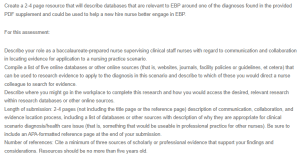
Create a 2-4 page resource that will describe databases that are relevant to EBP around one of the diagnoses found in the provided PDF supplement and could be used to help a new hire nurse better engage in EBP.
Locating Credible Databases and Research
For this assessment:
Describe your role as a baccalaureate-prepared nurse supervising clinical staff nurses with regard to communication and collaboration in locating evidence for application to a nursing practice scenario.
Compile a list of five online databases or other online sources (that is, websites, journals, facility policies or guidelines, et cetera) that can be used to research evidence to apply to the diagnosis in this scenario and describe to which of these you would direct a nurse colleague to search for evidence.
Describe where you might go in the workplace to complete this research and how you would access the desired, relevant research within research databases or other online sources.
Length of submission: 2-4 pages (not including the title page or the reference page) description of communication, collaboration, and evidence location process, including a list of databases or other sources with description of why they are appropriate for clinical scenario diagnosis/health care issue (that is, something that would be useable in professional practice for other nurses). Be sure to include an APA-formatted reference page at the end of your submission.
Number of references: Cite a minimum of three sources of scholarly or professional evidence that support your findings and considerations. Resources should be no more than five years old.
 Complete the order form and upload all of your files, including any instructions, rubrics, or other materials provided by your instructor.
  Complete the order payment after filling in the order form. We’ll receive your order and assign it to a writer.
 The assigned writer will complete your paper and forward it to our Editing Team for review and approval.
 Once approved by the editor, the completed paper will be uploaded to your account for you to download, review and approve.