
Locating Credible Databases and Research
Much evidence indicates that applying evidence-based practice in patient care improves the quality of the care services delivered and the patients’ experiences (Melnyk & Fineout-Overhold, 2022). Baccalaureate-prepared nurses are leaders and managers of the nursing staff and are expected to optimize the work environment (Dyck et al., 2021). They are responsible for promoting evidence-based practice (EBP) among nurses at levels of patient care. This paper focuses on the case of a surgical department nurse who wants to understand how to take care of a patient who has had kidney surgery. Besides the surgery pain the patient complains of, she suspects the patient has an underlying chronic pain syndrome. She wants to know how to diagnose best and manage chronic pain syndrome as the patient recovers from the surgery.
This paper will present the best communication strategies a baccalaureate-prepared nurse can apply to encourage the nurses to research the diagnosis and strategies to collaborate with the nurses to access resources. It will also describe the most suitable places to complete research and what types of resources to research for the diagnosis and identify five sources of evidence-based diagnosis. In addition, it will explain why the sources selected provide the best evidence for the diagnosis of chronic pain syndrome.
Communication Strategies to Encourage Evidence-Based Diagnosis and Collaboration to Access Resources
A baccalaureate-prepared nurse must have excellent communication skills to positively impact the nursing staff and encourage them to research and collaborate to access resources to support their practice. Effective communication involves conveying the correct information, feelings, and meanings and helps prevent misunderstandings and conflict (Li et al., 2019). Two of the best forms of communication to encourage research for evidence-based diagnosis of chronic pain syndrome are verbal communication, written communication such as presentations and emails, and active listening.
Adopting communication strategies that encompass verbal communication, written communication, and active listening will stimulate interest among the nurses to engage in the research for evidence to carry out a better diagnosis. Verbal communication is convenient and provides timely feedback. Written means of communication, such as emails and presentations, provide a permanent reference source for the nurses during the research. The baccalaureate-prepared nurse can use active listening to establish deeper connections with the nursing staff. Active listening represents respect, empathy, and focused attention (Jonsdottir & Fridriksdottir, 2019). The baccalaureate-prepared nurse can ignite research interest in the nursing staff through communication strategies.
Best Places to Complete Research and Types of Resources to Access
There are various places and resources that the nurses can utilize to complete their research for evidence-based diagnosis of chronic pain syndrome. The nurses can access, review, and meta-analyze nursing journals specializing in pain management, analyze the existing guidelines online or within the hospital on diagnosing various types of pain, and review other pain diagnosis and management manuals.
The nurses should search the various medical and nursing research databases for specialized nursing journals online. Nurses can search and analyze peer-reviewed articles focused on primary research and systematic reviews on pain management and chronic pain if they are open in the explored databases. The internal hospital library and certified medical websites also provide clear guidelines on diagnosing and managing various categories of pain, such as chronic pain syndrome.
Five Sources of Online Information to Support Diagnosis
Nurses can utilize various online sources of information to support an evidence-based diagnosis of the chronic syndrome. The nurses can search for evidence-based chronic pain diagnosis and management materials from the Cochrane Library, Scopus, and Pubmed Central databases. The other two useful online sources the nurse can use to obtain information to support their diagnosis are the American Pain Society website and the United States (U.S) Pain Foundation’s. Scopus provides access to significant nursing articles and abstracts. Pubmed Central allows access to MEDLINE’s other databases. The American Pain Society and the U.S. Pain Foundation websites provide diverse resources on pain management, including chronic pain.
Why the Sources Selected Provide the Best Evidence for the Diagnosis
There are many reasons why the selected sources to support the nursing research will be able to provide the best evidence to support the diagnosis of chronic pain syndrome. For instance, Scopus is the most extensive database with peer-reviewed articles supporting nursing practice and research. PubMed Central is a search engine maintained by the National Library of Medicine, thus giving access to various databases that provide access to peer-reviewed journals. Cochrane Library provides access to multiple databases, such as the Cochrane Database of Systematic Reviews (CDSR) and Cochrane Central Register of Controlled Trials (CENTRAL), which can support diagnosis and treatment decisions. The American Pain Society publishes the Journal of Pain. The sources have various features, including filters allowing the research to filter articles based on type of paper, date range, language, and specific topics.
Conclusion
Using appropriate communication strategies can help a baccalaureate-prepared nurse encourage other nursing staff to engage in research to develop evidence to support the diagnosis of medical and health conditions. The effectiveness of the nurse’s communication determines how the nurses understand resources for research and how to search for materials to support their research.
References
Dyck, N., Martin, D., & McClement, S. (2021). Baccalaureate Education as an Entry-to-Practice Requirement: Why It Matters Now More Than Ever. Nursing Leadership (Toronto, Ont.), 34(4), 103–112. https://doi.org/10.12927/CJNL.2021.26683
Jonsdottir, I. J., & Fridriksdottir, K. (2019). Active listening: is it the forgotten dimension in managerial communication? Https://Doi.Org/10.1080/10904018.2019.1613156, 34(3), 178–188. https://doi.org/10.1080/10904018.2019.1613156
Li, Y., Wang, X., Zhu, X. rui, Zhu, Y. xXin & Sun, J. (2019). Effectiveness of problem-based learning on nursing students’ and nurses’ professional communication competencies: A systematic review. Nurse Education in Practice, 37, 45–55. https://doi.org/10.1016/J.NEPR.2019.04.015
Melnyk, B. M., & Fineout-Overhold, E. (2022). Evidence-based practice in nursing & healthcare: A guide to best practice (5th ed.). Wolters Kluwer.
ORDER A PLAGIARISM-FREE PAPER HERE
We’ll write everything from scratch
Question 
Create a 2-4 page resource that will describe databases relevant to EBP around a diagnosis you chose and could be used to help a new hire nurse better engage in EBP.
Locating Credible Databases and Research
Introduction
Evidence-based practice (EBP) integrates the best evidence to guide optimal nursing care to enhance safety and quality. EBP is crucial to nursing practice because it incorporates the best evidence from current literature, along with the expertise of the practicing nurse. The concern for quality care that flows from EBP generates a desired outcome. Without these factors, a nurse cannot be an effective leader. It is essential to lead not only from this position but from knowledge and expertise. To gain the knowledge, you must understand how to search for scholarly resources and identify credible databases and websites to implement evidence-based changes in practice.
Your Online e-Portfolio
Creating an ePortfolio is not required in the BSN program, but you may find it helpful to create one to attach to your professional resume while job hunting. Online ePortfolios serve two essential purposes: 1) to support learning and reflection and 2) as a showcase tool. Your learning journey can be documented, and ePortfolios contribute to lifelong learning and growth through reflection and sharing. Online ePortfolios can also be shared with employers and peers to present artifacts demonstrating your accomplishments at Capella.
Professional Context
As a baccalaureate-prepared nurse, you will be responsible for providing patient-centered, competent care based on current evidence-based best practices. You must research, analyze, and disseminate the best evidence to stay abreast of these best practices. Understanding where to go to find credible sources and locate evidence, as well as which search terms to use, is the foundation of the incorporation of best practices.
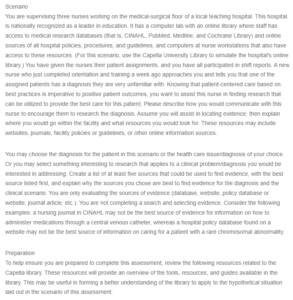
Scenario
You are supervising three nurses working on the medical-surgical floor of a local teaching hospital. This hospital is nationally recognized as a leader in education. It has a computer lab with an online library where staff has access to medical research databases (that is, CINAHL, PubMed, Medline, and Cochrane Library) and online sources of all hospital policies, procedures, and guidelines, and computers at nurse workstations that also have access to these resources. (For this scenario, use the Capella University Library to simulate the hospital’s online library.) You have given the nurses their patient assignments, and you have all participated in shift reports. A new nurse who just completed orientation and training a week ago approaches you and tells you that one of the assigned patients has a diagnosis they are very unfamiliar with. Knowing that patient-centered care based on best practices is imperative to positive patient outcomes, you want to assist this nurse in finding research that can be utilized to provide the best care for this patient. Please describe how you would communicate with this nurse to encourage them to research the diagnosis. Assume you will assist in locating evidence, then explain where you would go within the facility and what resources you would look for. These resources may include websites, journals, facility policies or guidelines, or other online information sources.
You may choose the diagnosis for the patient in this scenario or the health care issue/diagnosis of your choice. Or you may select something interesting to research that applies to a clinical problem/diagnosis you would be interested in addressing. Create a list of at least five sources that could be used to find evidence, with the best source listed first, and explain why the sources you chose are best to find evidence for the diagnosis and the clinical scenario. You are only evaluating the sources of evidence (database, website, policy database or website, journal article, etc.). You are not completing a search and selecting evidence. Consider the following examples: a nursing journal in CINAHL may not be the best source of evidence for information on how to administer medications through a central venous catheter, whereas a hospital policy database found on a website may not be the best source of information on caring for a patient with a rare chromosomal abnormality.
Preparation
To help ensure you are prepared to complete this assessment, review the following resources related to the Capella library. These resources will provide an overview of the tools, resources, and guides available in the library. This may be useful in forming a better understanding of the library to apply to the hypothetical situation laid out in the scenario of this assessment.
BSN Program Library Research Guide.
Evidence-Based Practice in Nursing & Health Sciences.
Databases A-Z: Nursing & Health Sciences.
Get Critical Search Skills.
Remember, looking at databases and resources outside the Capella library, such as organizational policies, professional organizations, and government healthcare resources, is also appropriate.
You are encouraged to complete the Evaluating the Credibility of Evidence activity. This activity offers an opportunity to practice evaluating the credibility of evidence. These skills will be necessary to complete Assessment 1 successfully and are for your practice and self-assessment. Completing this activity is also a way to demonstrate course engagement.
Instructions
The purpose of this assessment is to understand where to find evidence that can be applied to clinical scenarios and to learn effective communication and collaboration with clinical staff during the process of evidence location. As a baccalaureate-prepared nurse, you will not only use research for self-improvement in your clinical role, but you will also serve as a mentor to supervised nursing staff. Therefore, you will need to be able to communicate and collaborate effectively to guide them toward resources to find research, as well as support them through the initial evidence location process. In doing so, nurses can access evidence that can be analyzed and utilized to stay current on best practices. This allows them to provide safe, patient-centered care and improve patient outcomes.
For this assessment:
Describe your role as a baccalaureate-prepared nurse supervising clinical staff nurses about communication and collaboration in locating evidence for application to a nursing practice scenario.
Compile a list of five online databases or other online sources (that is, websites, journals, facility policies or guidelines, et cetera) that can be used to research evidence to apply to this scenario or clinical practice issue/diagnosis and describe to which of these you would direct a nurse colleague to search for evidence.
Describe where you might go to complete this research in the workplace and how you would access the desired, relevant research within research databases or other online sources.
Be sure to address the following in this assessment, corresponding to the grading criteria in the scoring guide. Please study the scoring guide carefully to know what is needed for a distinguished score.
Describe communication strategies to encourage nurses to research the diagnosis/practice issue and collaborate with the nurses to access resources.
Describe the best places to complete research and what types of resources you would want to access to find pertinent information for the diagnosis/healthcare issue within a specific healthcare setting.
Identify five sources of online information (medical journal databases, websites, hospital policy databases, et cetera) that could be used to locate evidence for a clinical diagnosis/practice issue.
Explain why the selected online information sources should provide the best evidence for the chosen diagnosis/health care issue.
Communicate using the current APA style using clear, logical, and professional writing with correct grammar and spelling.
Note: While not selecting and evaluating specific evidence to help with the clinical diagnosis/practice issue, you should cite the literature and best practices to support your communication and collaboration approach description. Additionally, it is appropriate to mention best practices related to EBP and evaluating databases to support your explanation of why you selected the five online information sources.
 Complete the order form and upload all of your files, including any instructions, rubrics, or other materials provided by your instructor.
 Complete the order payment after filling in the order form. We’ll receive your order and assign it to a writer.
 The assigned writer will complete your paper and forward it to our Editing Team for review and approval.
 Once approved by the editor, the completed paper will be uploaded to your account for you to download, review and approve.