
Liver Disease Teaching Plan
A teaching plan describes the organization and specifics of one session. A solid teaching plan should thoroughly describe the teaching techniques, the approximate length of each teaching segment, and pertinent materials and resources. The components of a teaching plan include the course title, session topic, course measurable learning outcomes, teaching topic (specific) learning outcomes, duration of the session, duration of each segment, and resources or the recommended readings. This paper develops a teaching plan for Associate Degree in Nursing (ADN) students.
Do you need an original copy of “Liver Disease Teaching Plan” ? Contact us.
Section 1: Introduction of the Topic for the Teaching Plan
Teaching Topic
Liver Disease is the title of my topic. Liver disease is a broad term that describes any condition affecting the normal physiological function of the liver (Jayalakshmi & Bernal, 2020; Sharma &Nagalli, 2022). The common types of this condition include fatty liver disease, liver cirrhosis, liver abscess, and hepatitis (CDC, n.d.). These conditions can lead to either acute or chronic liver failure. Data from 2018 demonstrates that more than 4.5 million adults in the USA have been diagnosed with liver disease (CDC, n.d.). These figures are likely to be higher because the majority of the population remains undiagnosed.
Furthermore, approximately 51,000 people succumb to the disease annually (CDC, n.d.). This implies that liver disease is associated with high morbidity and mortality rates. The disease has financial implications due to prolonged hospital stays and frequent hospitalizations.
According to Stravitz and Lee (2019), acute liver failure is characterized by rapid deterioration of liver function. It manifests with various signs and symptoms, such as encephalopathy, cerebral oedema, an international normalized ratio (INR) of more than 1.5, and jaundice (Jayalakshmi & Bernal, 2020). Fulminant and subfulminant hepatic failure represent acute liver failure. Various etiological factors have been linked to acute liver disease; they include viruses (Hepatitis A, B, C, cytomegalovirus, and hemorrhagic fever viruses), drug-induced hepatotoxicity, and toxin-related and acute fatty liver of pregnancy (Stravitz & Lee, 2019). On the other hand, chronic liver failure refers to the progressive deterioration of liver function over six months or more. Chronic liver disease involves perpetual inflammation. The hallmark features of these conditions are cirrhosis and fibrosis (Sharma &Nagalli, 2022). Other than viral hepatitis, alcoholic liver disease and non-alcoholic fatty liver disease are associated with chronic liver failure (Sharma &Nagalli, 2022).
The management of acute liver failure is dependent on the aetiology and the signs and symptoms. Relevant approaches include protecting the airway, managing encephalopathy, managing cerebral oedema, monitoring INR, and managing coagulopathy (Stravitz & Lee, 2019). The other method involves liver transplant and dietary modification. Treatment should be targeted and specific when the aetiology is known. This can occur in scenarios that involve acetaminophen toxicity and mushroom (Amanita phalloides) poisoning (Stravitz & Lee, 2019). Similarly, the management of chronic liver failure is dependent on the manifesting complications. Conditions such as oesophagal varices, encephalopathy, and hepatorenal syndrome should be addressed (Sharma &Nagalli, 2022). Also, liver transplants should occur in conditions such as alpha-1-antitrypsin deficiency (Sharma &Nagalli, 2022).
Liver disease is a relevant topic that should be included in undergraduate nursing education. Notably, nurses are critical stakeholders in the healthcare setup. Besides, they spend most of the time with the patient. As a result, they should be equipped with pertinent knowledge and skills concerning liver disease. By so doing, they will provide patient education, provide quality holistic care, and improve patient safety and outcomes.
Placement in Curriculum
The topic will be taught to Associate Degree in Nursing (ADN) students and will be offered during the second semester. The topic will be provided in the course titled Medical-Surgical 2 Class. The purpose of the course is to equip learners with pertinent knowledge and skills concerning acute and chronic medical conditions and post-surgical care. The course also provides the learner with relevant knowledge and skills concerning the management of acute and chronic medical conditions and post-surgical patients. The content will be taught in the second semester due to the limited timeframe required to complete the Nursing ADN program. Students will be expected to collaborate with the instructor, complete tasks on time, and seek clarification as needed. This will enable the instructor to cover course content within the allocated timeframe.
Learning Outcomes
Learning outcomes evaluate the effectiveness of the teaching and learning process. These outcomes identify pertinent skills or knowledge to be gained by the learner at the end of the teaching session. These outcomes are usually measurable. The first learning outcome is identifying the types of liver disease and explaining their pathogenesis and aetiology. Bloom’s level outcome addressed by this learning outcome is remembering. This learning outcome will evaluate the ability of students to recall the basic concepts about liver disease. The second learning outcome is to analyze case studies involving liver disease and develop pertinent pharmacological and non-pharmacological nursing care plans. Bloom’s level outcome addressed by this learning outcome is analyzing. This learning outcome demonstrates a higher level of Bloom’s taxonomy. This learning outcome is dependent on the student’s ability to recall, understand, and apply knowledge on liver disease.
The learning outcomes are harmonious with the course objectives. The course has five objectives that address various issues in Medical-Surgical Nursing. Successful fulfilment of the two learning outcomes will indicate that the objectives of the course have been met. The first objective is to describe the aetiology, epidemiology, pathophysiology, clinical manifestations, and diagnosis of acute and chronic medical conditions. The second objective is to apply the knowledge and skills learned in patient care using the nursing process that involves assessing, diagnosing, planning, implementing, and evaluating. The third objective is to prepare patient-centred holistic care plans for post-surgical patients. The fourth objective is to analyze case studies involving acute, chronic, and post-surgical conditions and develop pertinent pharmacological and non-pharmacological nursing care plans. Finally, the fifth objective is to apply patient laboratory findings to develop and optimize patient care plans.
Differentiated Essential Competencies (DEC)
My topic addresses two Differentiated Essential Competencies core competencies. Firstly, it addresses patient-centred care. It will equip learners with the knowledge and skills to provide care that fulfils the unique needs of the patient. Essentially, this is an enabler for holistic nursing care. Patient-centeredness increases the quality of healthcare services and improves patient safety. Patient-centeredness is achieved through patient and family engagement. Patient-centeredness requires the nurse to embrace therapeutic communication and perform perpetual patient monitoring and patient education. This is consistent with the Differentiated Essential Competency titled “Provider of Patient-Centered Care.” This DEC has eight requirements. They involve the reiteration of holistic care, application of relevant clinical knowledge, and accurate reporting of data (Differentiated Essential Competencies of Graduates of Texas Nursing Programs, 2021).
The second core competency is patient safety advocacy. Course content will enable learners to advocate for patient safety. This will be accomplished by allowing them to formulate or develop care plans that mitigate patient risks. These care plans will include aspects related to health promotion and prevention. Learners will also appreciate the role of nurses in policy formulation and advocacy to increase patient safety. This is consistent with the Differentiated Essential Competency titled “Patient Safety Advocate.” This Differentiated Essential Competency has six requirements. These requirements emphasize the formulation of goals to mitigate patient risks, provide quality healthcare services, and ensure compliance with regulatory provisions (Differentiated Essential Competencies of Graduates of Texas Nursing Programs, 2021).
Outline
The title of the teaching topic is Liver Disease. The purpose of the course is to equip learners with pertinent knowledge on various types of liver disease. The course also provides the learner with relevant knowledge concerning the management of multiple types of liver disease. The course has four expected learning outcomes. These outcomes are divided into course-measurable learning outcomes and teaching topic (specific) learning outcomes (see – appendix).
The first course’s measurable learning outcome is to describe the etiology, epidemiology, pathophysiology, clinical manifestations, diagnosis, and management of gastrointestinal disorders. The second course’s measurable learning outcome is to apply the knowledge and skills learned in patient care using the nursing process that involves assessing, diagnosing, planning, implementing, and evaluating. The first teaching topic (specific) learning outcome is identifying the types of liver disease and explaining their pathogenesis and etiology. The second teaching topic (specific) learning outcome is to analyze case studies involving liver disease and develop pertinent pharmacological and non-pharmacological nursing care plans.
The duration of the session is two hours. The content outline for the topic is divided into various sequential segments. The first segment is the definition of liver disease, which will be covered within five minutes. The second segment is to identify various types of liver disease and its signs and symptoms. Thirty minutes have been allocated for this segment. Further, the third section involves the description of the etiology of various types of liver disease (twenty minutes have been allocated for this segment). The fourth segment entails the explanation of the pathophysiology of various types of liver disease. Thirty minutes have been allocated for this section. Next, the fifth segment is the description of the diagnosis of liver disease. Fifteen minutes have been allocated for this segment. The sixth segment entails describing the pharmacological and non-pharmacological management of liver disease. Accordingly, twenty minutes have been allocated for this last segment. Test questions will be administered at the end of the sixth teaching segment.
The teaching strategy incorporates both the cognitive domain and the affective domain. The cognitive domain will embrace strategies such as face-to-face lectures, discussions, presentations, and assignments. The affective domain embraces audio stories during which individuals who suffer liver disease will share their experiences. The affective domain will also involve clinical rotations to identify and have a real-time experience with patients suffering from various types of liver disease. The prerequisite recommended reading for the students is “Ganong’s Review of Medical Physiology, 26 Edition.”
Section 2: Theory Guided Teaching Plan
Nursing Theory
In this context, I would incorporate the Chronic Illness Trajectory framework. The Chronic Illness Trajectory Model applies to patients with chronic conditions (Kamei et al., 2021). According to this model, trajectory refers to the prognosis of an illness and the interventions embraced by patients, their families, caregivers, and healthcare providers. As such, trajectory evaluates various phases and stages of a chronic condition (Kamei et al., 2021). Most chronic diseases are lifelong and harm the overall well-being of the person. Chronic diseases affect the patient holistically, socially, psychologically, and physiologically.
According to the Chronic Illness Trajectory Model, eight sequential phases are involved in chronic disease. The initial phase, also known as the pre-trajectory phase, starts before any symptoms or indicators appear (Kamei et al., 2021). The diagnostic phase is included in the trajectory onset phase, which starts when the first indications and symptoms appear. When a scenario that could endanger life occurs, it enters the crisis phase (Kamei et al., 2021). Following the crisis phase is the acute phase, which is the time when the patient’s symptoms can be managed with a prescribed regimen. The next phase is the phase of stability. After symptoms are under control, this phase begins (Kamei et al., 2021). Subsequently, the next phase is the unstable phase. Notably, this is when the patient’s symptoms are not under control despite the previous treatment plan. In addition, the other phase is the downward phase, where one’s mental and physical health gradually deteriorate. According to Kamei et al. (2021), the days or even hours just before death are referred to as the “dying phase.”
The nursing process can be incorporated into the Chronic Illness Trajectory Model. The first step entails figuring out the trajectory phase. The second step is the recognition of issues and setting objectives. The third step entails making preparations to achieve objectives. The fourth step involves the determination of the elements that either help or impede achieving goals. The fifth step entails putting interventions in place. The last step is the assessment of the performance of interventions.
I will incorporate the Chronic Illness Trajectory Model into the teaching plan to describe the pathophysiology of various types of liver disease. I will use the model’s eight sequential steps to explain the physiological changes associated with liver disease. This will be relevant when explaining the occurrence of acute and chronic liver failure. Furthermore, these steps will be used to evaluate the prognosis of liver disease, especially chronic liver disease.
Teaching Strategy and Learning Theory
As aforementioned, the teaching strategy incorporates both the cognitive domain and affective domain. The cognitive domain will embrace strategies such as face-to-face lectures, discussions, presentations, and assignments. The affective learning domain examines emotional changes when an individual advances from a low-order process, like listening, to a higher-order one, like solving a problem (Kurniati et al., 2020). The affective domain strategy will embrace audio stories during which individuals who suffer liver disease will share their experiences. The affective domain will also involve clinical rotations to identify and have a real-time experience with patients who suffer from various types of liver disease.
The selected learning theory is Behaviorism. According to this theory, all behaviors are learned by conditioning (Salamah et al., 2021). Furthermore, conditioning takes place via interaction with environmental stimuli. Behaviorism contends that behavior, irrespective of underlying psychological states, can be investigated methodically and visibly (Salamah et al., 2021). The behavioral theory also contends that observable behavior should be investigated because intellectual and psychological manifestations are so subjective.
Behaviorists hold that everyone can be taught to accomplish any task. This is independent of the person’s personality and thought process. Proper conditioning can facilitate the learning process. Behaviorism is relevant to instructors because it affects how learners act and behave. Furthermore, it implies that instructors may directly affect how their learners behave. In addition, it enables instructors to view learners’ behavior objectively and work toward behavior development by assisting them in realizing that environmental stimuli affect them significantly (Salamah et al., 2021). There are numerous ways in which instructors can apply behavioral learning approach techniques. The first technique is via drills. Drills allow instructors to demonstrate to learners how behavioral learning theory embraces repetition and reinforcement. By so doing, learners’ skills and knowledge are improved.
Question and response is the second technique. To help learners, instructors can utilize questions that gradually get harder as a stimulus and an answer as a reaction (Salamah et al., 2021). The other strategy is guided practice. In this context, instructors assist learners in working through issues to provide rewards and model the behavior they want learners to adopt. The other strategy is periodic reviews. Reviews play a significant role in behavioral learning theory (Salamah et al., 2021). Students will grasp content much more effectively if an instructor reviews it again and offers encouragement. The other technique is positive reinforcement. Essentially, positive reinforcement uses reward systems to motivate and promote learning among students. This reinforcement can be verbal, written, or both.
Assignment(s)
Two assignments will be used to assist students in learning the course content. The first assignment will be to review the physiology of the gastrointestinal system. This assignment aims at enabling learners to recall the basic physiological aspects of the liver. This information is a precursor to the understanding of the liver disease. Students will be expected to review their physiology and present their findings. The presentation will be oral and via written assignment. Notably, the assignment will focus on the description of the major functions of the liver, understanding the liver’s functional anatomy and hepatic circulation, and identifying common clinical problems associated with the liver. The successful completion of this assignment will enable students to understand the liver disease by integrating their knowledge of physiology.
Students will be subdivided into groups of five to complete this assignment. Each group will be expected to conduct thorough research on the physiology of the gastrointestinal system. The scope of the assignment entails an overview of the function and regulation of the gastrointestinal system, digestion, absorptions and principles of nutrition, gastrointestinal motility, and the transport and metabolic processes of the liver. The focus will be channeled on the transport and metabolic processes of the liver. The assignment will account for ten percent of the course grade. As such, the students will be expected to demonstrate a high level of accountability to boost their scores.
The second assignment will involve participating in clinical rotations during which students will identify a clinical case involving a patient suffering from liver disease. Students will be divided into groups of ten to accomplish this assignment. After that, each group will be required to identify and present the clinical case in the classroom. To accomplish this, students will visit the medical surgical unit of the nearest healthcare facility. Authority to collect this data will be sought from the administration of the healthcare facility. The scope of the student’s presentation will address aspects such as the presenting complaint, history of presenting complaint, general examination, diagnosis, and management of the patient.
This assignment will boost the affective learning domain. Clinical rotations will enable students to interact with an interdisciplinary team of healthcare providers and engage them in clinical cases related to liver disease. Subsequently, this will boost all levels of the affective domain, including their ability to receive, respond, value, organize and characterize. Students will have prior knowledge about the liver disease before the actual lecturer. Familiarity with a topic enhances the student’s ability to grasp course content. Students are likely to engage the instructor and seek clarification when they have prior knowledge about a topic.
Test Questions
Summative assessment evaluates learning outcomes at the end of the teaching session. Summative evaluations measure a student’s success or level of understanding at the end of a unit, learning session, course, or other instructional time (Yale.edu, n.d.). Summative tests are virtually always officially graded and frequently given significant weightage (Yale.edu, n.d.). Instructors can examine a variety of methods to combine these approaches, and summative assessment can complement formative assessments to great advantage (Yale.edu, n.d.). This assessment is based on specific benchmarks that focus on the goals and objectives of the topic or course. In this context, summative evaluation will occur via the formulation of two test questions. The test questions will evaluate both course’s measurable learning outcomes and teaching topic (specific) learning outcomes.
The first test question states, ‘describe the role of a nurse as a member of the interdisciplinary team involved in the management of a patient with liver disease.’ This test question evaluates course-measurable learning outcomes. Specifically, it evaluates the student’s ability to apply the knowledge and skills learned in patient care using the nursing process. Successful completion of this question indicates that the student has achieved this course’s measurable learning outcome. The second test question is, ‘state the leading cause of liver disease in the USA and explain its etiology and pathogenesis.’ This test question evaluates teaching topic (specific) learning outcomes. Specifically, it evaluates the student’s ability to identify the types of liver disease and explain their pathogenesis and etiology. These two test questions will measure students’ success or level of understanding and achievement of earning outcomes.
Conclusion
A teaching plan describes the specifics and organization of one session. A good teaching plan should thoroughly describe the teaching techniques, the approximate length of each teaching segment, and pertinent materials and resources. In addition, a teaching plan should also include test questions to evaluate the achievement of learning outcomes. Questions that debunk existing myths and misconceptions about the topic should also be included. The other components of a teaching plan include learning outcomes, duration of the session, duration of each segment, and resources or the recommended readings. A teaching plan enables the instructor to remain objective. As a result, the goals and objectives of the learning session are achieved.
It is important to note that this assignment equipped me with pertinent knowledge regarding the development of a teaching plan. Furthermore, the assignment enabled me to familiarize myself with various nursing theories. Notably, the Chronic Illness Trajectory framework is relevant to my teaching plan. This is based on the fact that the theory identifies the stages involved in chronic illness. Furthermore, it evaluates the prognosis of a disease and the interventions embraced by patients, their families, caregivers, and healthcare providers. The assignment enabled me to research and learn about liver disease. Notably, the assignment equipped me with knowledge about the epidemiology of liver disease, the signs and symptoms, aetiology, and management of acute and chronic liver disease. Still, I experienced difficulties in the formulation of assignments and test questions. However, I solved these shortcomings by aligning the questions with learning outcomes. In addition, critical thinking enabled me to maintain objectivity in the analysis of information. By so doing, I could formulate assignments and test questions relevant to the teaching program and course.
References
CDC. (n.d.). Chronic Liver Disease and Cirrhosis. https://www.cdc.gov/nchs/fastats/liver-disease.htm
Differentiated Essential Competencies of Graduates of Texas Nursing Programs. (2021). Differentiated Essential Competencies of Graduates of Texas Nursing Programs: Evidenced by Knowledge, Clinical Judgments, and Behaviors. https://www.bon.texas.gov/pdfs/publication_pdfs/Differentiated%20Essential%20Competencies%202021.pdf
Jayalakshmi, V. T., & Bernal, W. (2020). Update on the management of acute liver failure. Current Opinion in Critical Care, 26(2), 163–170. https://doi.org/10.1097/MCC.0000000000000697
Kamei, T., Kawada, A., Nishimura, N., & Kakai, H. (2021). A Fully Longitudinal Mixed Methods Case Study Design: An Example Based on the Illness Trajectory of a Person With Chronic Conditions in Home-Monitoring-Based Telenursing During the COVID-19 Pandemic. Journal of Mixed Methods Research, 15(3), 413–436. https://doi.org/10.1177/15586898211019512
Kurniati, K., Nurdin, N., & Nurasmawati, N. (2020). Improving Students’ Cognitive and Affective Domains Students through Fostering Teacher Development. International Journal of Contemporary Islamic Education, 2(2), 56–70. https://doi.org/10.24239/ijcied.vol2.iss2.20
Salamah, U., Mufidah, N., Agil, I. M. Bin, & Soumena, I. M. P. H. (2021). Application of Behavioristic Learning Theory in Learning “Ta’lim Afkar.” Proceedings of the International Conference on Engineering, Technology and Social Science (ICONETOS 2020), 529(Iconetos 2020), 620–624. https://doi.org/10.2991/assehr.k.210421.090
Sharma, A., & Nagalli, S. (2022). Chronic Liver Disease. https://www.ncbi.nlm.nih.gov/books/NBK554597/
Stravitz, R. T., & Lee, W. M. (2019). Acute liver failure. The Lancet, 394(10201), 869–881. https://doi.org/10.1016/S0140-6736(19)31894-X
Yale.edu. (n.d.). Formative and Summative Assessments. https://poorvucenter.yale.edu/Formative-Summative-Assessments
ORDER A PLAGIARISM-FREE PAPER HERE
We’ll write everything from scratch
Question 
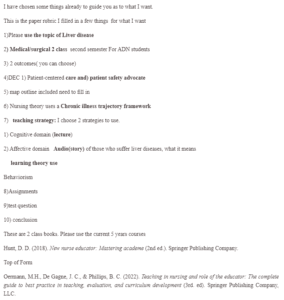
Liver Disease Teaching Plan
I have chosen some things already to guide you as to what I want.
This is the paper rubric. I filled in a few things for what I want
1)Please use the topic of Liver disease
2) Medical/surgical 2 class second semester For ADN students
3) 2 outcomes( you can choose)
4)DEC 1) Patient-centered care and) patient safety advocate
5) map outline included need to fill in
6) Nursing theory uses a Chronic illness trajectory framework
7) teaching strategy: I choose 2 strategies to use.
1) Cognitive domain (lecture)
2) Affective domain Audio(story) of those who suffer liver diseases, what it means
learning theory use
Behaviorism
8)Assignments
9)test question
10) conclusion
These are 2 class books. Please use the current 5 years courses
Hunt, D. D. (2018). New nurse educator: Mastering academe (2nd ed.). Springer Publishing Company.
Top of Form
Oermann, M.H., De Gagne, J. C., & Phillips, B. C. (2022). Teaching in nursing and role of the educator: The complete guide to best practice in teaching, evaluation, and curriculum development (3rd. ed). Springer Publishing Company, LLC.
 Complete the order form and upload all of your files, including any instructions, rubrics, or other materials provided by your instructor.
  Complete the order payment after filling in the order form. We’ll receive your order and assign it to a writer.
 The assigned writer will complete your paper and forward it to our Editing Team for review and approval.
 Once approved by the editor, the completed paper will be uploaded to your account for you to download, review and approve.