
Lifespan Management in the US
Lifespan management encompasses the kind of care following drug prescription and is also accompanied by diet and nutrition recommendations and lifestyle changes. Lifespan management is meant for the continuity of life following a specific treatment to the desired levels. Two examples of populations that may need lifespan management are children and adults with chronic diseases.
Populations That May Need Lifespan Management
When children are born, they need to be immunized once a few years into their lives. Children also need to be monitored for nutritional intake as well as growth development (Robinson et al., 2019). Persons who are diagnosed with chronic illnesses such as hypertension and diabetes also need lifespan management because of the altered state of their health. For these persons to live longer, they need to manage their illnesses through medication, nutrition, and lifestyle management (Edelman et al., 2021).
Specific Differences and Needs of Each Group
Infants and children’s needs differ from the time they are born to adolescence. Children need to be immunized from birth to around six years. The different vaccines are administered more than once, in various combinations, and at different ages. A parent, therefore, needs to keep a proper record of all immunizations. Immunizations protect a child from communicable and some life-threatening diseases such as diphtheria and measles, among others (Robinson et al., 2019). Children also need to be monitored for growth development to ensure that they are within the normal rate for their age. Children should be monitored for malnutrition, including undernutrition and overnutrition, stunted growth, and nutritional deficiency diseases (Scherdel et al., 2016). The goal of lifespan management is to ensure that the infant and child grow into healthy adolescents and adults and eliminate the possibility of early mortality.
Adults with chronic illnesses such as diabetes and hypertension need to learn how to manage their conditions to live longer. Medication adherence should be emphasized for this group of persons, as non-adherence can result in adverse health outcomes. In addition to medication adherence, patients should make lifestyle modifications, including exercising more, eating healthier foods, and avoiding stress. A person should also avoid triggers of negative health, such as smoking, illicit drug use, and drinking alcohol (Daniali et al., 2017). The goal is to lengthen the life of the patient and help the patient live with the disease with minimal dependency on others.
The Effect of Culture on Lifespan Management
Culture plays an important role in lifespan management and can either support or deter lifespan management progress. For example, when a person has been diagnosed with hypertension and obesity, they will need to change their nutritional intake and include exercise in their lifestyle changes. However, if the person believes in eating greasy food as the best type of food, then managing the illness will be a problem. Additionally, if being overweight and obese is considered admirable in a certain culture, such as is the case with Hispanic children, then such a person may be unwilling to lose weight and fail to adhere to lifestyle modifications (Stang & Bonilla, 2018).
As regards infants and children, some religions believe that a child should not be immunized. This can be risky because it exposes the child to infectious diseases. The child also poses a risk to other children in the event that it contracts an infectious disease.
The Role Demographics Play in Lifespan Management
Demographics also play an important role in lifespan management, especially the socio-economic status of a person. According to Durfey et al. (2018), persons living in poor neighborhoods that lack resources, such as public parks and gyms, have a lower chance of keeping fit and healthy compared to persons with similar chronic diseases but living in resource-full areas. Unsafe environments such as highly polluted and crime-infested neighborhoods are not ideal for supporting lifespan management. For example, persons who are diagnosed with lung cancer and other forms of cancer will not thrive in a highly air-polluted neighborhood. An unsafe area will not offer opportunities for persons to engage in outdoor activities such as walking or jogging. Additionally, poor persons cannot afford to eat nutritious food that can help in controlling and managing chronic diseases; this can render the disease management protocols ineffective (Durfey et al., 2018).
Examples of Communication Techniques Used with Diverse Populations.
Different techniques can be used in reaching diverse populations regarding lifespan management. One such way is to have brochures and reading material that patients are given. The reading material would contain important information on frequently asked questions, actions to take during emergencies, such as when a person has hyperglycemia and triggers to look out for, such as increased heart rate for hypertensive patients, among others (van der Heide, 2018). Also, a healthcare facility can have telehealth services where patients can be contacted via phone and video and interact with their designated disease management nurses. Lastly, communication can be achieved through having disease awareness week at the community level. A healthcare facility can organize a community education week on diabetes, for example, and teach the community how to prevent the disease or manage it in case of a diagnosis.
How Differences in Demographics Contribute to Changes in Communication
Communication can be affected by demographics in two ways. First, if the people the communication is targeted do not speak English, it becomes difficult to relay the message to the recipient. It becomes even more complicated when the target audience is elderly and illiterate. However, this can be resolved by either having an interpreter or using images on handout material or both (Poureslami et al., 2017).
The second barrier would be poverty. If the target audience does not have access to the internet, it may be difficult to access the patient through telehealth services. In such a situation, advocacy would be important, where the local government will be presented with the proposal to install affordable internet services in poor neighborhoods to improve health outcomes.
References
Daniali, S. S., Darani, F. M., Eslami, A. A., & Mazaheri, M. (2017). Relationship between self-efficacy and physical activity, medication adherence in chronic disease patients. Advanced biomedical research, 6.
Durfey, S. N., Kind, A. J., Buckingham, W. R., DuGoff, E. H., & Trivedi, A. N. (2019). Neighborhood disadvantage and chronic disease management. Health services research, 54, 206-216.
Edelman, C. L., Kudzma, E. C., & Rnc, D. M. (2021). Health promotion throughout the life span-e-book. Elsevier Health Sciences.
Poureslami, I., Nimmon, L., Rootman, I., & Fitzgerald, M. J. (2017). Health literacy and chronic disease management: drawing from expert knowledge to set an agenda. Health Promotion International, 32(4), 743-754.
Robinson, C. L., Bernstein, H., Romero, J. R., & Szilagyi, P. (2019). The Advisory Committee on Immunization Practices recommended an immunization schedule for children and adolescents aged 18 years or younger—United States, 2019: morbidity and Mortality Weekly Report, 68(5), 112.
Scherdel, P., Dunkel, L., van Dommelen, P., Goulet, O., Salaün, J. F., Brauner, R., … & Chalumeau, M. (2016). Growth monitoring as an early detection tool: a systematic review. The lancet diabetes & endocrinology, 4(5), 447-456.
Stang, J., & Bonilla, Z. (2018). Factors affecting nutrition and physical activity behaviors of Hispanic families with young children: Implications for obesity policies and programs. Journal of nutrition education and behavior, 50(10), 959-967.
Van der Heide, I., Poureslami, I., Mitic, W., Shum, J., Rootman, I., & FitzGerald, J. M. (2018). Health literacy in chronic disease management: a matter of interaction. Journal of Clinical Epidemiology, 102, 134-138.
ORDER A PLAGIARISM-FREE PAPER HERE
We’ll write everything from scratch
Question 
Lifespan Management in the US
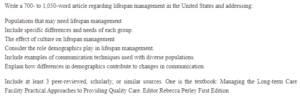
Write a 700- to 1,050-word article regarding lifespan management in the United States and addressing:
Populations that may need lifespan management
Include specific differences and needs of each group.
The effect of culture on lifespan management
Consider the role demographics play in lifespan management.
Include examples of communication techniques used with diverse populations.
Explain how differences in demographics contribute to changes in communication.
Include at least three peer-reviewed, scholarly, or similar sources. One is the textbook Managing the Long-term Care Facility Practical Approaches to Providing Quality Care. Editor Rebecca Perley First Edition
 Complete the order form and upload all of your files, including any instructions, rubrics, or other materials provided by your instructor.
  Complete the order payment after filling in the order form. We’ll receive your order and assign it to a writer.
 The assigned writer will complete your paper and forward it to our Editing Team for review and approval.
 Once approved by the editor, the completed paper will be uploaded to your account for you to download, review and approve.